Azerbaijan's multicultural environment-BUDUGS

One of the ethnic groups belonging to the Shahdag ethnic group is the Budug people. Their main residence is Budug village in Guba region. The Budug people have a special place and place in the ethnic history of Azerbaijan. In the early Middle Ages, they settled in the difficult mountainous areas of Caucasian Albania to protect themselves from Sassanid invasions.This is confirmed by both ethnographic materials and toponymic information given in ancient sources.Historical and ethnographic information suggests that the Budug people are one of the heirs of the ancient Albanian tribes, and that their ancestors came from the Bed district. The first official document on the territory of Budug village is a decree issued in 1607 by the Safavid ruler Shah Abbas I. According to this decree, the king entrusted the administration of Budug district to Malik David. Sources of the 18th century, including Abbasgulu aga Bakikhanov’s “Gulustani-Iram”, state that Budug was a district within the Guba khanate. In the 18th and early 19th centuries, Budag district was mentioned in the decrees of Huseynali khan, Fatali khan and Sheykhali khan from Guba khans. From the 18th century to the 1930s, Budug was considered one of the ten districts of Guba province. In the architectural and tomb monuments of Budug village, the astral beliefs and motives related to the forces of nature, which are characteristic of Albanian culture, are preserved to this day. The ethnic history, ethnography, household traditions, ancient religious and mythical worldviews of the Budug people are a monument of the rich traditions of the spiritual heritage of Azerbaijan as a whole. These traditions once again confirm the deep roots of the heritage of Azerbaijani culture and history, creating a bridge between the past and present of the Azerbaijani people.

Let's learn our history!

He was born in 1877 in Guba district in a merchant family. He was one of the prominent intellectuals in Guba. Therefore, when the Republic of Azerbaijan was established in 1918, the people of Guba considered him worthy of parliamentary membership. Murtuza Bey joined the Musavat faction and was one of the 96 members of parliament. He was 41 years old at the time. After the Republican Parliament handed over the government to the Bolsheviks under certain conditions on April 28, 1920, the Bolsheviks did not comply with any of the conditions, and the new government began to erase the traces of the previous government. Everyone connected with the republic either left the country secretly in order to return and change something, or were destroyed by the Bolshevik-Dashnaks in various ways. Assassinations and shootings became commonplace. Many intellectuals of the time were shot on the island of Nargin as “enemies of the people.” One of these martyrs, who wrote his name in the glorious pages of history, was Murtuza Akhundzadeh, who was shot in 1920 as an “enemy of the people” and was acquitted only 72 years later.

Azerbaijan's multicultural environment - Gryzs.

The Gryzs, who live in Azerbaijan and belong to the Shahdag group, are the descendants of the ancient Albanian tribes.Gryz village of Guba is considered to be their ancient and main village. The Gryz toponym is first mentioned in a source dating back to the 10th century.
The Gryzs say that their ancestors came from the ancient city of Harna. Anthropological materials also confirm that the Gryzs are one of the ancient indigenous tribes of Azerbaijan. Gryz village was a temporary residence of Guba khanate. Abbasgulu aga Bakikhanov once wrote about the village of Gryz: “Sheikh Ali khan, who stayed in Tabasaran in 1810, allied most of the population of Guba with himself, occupied the country and besieged the fortressfor four months. He relocated part of the population to the village of Gryz and built a new city. ” At the beginning of the 19th century, when Russia invaded Azerbaijan, a revolt against the Russian invasion broke out in the Gryz district, as in many regions of Azerbaijan.
At present, the people of Gryz have settled in Chek, Alik, Hapit, as well as Gryz-Dahna villages of Guba region. In these villages, handicrafts, especially weaving, wool and leather processing, are widely developed.
The main agricultural activity of Gryz peasants is sheep breeding. Every year in October-November, they take their cattle and move with their families to the lowlands of Azerbaijan. During the winter months, these villages are almost empty. Only the non-migrant population stay here.
The Gryz have their own language and culture.

A multicultural environment of Azerbaijan - AVARS. The Avars, who have a special place on the colorful ethnic map of Azerbaijan and call themselves mainly "maarulal", migrated to these lands from the territory of the present-day Republic of Dagestan.

At present, most Avars live in the south-western part of Dagestan. In Azerbaijan, the Avars are settled in the north-western villages – Mahamalar, Matsekh, Baratbina, Katekh, Chadarovtala, Gasbina, Gabizdere, Gochahmed, Qabaqchol, Khirkhatala, Beretbina, Mazimgara, Saribulag, Uzuntala, Mollachibina, Pirdakh, Hotaj, Merashda, Mesta, Mechard Kilsabugov, Tsar, Akhakhdare, Yukhari Tala, Ashagi Tala, Goyam, Dardoggaz, Yolayryj, Danachi, Takhtalar, Chokakoba, Ashagi Chardakhs, Yukhari Chardakhlar, Silban, Makov, Oytala, Pashan, Matsekh, Zilbal Maziz-dara.
The ethnic name of the Avars – is maarulal – is interpreted as “mountain people”, and “mountain man”.The word “Avar” means “crazy, stubborn, belligerent, brave.” This was the reason why the Avars, known as a warlike people at all stages of history, were often involved in wars. Alexander Bestujev-Marlinsky, a Russian writer exiled to the Caucasus, also described the Avars as the most militant tribe in the Caucasus, a free, unyielding, courageous, straightforward, and hospitable people.
Abbasgulu aga Bakikhanov, one of the Azerbaijani enlighteners of the 19th century, also wrote that a tribe of the mighty Avar people still lives in the Caucasus mountains and has its own language and traditions.
Today, Azerbaijan, has created favorable conditions for the Avars to preserve and develop their national traditions of self-determination. The Avar language is taught in the settlements and rural schools where the Avars live. Folklore groups, including boys’ dance groups “Qafqaz” and “Cahan” in Balakan, and folk dance groups “Alazan” and “Hudulki” operate in Zagatala to preserve Avar traditions and pass them on to future generations.

Dear viewers! We present you the brief information about the initiators and organizers of the 1918 genocides in one of the sections of the museum and the essence of the policy of genocide pursued by them.

The growing process of national revival in Azerbaijan during the Bolshevik-Dashnak regime led by the chairman of the Baku Council of People’s Commissars, Stepan Shaumyan, and the growing influence of the Musavat party brought the Bolshevik-Dashnak and other pro-Russian groups in Baku closer.The Bolsheviks had no authority or social support among the local population. This was clearly shown by the results of the elections to the Baku Soviet in October 1917.The Bolsheviks, who won a small number of votes in the elections, were seriously behind the Musavat party. The Bolsheviks were seriously concerned about Musavat’s confident struggle for Azerbaijan’s territorial autonomy and political power. That is why S. Shaumyan committed genocide against Azerbaijanis in Baku, aimed to stifle the awakening national liberation movement, weaken the social base of the “Musavat” party, as well as to minimize the Muslim population by committing genocides in the region. Shaumyan, in close cooperation with members of the Armenian forces in the Caucasus, including the Dashnaktsutyun party, abused his authority and began a mass genocide of the Muslim population in March 1918 with troops consisting of 70% Armenian soldiers.
The section also displays samples of cold steel arms, firearms and torture tools used by Armenian bandits during the genocide.

A section on the participation of the Azerbaijani delegation in the Paris Peace Conference in the Museum of the Genocide Memorial Complex.

Dear viewers! We present to you the information about the activities of the Azerbaijani delegation sent to the Paris Peace Conference community in one of the sections of the museum.
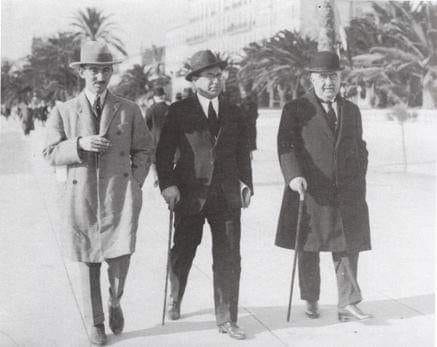
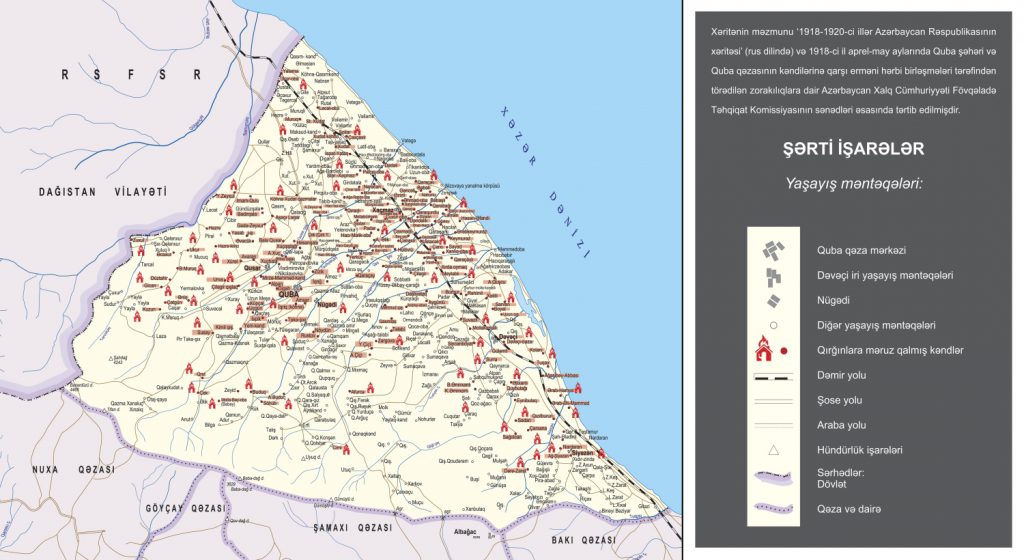
On December 28, 1918, the Azerbaijani parliament elected a delegation to the Paris Peace Conference and Alimardan bey Topchubashov was appointed chairman of the delegation.The exposition includes photographs of the delegation participating in the 1919 Paris Peace Conference (A. Topchubashov-chairman, A. Atamalibeyov, Y. Mehdiyev, J. Hajibeyli, A. Sheykhulislamov, M. Maharramov), as well as historical map of Caucasus showing the exact location of the historical borders of the Azerbaijan Democratic Republic. The main purpose of the delegation was to introduce Azerbaijan as an independent state, as well as to inform the world community about the crimes committed by the Armenian-Dashnaks against the Azerbaijani people in 1918. For this purpose, part of the materials of the Extraordinary investigation Commission was sent to the delegation in Paris. These materials consisted of a 6-volume of documents and 102 photographs reflecting the genocides of 1918 in Baku, Shamakhi, Guba, Goychay, Javad areas. The Azerbaijani delegation fulfilled its task and the copies of the documents were submitted to the heads of major states and various international organizations.
On January 15, 1920, Topchubashov, who was invited to the French embassy, ​​was informed that Azerbaijan was de facto recognized by the allies and an official document of the Paris Peace Conference was presented.
The joy of the Azerbaijani people and its leaders living in those historical days is reflected in their speeches at the ceremonies, documents of the Azerbaijan Democratic Republic, the press and photographs of the time.
All materials sent from Baku to Paris were found in Topchubashov’s personal archives in France in 2011 by Doctor of Historical Sciences, Professor Solmaz Rustamova (Tohidi) and submitted back to homeland after 94 years. Copies of most of these documents and photographs are displayed in the museum’s exposition.

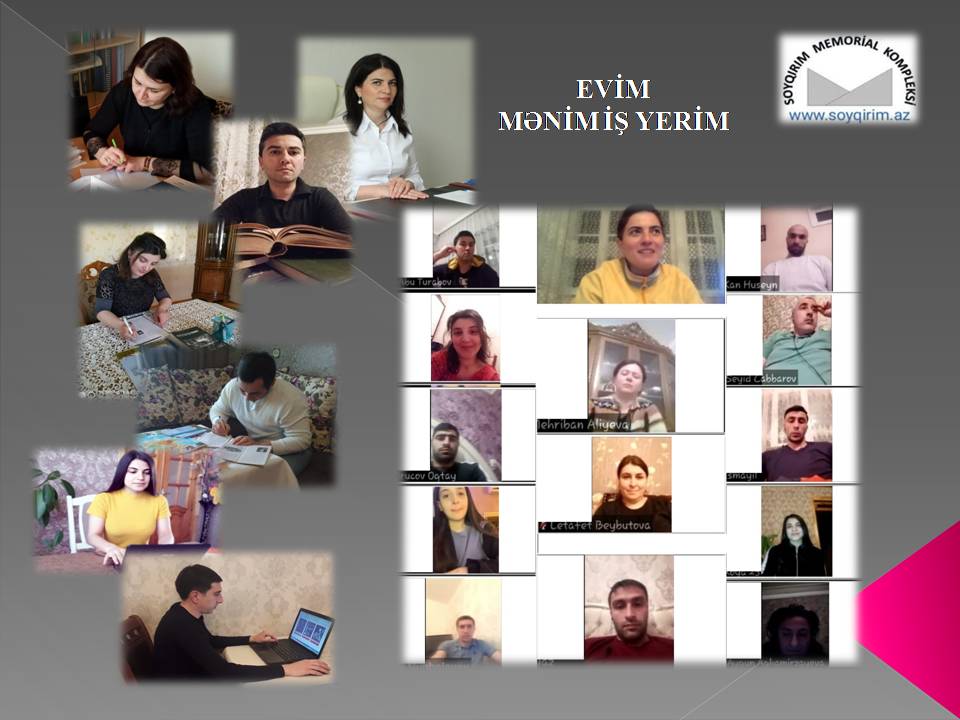
#evimyeniişyerim Evim -Yeni is yerim

Əziz dostlar! Koronovirus pandemiyasının qarşısının alınması məqsədilə qəbul edilmiş müvafiq qərar və əmrlərə uyğun olaraq virtual fəaliyyət göstərən Quba şəhərində “Soyqırımı Memorial Kompleksi” Azərbaycan Respublikası Mədəniyyət Nazirliyi tərəfindən elan edilmiş “EVİM -YENİ İŞ YERİM” layihəsi çərçivəsində Sizləri əməkdaşlığa dəvət edir, yeni ideya və təkliflərinizi bizə göndərməyinizi xahiş edirik. /Soyqırımı Memorial Kompleksinin direktoru Rəxşəndə Bayramova

Bringing the 1918 genocide to the attention of the world community at the Paris Peace Conference


A section on the participation of the Azerbaijani delegation in the Paris Peace Conference in the Museum of the Genocide Memorial Complex.

Dear viewers! We present to you the information about the activities of the Azerbaijani delegation sent to the Paris Peace Conference community in one of the sections of the museum.
On December 28, 1918, the Azerbaijani parliament elected a delegation to the Paris Peace Conference and Alimardan bey Topchubashov was appointed chairman of the delegation.The exposition includes photographs of the delegation participating in the 1919 Paris Peace Conference (A. Topchubashov-chairman, A. Atamalibeyov, Y. Mehdiyev, J. Hajibeyli, A. Sheykhulislamov, M. Maharramov), as well as historical map of Caucasus showing the exact location of the historical borders of the Azerbaijan Democratic Republic. The main purpose of the delegation was to introduce Azerbaijan as an independent state, as well as to inform the world community about the crimes committed by the Armenian-Dashnaks against the Azerbaijani people in 1918. For this purpose, part of the materials of the Extraordinary investigation Commission was sent to the delegation in Paris. These materials consisted of a 6-volume of documents and 102 photographs reflecting the genocides of 1918 in Baku, Shamakhi, Guba, Goychay, Javad areas. The Azerbaijani delegation fulfilled its task and the copies of the documents were submitted to the heads of major states and various international organizations.
On January 15, 1920, Topchubashov, who was invited to the French embassy, ​​was informed that Azerbaijan was de facto recognized by the allies and an official document of the Paris Peace Conference was presented.
The joy of the Azerbaijani people and its leaders living in those historical days is reflected in their speeches at the ceremonies, documents of the Azerbaijan Democratic Republic, the press and photographs of the time.
All materials sent from Baku to Paris were found in Topchubashov’s personal archives in France in 2011 by Doctor of Historical Sciences, Professor Solmaz Rustamova (Tohidi) and submitted back to homeland after 94 years. Copies of most of these documents and photographs are displayed in the museum’s exposition.