The museum's exposition on the "Baku area" presents a photo of the Ismailiyya building, which houses the Muslim Charity Society, which was destroyed by Bolshevik-Dashnak forces

During the events of March 1918, the Armenians who took control of Baku, along with the population of the city, systematically and purposefully destroyed the cultural monuments of our people. One of these magnificent architectural monuments is the Ismailiyya building of the Muslim Charity Society, located on Nikolayev (Istiglaliyyat) Street, one of the central streets of Baku.
In 1917, the idea of ​​giving autonomy to Azerbaijan was voiced in this building where the Congress of Caucasian Muslims was held, and the history of our independence became the main headquarters of the struggle for independence. During the events of March 1918, Armenians looted the Ismailiyya building and then set it on fire. In addition to the damage caused to the building during the fires, the archives of the institutions operating in the palace, including the palace itself, were destroyed by fire.
The Ismailiyya building was restored during the Azerbaijan Democratic Republic and currently serves as the building of the Presidium of the Azerbaijan National Academy of Sciences.

Tazapir Mosque

A photo of the Tazapir Mosque, located in one of the sections of the museum at the Genocide Memorial Complex, is presented to the viewers.
The Tazapir Mosque of the 14th-15th centuries was shelled and damaged by artillery fire during the March 1918 genocide in Baku, and the Turkish Muslim population gathered in the mosque was severely tortured.
At that time, the Tazapir Mosque played an important role in all socio-political issues in the life of the Azerbaijani people. The funeral of Muslims who were subjected to genocide during the March events was held in this mosque. In addition, on the occasion of the liberation of Baku from enemy forces on September 15, 1918, the commander of the Caucasian Islamic Army Nuru Pasha was invited to the Tazapir Mosque on September 16, and hundreds of people celebrated the liberation of Baku in the courtyard of the mosque.On the instructions of President Ilham Aliyev, the Tazapir Mosque has been overhauled and currently the building of Baku Islamic University and the Caucasian Muslims Office locate here.

Policy of ethnic cleansing and genocide against Azerbaijanis (1988-1994)


The last stage of the Armenian policy of ethnic cleansing and genocide against Azerbaijanis covers the period from 1988 to 1994. Since 1988, from 22 districts, 170 villages and 94 settlements of the Armenian SSR, in which Azerbaijanis lived compactly with Armenians, about 250 thousand of our compatriots were deported from their historical lands. Thus, the process of ethnic cleansing of Azerbaijanis from the Armenian SSR was completed.
According to the Batumi agreement, signed in 1918, the territory of Armenia was 9 thousand km2, but in Soviet period it was increased to 29.7 thousand km2 due to Azerbaijani lands. The hated enemy, together with the occupied territories, appropriated 45 thousand km2 of Azerbaijani lands.

Azerbaijan Press 1918

An article titled “Nightmare Days,” published in the 59 issue of “Our Voice” of March 24 (April 4), 1918, reads:
Everywhere, corpses are distorted, mutilated, disfigured… The Tazapir Mosque was severely damaged by artillery shelling… In the yard of the 6th section, the patrol found about 600 Muslim women prisoners with children, freed and escorted them to the Muslim part of the city. The broad masses are full of anger and hatred, growing into a sense of fierce vengeance that will not be so easy to deal with…

French writer of Azerbaijani descent Ummulbanu (Banin)

Ummulbanu Mirza kyzy Asadullaeva, a French writer of Azerbaijani descent, who is in one of the section of the museum, is one of the witnesses of the March events of 1918. She writes in her “Days in Caucasus” autobiographical novel :
A pro-socialist Armenian organization created a military dictatorship in the country under the slogan “save the country from the communist coup.” But there was talk among the people that the Bolsheviks were at the head of this organization. One night at 2 o’clock my nanny Anna woke me up. The whole city was without electricity.Sounds of firing could be heard from unknown directions in this terrific dark, bullets were whistling everywhere. The sound of machine-gun fire could be heard in the distance. Horrified, we were expecting arrival of the Dashnaks ( this was the name of an Armenian party) at our home, and thinking how they would destroy our home and kill us… Armenian neighbours living opposite side offered us a shelter in their home…We had to cross the street. But endlessly raining bullets from all around made even this distance a deadly threat… However,God took compasion upon us… On the following daw we saw trucks before our home. Men with full cartridge-belts were loading the trucks with items thrown out of our windows. Dressed on dirty military clothes, these men’s appearance was terrifying. However, looking at this disgusting scene of robbery, we felt happy inside, as they would have thrown us out the same windows without any hesitation, had we stayed in our home…
After power passed to the Bolsheviks in 1920, the family was forced to leave Azerbaijan. The place of emigration was France. Banin was known in France not only for her novels, but also as a fine translator of Russian, English and German fiction.

Witness testimony - Surayya Mashadi Dadash qizi

We present to you the testimony of 18-year-old Suraya Mashadi Dadash gizi, a resident of the village of Khojaly in Javad area, one part of the museum’s expositions, in the fall of 1918 as a witness in accordance with the Code of Criminal Procedure of the Extraordinary Investigation Commission under the Government of Azerbaijan During the attack of the Armenian Bolsheviks on our village, I with my youngest baby daughter, two younger brothers – 9-year-old Abbasali and 6-year-old Abu Samad, my fellow villagers Annana Allahverdi, Tohva Meshadi Mikail, Qoncha Ibadullah and her baby, Agakishi Ibadullah ran to the mountains and hid behind the hills. Eight Armenian cavalrymen found us and opened fire. We all fell to the ground. The Armenians were gone. Despite the fact that I was injured in my left shoulder, right arm and leg, I survived. My brothers and child were also alive. The rest were dead. I suffered a lot. Soon, the Armenians returned and killed four Muslims whom they brought with them. I asked the Armenians to shoot me. They did not agree and said they were leaving me alive so that my Muslim brothers would see me. When they saw that my child and brothers were alive, they cut them on my chest and killed. The baby of my fellow villager, Qoncha, also survived, but the Armenians killed him too. Muslims from the village of Beshtaly found me and took to their village. They also buried the bodies of killed.

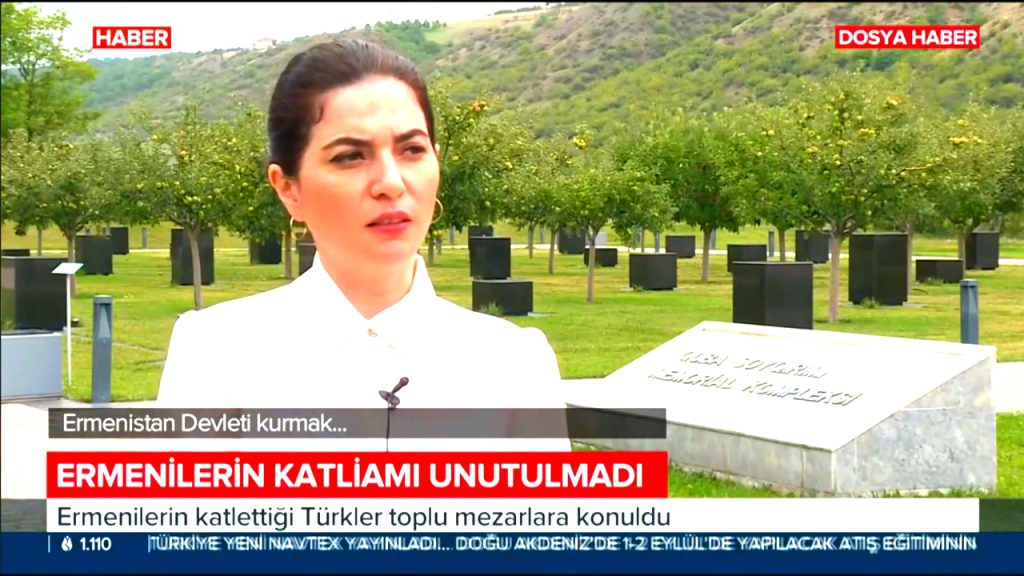
On May 7, 2020, within the framework of the project “Online Travel of Finnish Azerbaijanis to Museums of Azerbaijan”, the coordinator of the Council of Scandinavian Azerbaijanis in Finland,

On May 7, 2020, within the framework of the project “Online Travel of Finnish Azerbaijanis to Museums of Azerbaijan”, the coordinator of the Council of Scandinavian Azerbaijanis in Finland, the chairman of the youth organization Azer Turk, Ulviya Jabbarova and the “Genocide Memorial Complex” in Guba city held a seminar “Azerbaijani Genocide in 1918″. The aim of the seminar was to show the true face of Armenian vandalism and to propagate the events of genocide by providing historical facts. The seminar was attended by Azerbaijanis living in the Scandinavian countries, including Finland, as well as our compatriots living in England, France, Germany, the Netherlands, the USA and Greece. The moderator was Ulviya Jabbarova, and the reports were presented by the director of the “Genocide Memorial Complex”, doctor of philosophical sciences in history Rakhshanda Bayramova and the specialist in the English language of the complex Aygun Aghamirzaeva
It should be noted that the project continues with sessions in other reserves and museums.