
Dear viewers! In the museum of the complex we present you a photo of a black marble stone erected in the center of the hall in honor of the victims of the tragedy who were brutally killed during the genocides in various regions of Azerbaijan.

Dear viewers! In the museum of the complex we present you a photo of a black marble stone erected in the center of the hall in honor of the victims of the tragedy who were brutally killed during the genocides in various regions of Azerbaijan.



On April 23, a seminar was held on the topic “Multicultural values, the history of ethnic groups in Azerbaijan.” Employees of the Institute of History of ANAS named after AA Bakikhanov Irada Aliyeva, Narmina Amirbayova and Doctor of Philosophy in History Mahammad Aliyev made reports at the seminar moderated by the director of Guba Genocide Complex Rakhshanda Bayramova. The multicultural environment in our country, the historical traditions of our people and friendly fraternal relations with ethnic groups were discussed at the seminar. We express our deep gratitude to all the participants and look forward to their participation in our next seminars


Dear viewers! As previously reported, every Wednesday we will share information about the genocides committed against different peoples and nations, as well as the existing genocide complexes and museums in the framework of the project “Genocides are crimes against humanity.” Today we present you a brief information about the genocide committed against Bosnian Muslims.
The Srebrenica genocide is the largest genocide in Europe since World War II and the first legally documented act of genocide. After the collapse of the Soviet Union, socialist regimes began to overthrow throughout Europe. In Yugoslavia, a deep economic crisis began. As a result, since 1990, the country has been divided into republics, which has led to inter-ethnic tensions and displacement. The worst crimes took place in the newly formed Bosnia .General Ratko Mladic and the Serbian Republican Army killed thousands of Bosnian Muslims and Serbs in an attempt to “ethnic cleanse” Srebrenica. It has been documented that women and children were also killed during the genocide. Along with the Serbian army, Serbian special security forces known as “Scorpions” also took part in the genocide. Despite the deployment of 400 Dutch peacekeepers by the UN in Srebrenica, the genocide could not be prevented. By 2006, 42 mass graves had been discovered around Srebrenica. The identities of 2,070 victims have been identified. The body parts in 7,000 sacks still remain unidentified. The remains of another 1,000 bodies were found in the mass grave of the Srebrenica genocide in Kamenica on August 11, 2006.

Dear viewers! We present you a description of the map of Azerbaijan before 1920, located in one of the sections of the museum in the Genocide Memorial Complex. On the map, the regions where genocides were committed by the Armenian Dashnaks in 1918 are labled with red marks.


Bugün Soyqırımı Memorial Kompleksinin direktoru t.ü.f.d.Rəxşəndə Bayramovanın moderatorluğu ilə keçirilən seminarda AMEA-nın A.A.Bakıxanov adına Tarix İnstitutunun əməkdaşları t.ü.f.d.dos Natig Məmmədzadə, t.ü.e.d.dos.Vaqif Abışov, AMEA-nın Şərqşünaslıq İnstitutunun aparıcı elmi işçisi t.ü.f.d. dos.Sübhan Talıblı, tarixçi, dəyərli tədqiqatçı Elmar Həsənli məruzələrlə çıxış etdilər.
Seminarda 1918-ci ilin yazında Bakı quberniyasında, Quba qəzasında baş vermiş soyqırımı və yerli qüvvələrin müqaviməti, Gəncə quberniyası və Lənkəran qəzasında türk-müsəlmanların soyqırımı, Cənubi Azərbaycanda türk-müsəlmanların soyqırımı, Azərbaycan Xalq Cümhuriyyəti hökumətinin soyqırımlarının tanıdılması ilə bağlı gördüyü işlər və Fövqəladə Təhqiqat Komissiyasının həyata keçirdiyi tədbirlərdən danışıldı.
Bütün iştirakçılara dərin təşəkkürümüzü bildirir, növbəti seminarlarımıza qatılmalarını səbirsizliklə gözləyirik.


Among the documents collected by the EIC, and a photograph taken by a member of the commission, Belarusian photographer Lev Dashkeevich, was a photograph of the Juma mosque in Shamakha, which dates back to the 8th century. Historical and cultural monument of the people of Azerbaijan, “Juma” mosque was recognized as one of the oldest Muslim temples not only in the South Caucasus, but also in the Middle East.
Mosque destroyed during earthquake in Shamakhi and which was rebuilt several times, was seriously damaged during the 1918 genocide in Shamakhi. So, during the March genocide in Baku, representatives of the Dashnaktsutyun party in Shamakhi, led by Stepan Lalayan, launched genocide against the peaceful Muslim population, during which Armenian Dashnaks burnt the Juma mosque together with 1800 civilians, including women , children and the elderly. Numerous rare manuscripts and books were destroyed during the fire. Traces of this fire committed by the Armenian Dashnaks can still be seen on some walls of the mosque.
In 2009, President of the Republic of Azerbaijan Ilham Aliyev issued a decree on the overhaul of this important historical and architectural monument, and in 2013, after reconstruction, it was inaugurated. Today this historical place serves as a mosque.


On the ethnic map of the world there is only one Khinalig village and the only Khinalig language
that belongs to the Guba region of the European part of Azerbaijan. The Khinalig people are the oldest inhabitants of Azerbaijan, and the village of
Khinalig is one of the highest settlements in the world. Local residents consider the village of Khinalig a sacred place that protects them from all evils and evil forces. The inhabitants of Khinalig, with a population of about 400 houses and 3,000 people, still preserve their ancient way of life and traditions.
According to historical sources, the inhabitants of Khinalig were one of the ancient tribes of Caucasian Albania. Because of its
location, this ethnic group belongs to the Caucasian language group and is called “Shahdag peoples” in historical and ethnographic literature . In addition to the official Azerbaijani language, local residents communicate in the Khinalig language, which is unique in the world and which is spoken
and understood only by them. Khinalig language is included in the list of endangered languages by UNESCO.
The population of the village of Khynalyg is mainly engaged in animal husbandry, cattle breeding, vegetable growing. At the same time, local residents are engaged in carpet,palas weaving, weaving patterned clothing, shawls, colored socks. In Khinalig was popular wool scarf. It was bought in the surrounding villages for the manufacture of
outerwear. Chukha, made from wool shawls, was once the national costume of rich people in villages. Other activities of the villagers are collecting
and drying medicinal herbs, which are widely used in medicine and in the kitchen.
According to historians, the village of Khinalig was built before
our era. The ancient Greek scholar Strabo in his 17-volume book “Geography” notes that in Caucasian Albania there are 26 Albanian tribes, each of
which speaks its own language. The people of Khinalig are probably one of the 26 tribes. In other words, the inhabitants of Khinalig are aborigines
who have lived in the Caucasus for thousands of years.
The 5000-year-old village of Khinalig, located at an altitude of 2300 meters above sea level,
is included in the list of world-famous historical monuments of UNESCO and resembles an open-air Museum in Azerbaijan. This village, called “Island
in the mountains”, is located 57 km from the district center. You can also see tourists from all over the world. The antiquity, history, architecture
and geographical structure of the village attract the attention of tourists, especially the unique way of life of the residents of khinalyg.
Currently, this village is part of the Khinalig state historical, architectural and ethnographic reserve, protected and promoted throughout the
world.
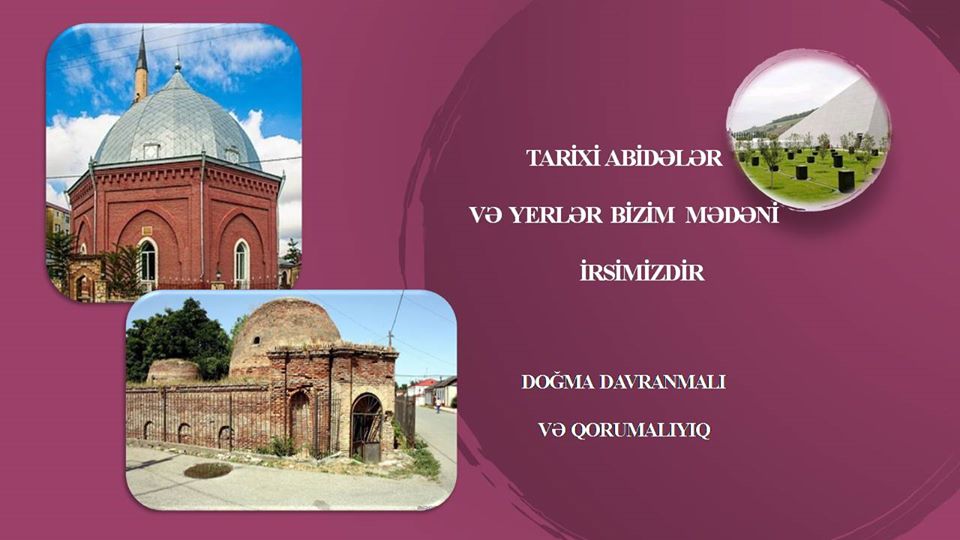
Let’s preserve our monuments and historical sites, which are considered to be examples of our cultural heritage.
Every year, April 18 is celebrated around the world as the International Day of Monuments and Historic Sites. This significant day was established by UNESCO in 1983 by the suggestion of the International Council of Monuments and Sites (ICOMOS). The aim is to draw people’s attention to the protection of monuments and historical sites.
This significant day is widely celebrated in Azerbaijan as well. Every year on this date, various events and exhibitions are organized to promote the protection of monuments and historical sites in reserves and historical places. This year, in accordance with the relevant decisions and orders adopted in connection with the prevention of the existing coronavirus pandemic, the above-mentioned measures have been suspended, and the promotion of historical monuments and places on the Internet has been taken into account. The Genocide Memorial Complex also joined this propaganda.
It should be noted that President of the Republic of Azerbaijan Ilham Aliyev and First Vice-President, President of the Heydar Aliyev Foundation Mehriban Aliyeva are doing great work to protect our historical monuments and pass them on to future generations. Thanks to the attention and care of the President, a number of projects are being implemented in our country to study, protect and restore historical monuments, and promote cultural heritage in the international arena. All this ensures the integration of Azerbaijan into the global world with its material and spiritual culture. Relations with international organizations in this area are also developing successfully. In 2000, Icheri Sheher together with the Maiden Tower and the Palace of Shirvanshahs, and in 2007 the Gobustan State Historical and Artistic Reserve was included in the UNESCO World Heritage List. At present, work is underway to include other historical sites and monuments in this list.

The social-historical museum, built in a new style, collects information about the changes that took place in the lives of the population before, during and after the genocide. Architect Vahid Kasimoglu did not use any decorations or ornaments as a sign of deep respect for the memory of the victims of the genocide. The appearance of the museum is in the form of two swords stuck to the ground. The fact that these swords came out from under the ground shows the impossibility of hiding history, and the sharp point indicates the violence that breaks hearts.
Apple trees, which have long been a symbol of Guba and a symbol of life, have been planted in the garden of the complex. 40 symbolic marble stones for 3 age groups were placed in the apple orchard. These symbolic tombstones were created as a sign of respect for the memory of women, youth, children and the elderly who were victims of the 1918 tragedy.


Presentations were made at the conference, by the Head of the State Service for the Protection, Development and Restoration of Cultural Heritage Zakir Sultanov, Chairman of the Board of the State Historical and Architectural Reserve “Icherisheher” Asker Alekperov, Chairman of the Board of the Union of Architects of Azerbaijan Elbai Gasymzade, Doctor of Historical sciences Professor G.Jabiyev.
The conference was devoted to the celebration of the International Day of Monuments and Historical Places, State care for historical and cultural monuments in our country and issues of governance in this field.
We express our deep gratitude to all participants and look forward to your participation in our seminars next week