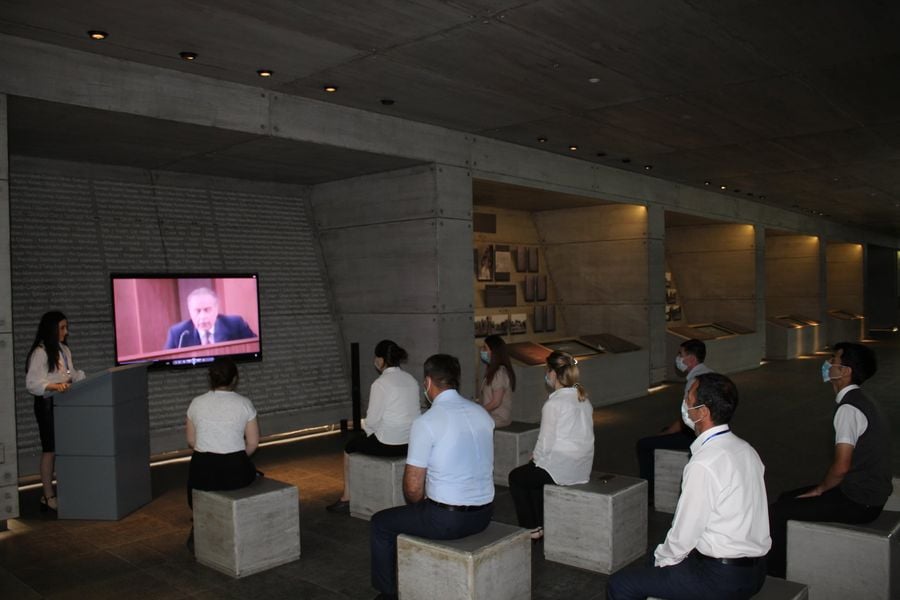
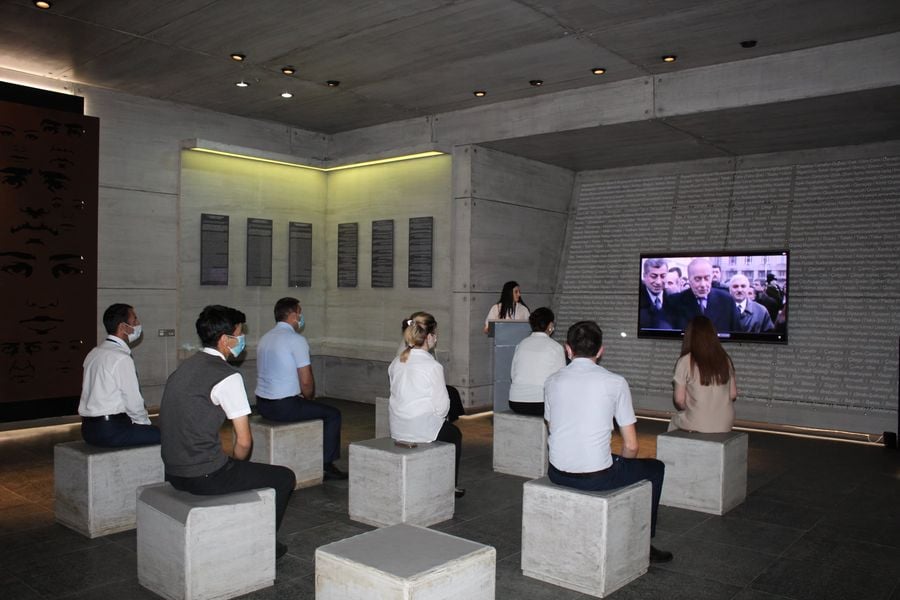
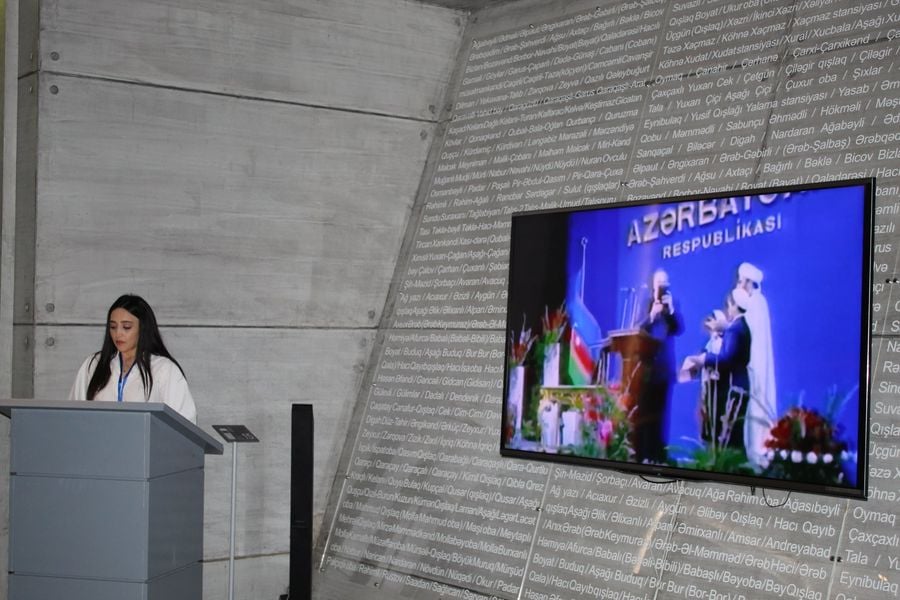
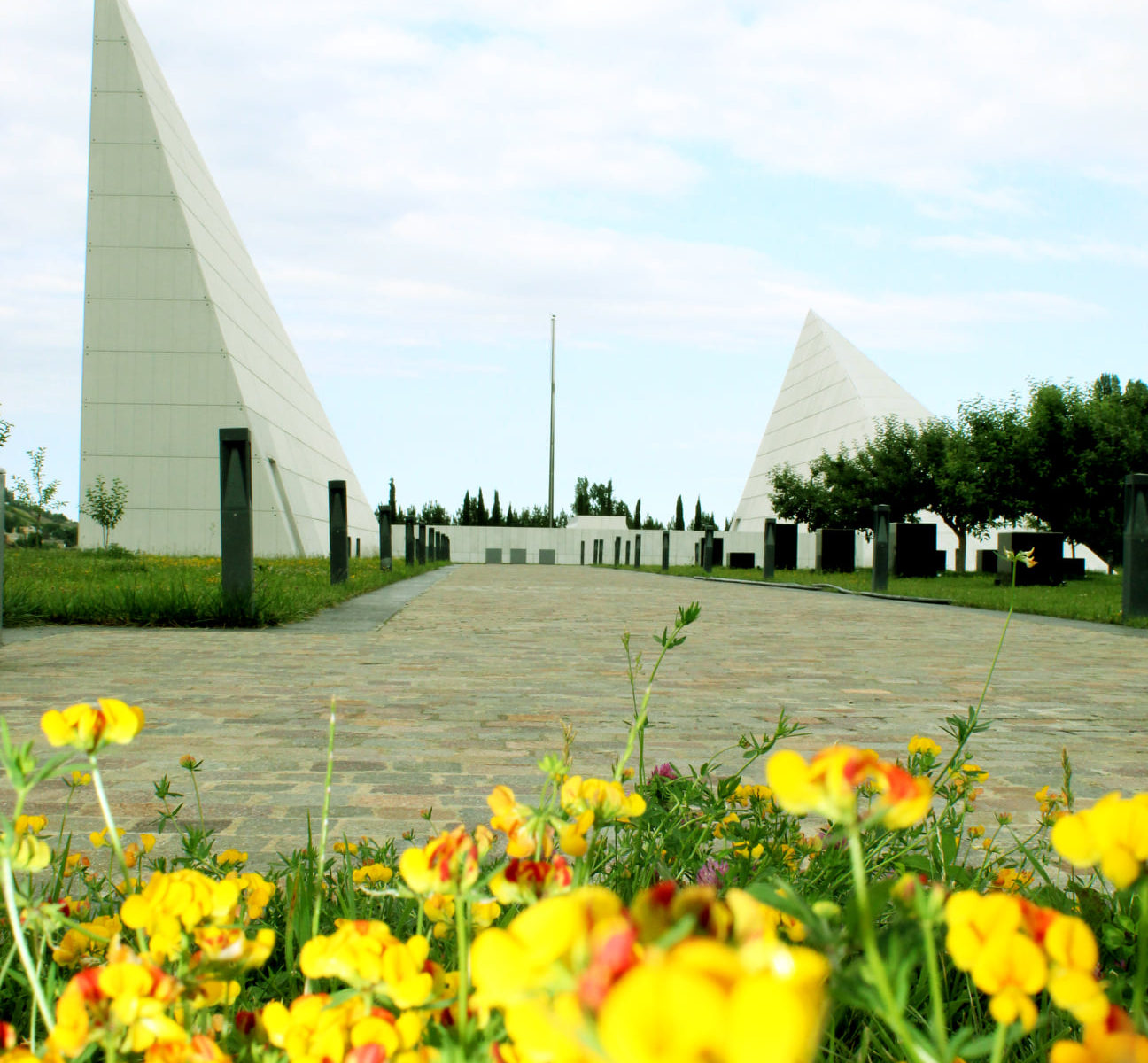
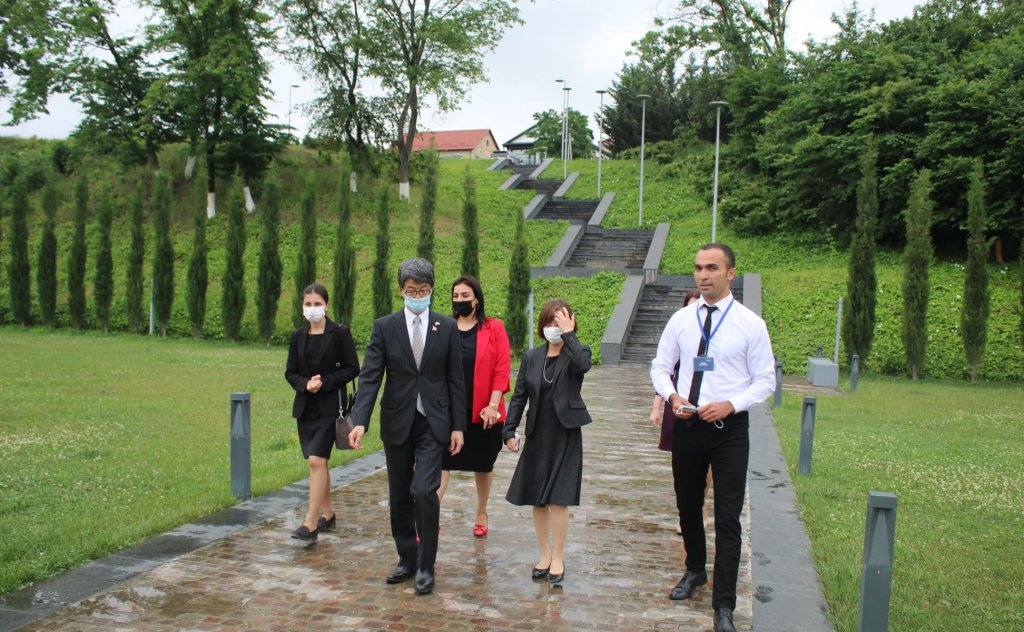
On the initiative of the Association of Independent Industrialists and Entrepreneurs, the newly appointed Ambassador Extraordinary and Plenipotentiary of Turkey to Azerbaijan, Mr. Jahit Bagchi, visited Guba. During the visit, J. Bagci, together with a group of Turkish businessmen, visited the "Genocide Memorial Complex" in Guba.

First, flowers were laid at the monument to the victims of the genocide, then the ambassador and other guests were informed in detail about the inhuman atrocities committed by Armenian vandals in Azerbaijan in 1918. At the end of the meeting, the visitors were presented with propaganda and advertising books, booklets, flyers and other printed materials prepared by the Complex.

MAY 9 DAY OF VICTORY OVER FASCISM

The state and citizens of Azerbaijan have seen the pain of World War II and have shown great determination. Thus, more than 600,000 Azerbaijani citizens took part in the war, more than 130 Azerbaijanis were awarded the title of Hero of the Soviet Union, and more than 170,000 soldiers and officers were awarded various orders and medals.

III-part RESOLUTION August 31, 1918, Ganja city

To implement the Government’s Decision of July 15, 1918, an Extraordinary Investigation Commission shall be established consisting of the chairman-juror Alakbar bey Khasmammadov and the following members: Ganja District Court members Ismayil bey Shahmaliyev and Andrey Fomich Novatski, Deputy Prosecutor of the same district court Nasraddin bey Safikurdski , Nikolai Mikhailovich Mikhailov, a member of the Ganja Resettlement Department, and V.V.Gudvillo, a former Chairman of the Conciliation Judges Congress, a real civil counselor, and Mammad Javad Akhundzadeh, a teacher. To allocate the daily salary: to the chairman of the commission – 60 rubles, to members of the commission on public service – 40 rubles a day, to the rest – 50 rubles. Travel expenses must be reimbursed at actual cost. The commission should be given the opportunity to invite secretaries, specialists and other persons in need.
Chairman of the Commission: A. Khasmammadov (signature) F. Khoyski instead of the Minister of Foreign Affairs

Guba genocide 1918 ( May 1-9)

In Guba, as in other parts of the Baku province, the Bolshevik-Dashnak leadership of the Baku Soviet decided to send a second military force after Gelovani, this time a punitive force consisting only of Armenians, under the leadership of Hamazasp, to suppress the national movement. Hamazasp did not deny that his group was sent to Guba for punishment: “I am a hero of the Armenian people and its defender.” Before reaching the city of Guba, Armenian gangs began to burn and destroy civilian villages along the way, committing mass genocides. Merciless Armenians did not spare the old people, children and women and killed every muslim they met.
According to eyewitnesses, at the end of April the Khamazasp group approached Khachmaz, but local forces resisted. However, due to inequality of forces, after two days of fighting, the punitive detachment was able to leave for Guba. Hamazasp was at the head of this group. His assistant was Nikolai, and his guide was Harutyun Hayrapetov, a local Armenian nicknamed “The Mill.” Hamazasp’s group consisted of about 3,000 men, 4 cannons and 8 machine guns.
On May 1, the Armenian Dashnaks, who entered the city from three sides under the name of Bolsheviks, immediately began killing and looting. On the first day, 715 Muslims, mostly women and children, were killed in the lower part of the city, and the Boyuk Shosse and Bazar streets were destroyed and on the second day, 1,012 civilians were killed. A.Alibeyov, who came to Hamazasp as a representative of the city population, asked him to allow him to bury the dead, but his request was denied. Despite repeated appeals, Hamazasp did not allow the bodies of slain Muslims to be collected from the streets and buried. The aim was to intimidate and frighten the population. Violence, murder and robbery lasted for 9 days, and the property of the area population was looted. Examination of archival documents revealed that when Hamazasp arrived, an additional force was sent to Guba from Petrovsky. In general, the number of members of the Armenian Dashnak gang that committed genocide in Guba district was more than 5-6 thousand.
The members of the criminal gang committed atrocities against Muslims that are beyond human comprehension. Witness testimonies confirm that Armenian vandals enjoyed the inhumane “experiments” they inflicted on wounded and killed people. Mashadi Hamdulla Aliyev, a 40-year-old resident of Guba, said he had seen many bodies in the city, about two-thirds of which belonged to children and women. Many women had their breasts cut off and their corpses disfigured with daggers.
There are also archival materials that 300 people killed by Armenians were buried in 51 graves. As a result of Hamazasp’s atrocities, more than 16,000 civilians were killed in Guba area. The documents submitted to the Emergency Commission in connection with the damage caused to individual rural communities in the area provided a general overview of the damage to families, and in some cases did not provide information on burned houses and other buildings. T
The Dashnaks annihilated thousands of valuable books on Islam, oriental history and literature. Armenians set on fire the Abdurrahim Efendi’s madrasa in the center of Guba and burnt about 1,300 books. According to reports, the Digah mosque had books written in the Albanian and Arabic alphabets about 600-700 years ago. In addition to destroying the books, the Armenians also blew up a shrine stone about a kilometer from the village mosque. It was a huge stone with Albanian inscriptions on it.
In December 1918, Andrei Novatsky, a member of the Ganja District Court, arrived in Guba with his assistant and began an investigation. The investigation team, in connection with the genocide committed in the Guba district in April-May 1918, listened to dozens of witnesses for several months, inspected the scene of the incident and prepared a three-volume collection of documents consisted of 451 pages. Novatsky, the member of the EIC presented a report to the Chairman of the Commission on the destruction of the city of Guba, as well as in the villages of the Guba district, as well as violence against civilians.
The direct organizers of the Guba massacres were Shaumyan, Korganov, the executors were Hamazasp, Volunts and other criminals of Armenian descent. The atrocities committed in Guba by the gangs of the Baku Soviet, headed by S. Shaumyan, consisting mainly of Armenians and under the command of the Dashnak Hamazasp, it was not a civil war or the establishment of Soviet power, but a massacre of an entire nation.

Today in history Arrival of D. Gelovani in Guba (April 1918)

In April 1918, when the city of Baku and the Baku province fell into the hands of the Bolsheviks, on the instructions of S. Shaumyan, David Gelovani, a georgian menshevik, was sent to Guba with about 200 armed soldiers (consisting of Armenians) to seize power in Guba. Here, D. Gelovani, who declared himself the Guba Accident Commissioner, gave the locals two hours to recognize the Bolshevik government, and the helpless city administration agreed to this proposal. As soon as the accident happened, first of all, D. Gelovani disarmed the local community and released more than two hundred Armenians. Robberies and assassinations of locals by members of Gelovan’s gang and released Armenians are on the rise in the city. Seeing these atrocities in the area under the name of Bolshevism, the locals formed gangs a few days later and began a local resistance movement. According to the ancient calendar, April 9-11 / April 19-23, in this struggle, which remained in history as “3-day battles”, Gelovani and his armed groups were expelled from Guba. When he leaves the city, he takes the Armenians with him. Many Armenian bandits are killed in the battles by the people of Guba. In the event of an accident, peace is restored. However, the people of Guba were unaware that an army of Dashnak Armenians led by the executioner Hamazasp would arrive in their homeland on May 1 and that genocide would be committed within 9 days.

Report to the government of the Minister of Foreign Affairs of the ADR Mamedhasan Hajinsky dated July 15, 1918 on the genocides committed against Azerbaijanisand, an extract prepared on the basis of this report, as well as a copy of the decree signed in Ganja on August 30, 1918 on the establishment of the Extraordinary Investigative Commission. We present photographs and text of these documents.

REPORT TO GOVERNMENT
For four months now, various regions of Azerbaijan have been destroyed by gangs, and under the guise of the Bolsheviks, Armenian military units and others have committed unprecedented atrocities against the lives and property of the civilian Muslim population. At the same time, on the basis of false information sent by the organizers of these gangs, public opinion in European countries is turned in the opposite direction. The interests of the state and the affected groups of the population necessitate the creation of an organization that would deal with the following:
1. Accurate registration of all incidents of violence;
2. Determining the circumstances of the violence;
3. Identification of culprits and determination of the total amount of damage caused by them;
This organization should have the character of an Extraordinary Commission , as well as the results of the work of this commission should be announced and widely disseminated in the major European languages ​​(Russian, French, German, and, of course, Turkish). It is necessary to start the organization of this commission without delay,since it can easily implement many things now on th hot trail, in the sense of questioning persons, taking photographs, and collection of other evidences, which later may become difficult, if not completely , impossible to do.
If the Government agrees with this proposal, I would ask that one of the Ministers be entrusted with the establishment of this Commission and that 50,000 rubles be temporarily allocated for the Commission’s expenses.
Minister of Foreign Affairs Mohammad Hasan Hajinski ,Yelizavetpol. July 15, 1918.

Deputy Chief of Mission of the State of Israel, Chargé d'Affaires Doron Pe'er visited Guba region During the visit, the guest was in the "Genocide Memorial Complex" in Guba

Deputy Chief of Mission of the State of Israel, Chargé d’Affaires Doron Pe’er visited Guba region During the visit, the guest was in the “Genocide Memorial Complex” in Guba and laid flowers at the monument to the victims of the genocide. Mr. Doron Peer was informed in detail about the inhumane atrocities committed by Armenian vandals in Azerbaijan in 1918, including in Guba, and was told that during this genocide, Jews living in Guba also became victims of Armenian terror.