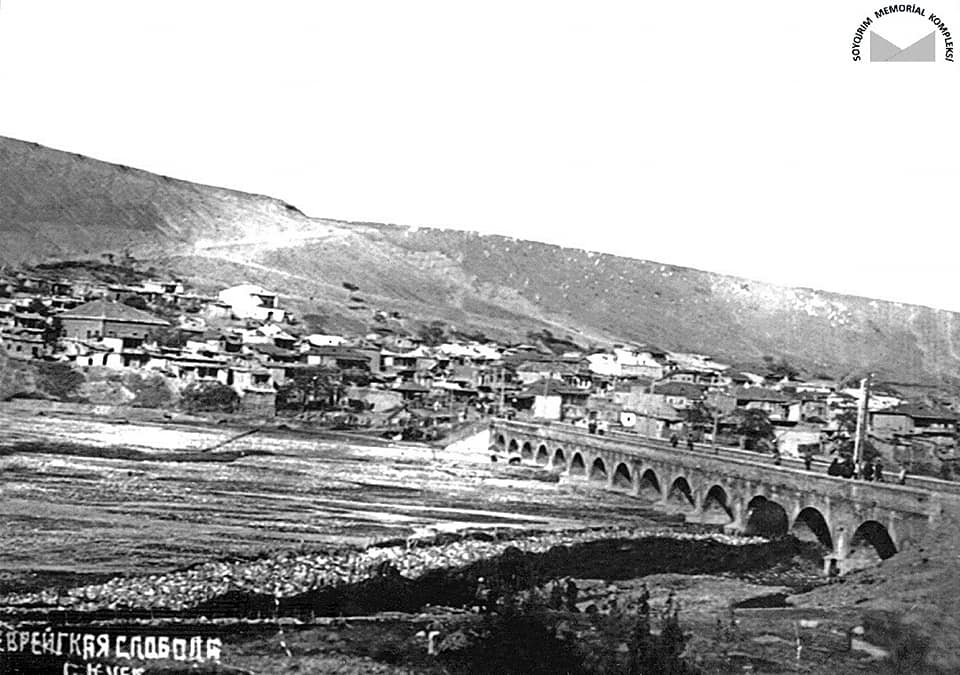
In Guba, as in other parts of the Baku province, the Bolshevik-Dashnak leadership of the Baku Soviet decided to send a second military force after Gelovani, this time a punitive force consisting only of Armenians, under the leadership of Hamazasp, to suppress the national movement. Hamazasp did not deny that his group was sent to Guba for punishment: “I am a hero of the Armenian people and its defender.” Before reaching the city of Guba, Armenian gangs began to burn and destroy civilian villages along the way, committing mass genocides. Merciless Armenians did not spare the old people, children and women and killed every muslim they met.
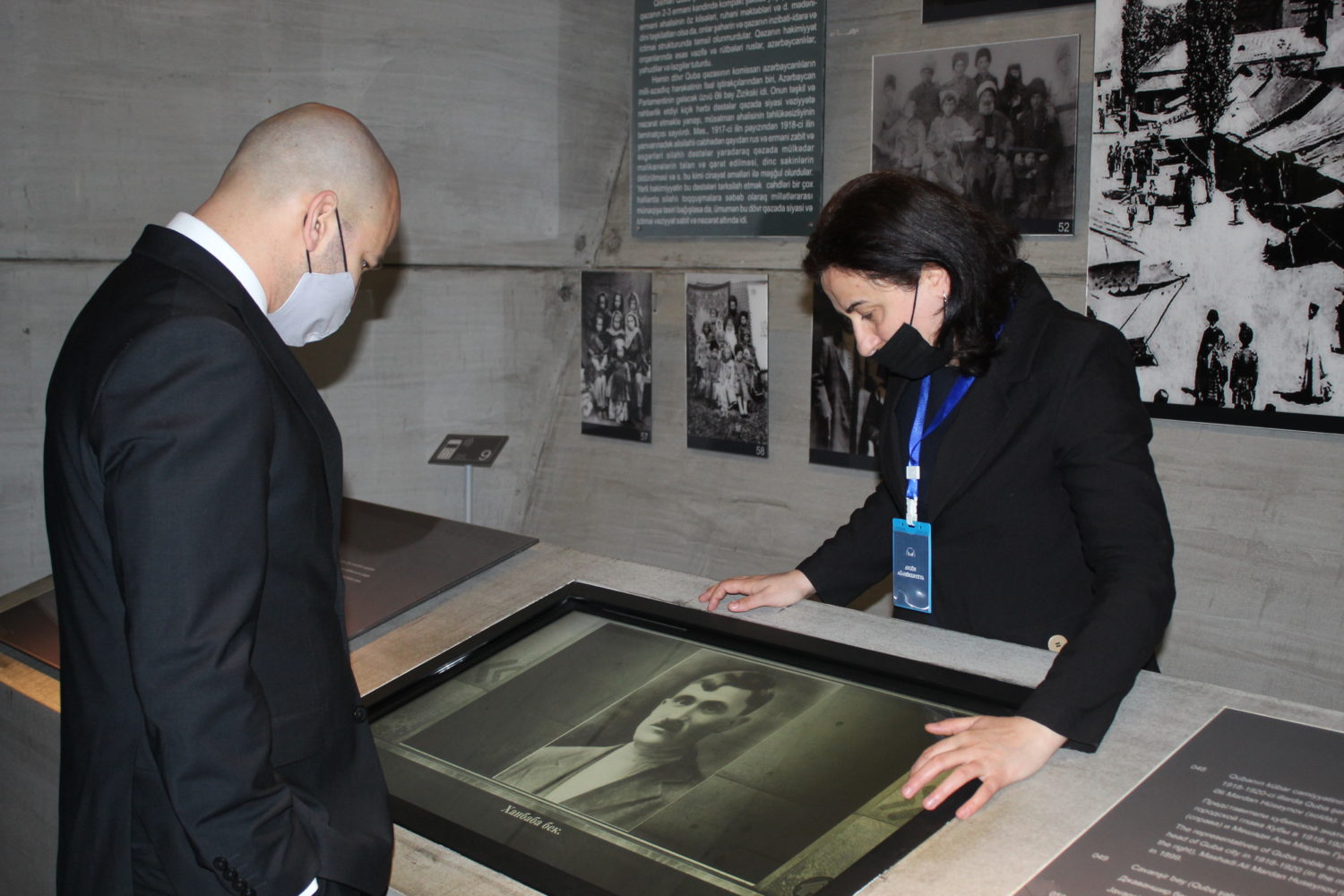
According to eyewitnesses, at the end of April the Khamazasp group approached Khachmaz, but local forces resisted. However, due to inequality of forces, after two days of fighting, the punitive detachment was able to leave for Guba. Hamazasp was at the head of this group. His assistant was Nikolai, and his guide was Harutyun Hayrapetov, a local Armenian nicknamed “The Mill.” Hamazasp’s group consisted of about 3,000 men, 4 cannons and 8 machine guns.
On May 1, the Armenian Dashnaks, who entered the city from three sides under the name of Bolsheviks, immediately began killing and looting. On the first day, 715 Muslims, mostly women and children, were killed in the lower part of the city, and the Boyuk Shosse and Bazar streets were destroyed and on the second day, 1,012 civilians were killed. A.Alibeyov, who came to Hamazasp as a representative of the city population, asked him to allow him to bury the dead, but his request was denied. Despite repeated appeals, Hamazasp did not allow the bodies of slain Muslims to be collected from the streets and buried. The aim was to intimidate and frighten the population. Violence, murder and robbery lasted for 9 days, and the property of the area population was looted. Examination of archival documents revealed that when Hamazasp arrived, an additional force was sent to Guba from Petrovsky. In general, the number of members of the Armenian Dashnak gang that committed genocide in Guba district was more than 5-6 thousand.
The members of the criminal gang committed atrocities against Muslims that are beyond human comprehension. Witness testimonies confirm that Armenian vandals enjoyed the inhumane “experiments” they inflicted on wounded and killed people. Mashadi Hamdulla Aliyev, a 40-year-old resident of Guba, said he had seen many bodies in the city, about two-thirds of which belonged to children and women. Many women had their breasts cut off and their corpses disfigured with daggers.
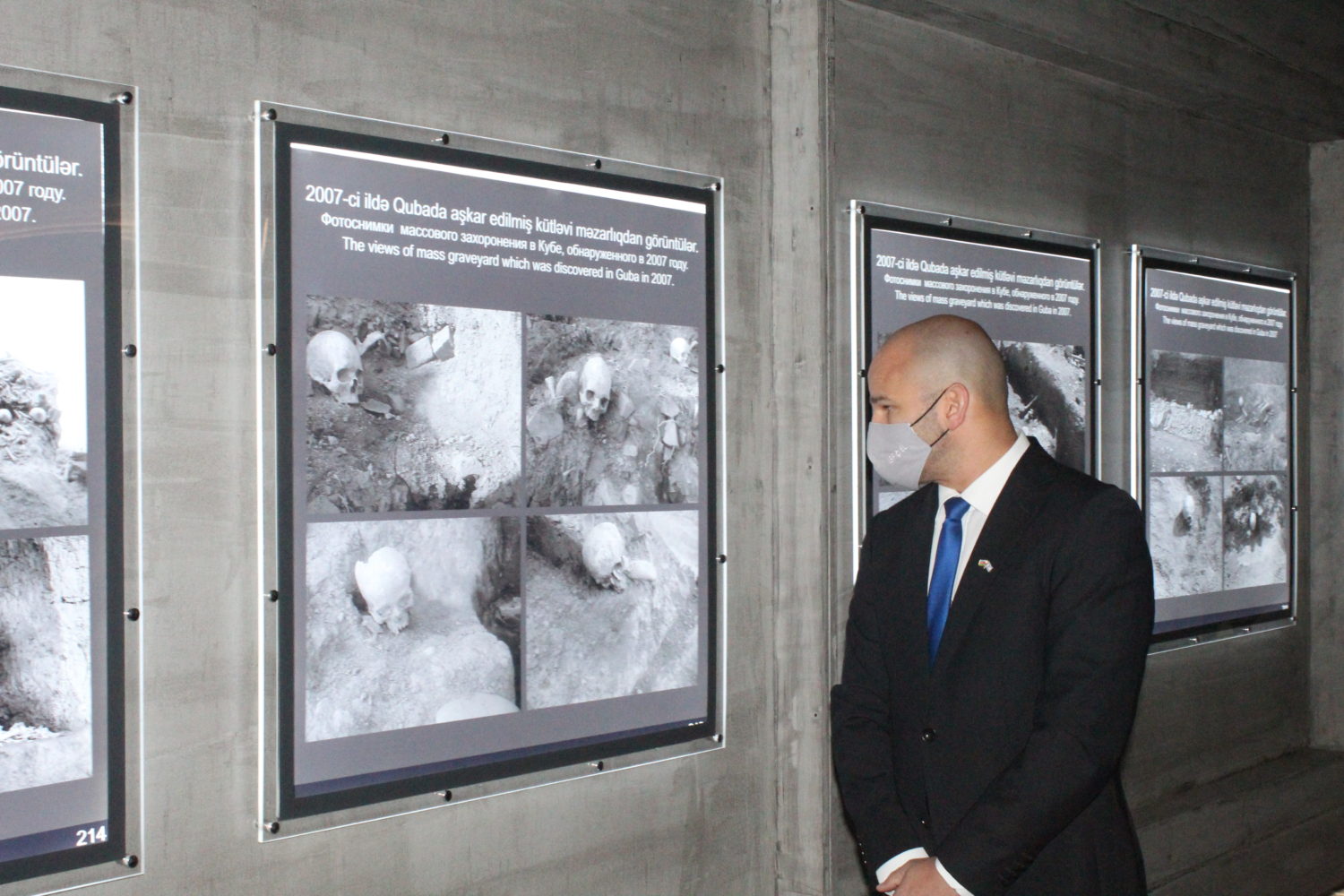
There are also archival materials that 300 people killed by Armenians were buried in 51 graves. As a result of Hamazasp’s atrocities, more than 16,000 civilians were killed in Guba area. The documents submitted to the Emergency Commission in connection with the damage caused to individual rural communities in the area provided a general overview of the damage to families, and in some cases did not provide information on burned houses and other buildings. T
The Dashnaks annihilated thousands of valuable books on Islam, oriental history and literature. Armenians set on fire the Abdurrahim Efendi’s madrasa in the center of Guba and burnt about 1,300 books. According to reports, the Digah mosque had books written in the Albanian and Arabic alphabets about 600-700 years ago. In addition to destroying the books, the Armenians also blew up a shrine stone about a kilometer from the village mosque. It was a huge stone with Albanian inscriptions on it.
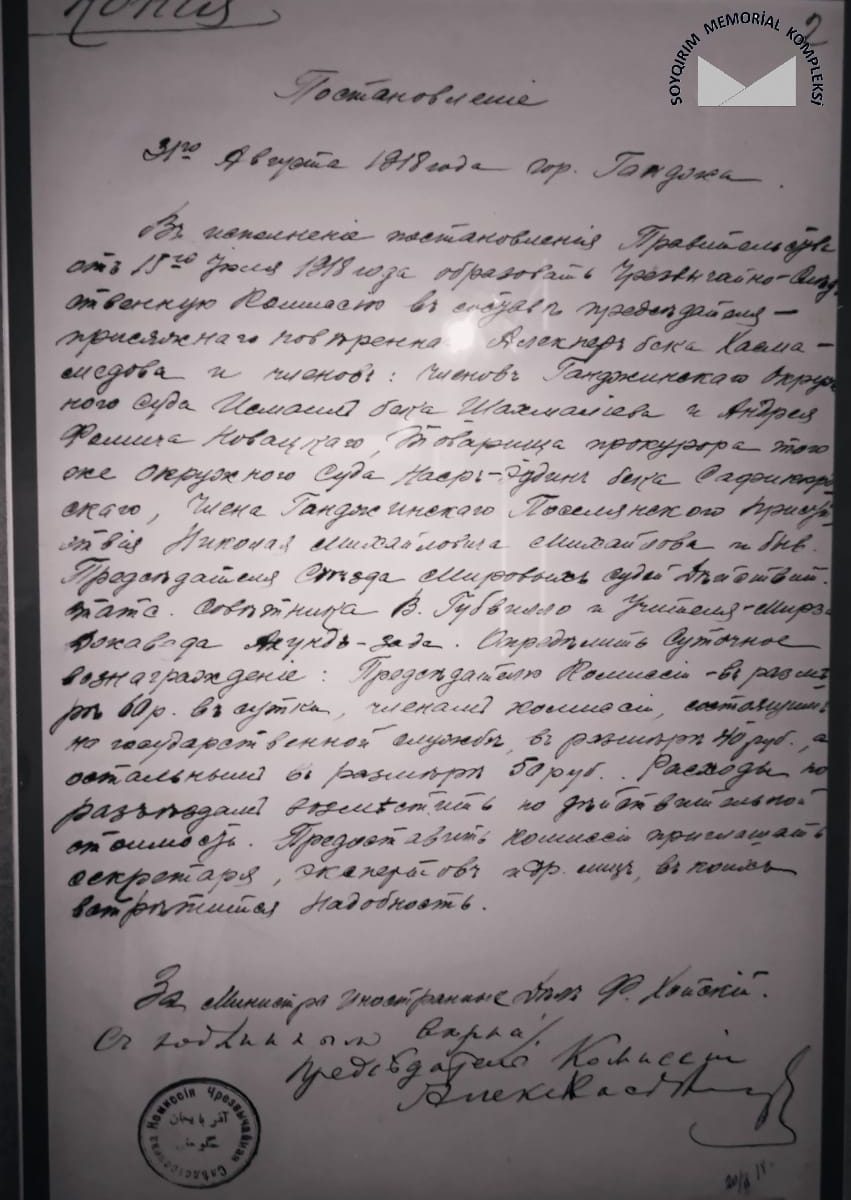
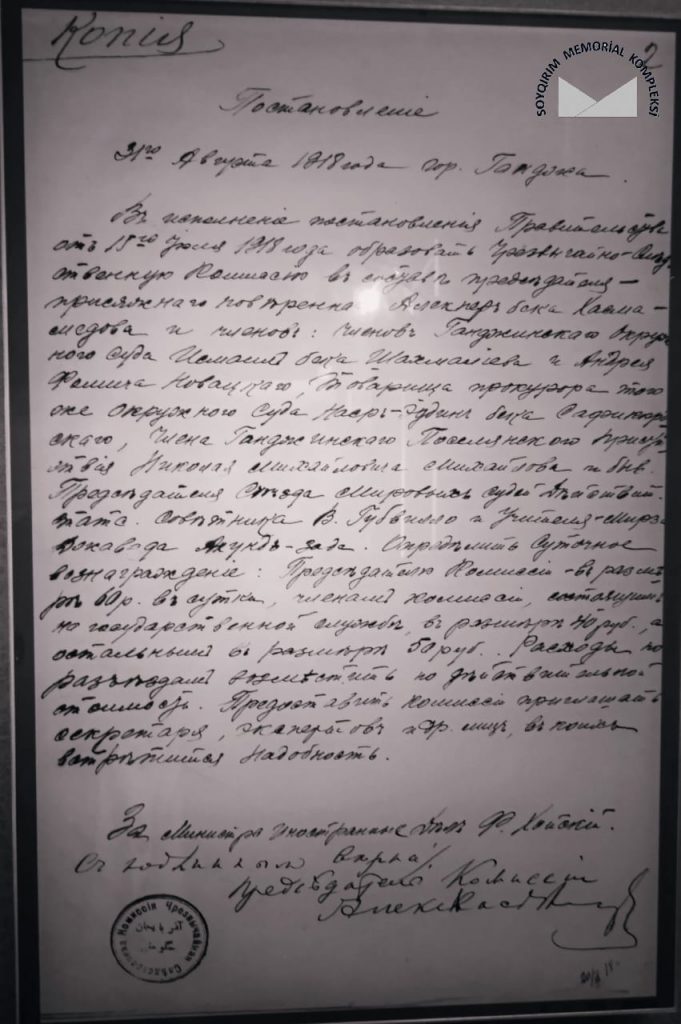
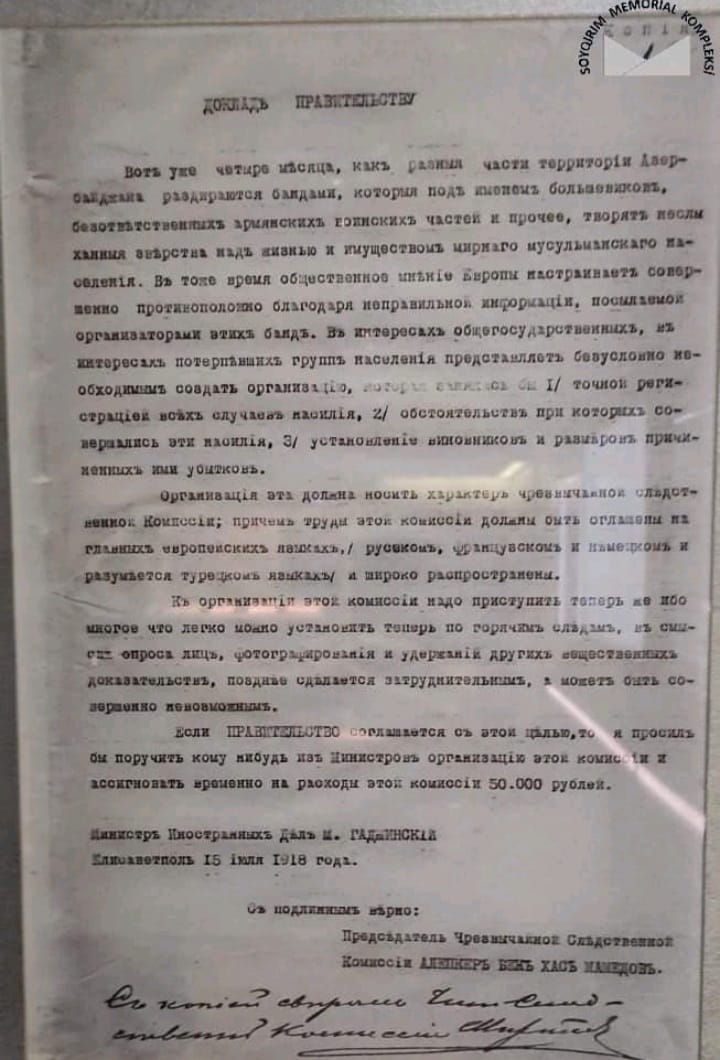
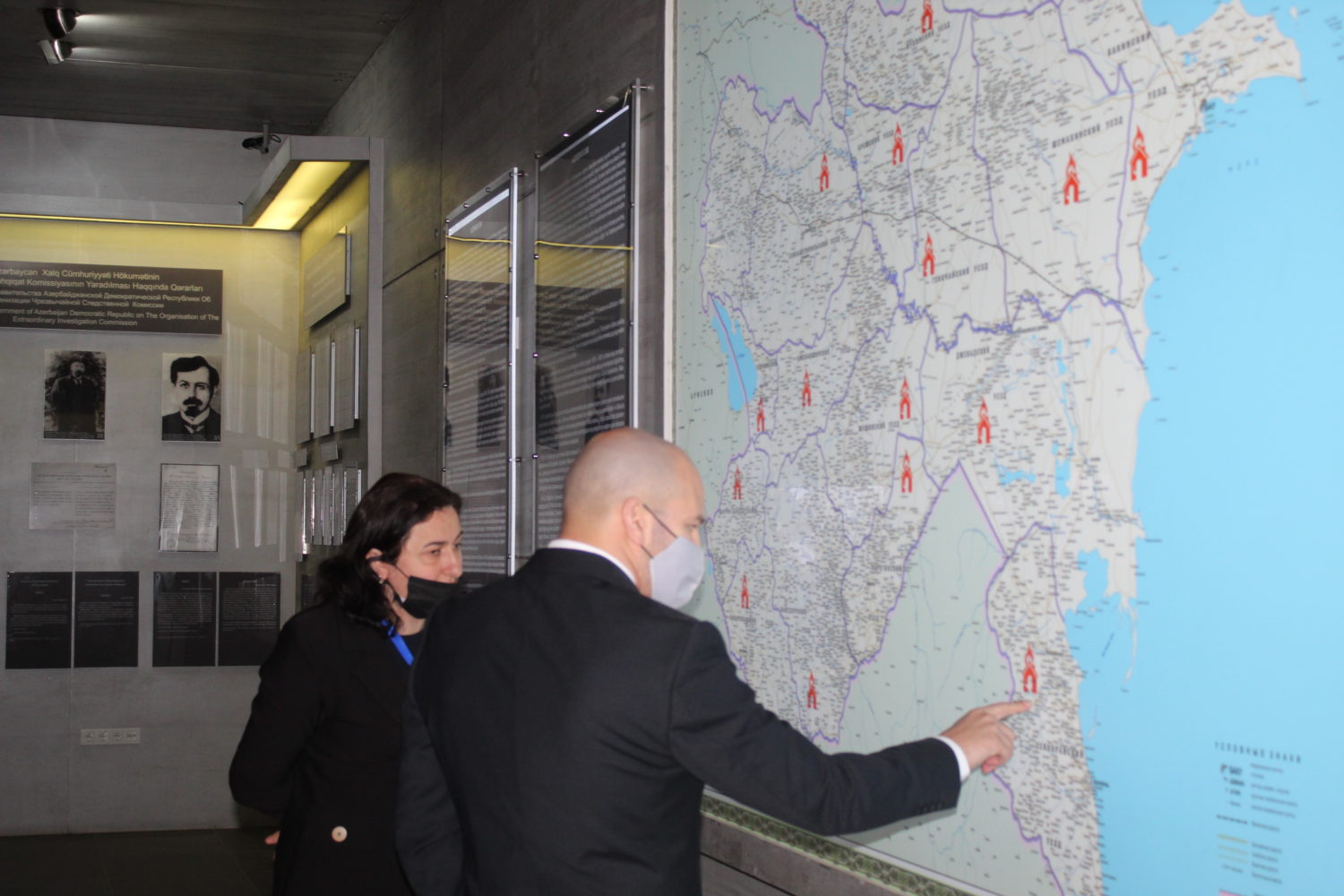
In December 1918, Andrei Novatsky, a member of the Ganja District Court, arrived in Guba with his assistant and began an investigation. The investigation team, in connection with the genocide committed in the Guba district in April-May 1918, listened to dozens of witnesses for several months, inspected the scene of the incident and prepared a three-volume collection of documents consisted of 451 pages. Novatsky, the member of the EIC presented a report to the Chairman of the Commission on the destruction of the city of Guba, as well as in the villages of the Guba district, as well as violence against civilians.
The direct organizers of the Guba massacres were Shaumyan, Korganov, the executors were Hamazasp, Volunts and other criminals of Armenian descent. The atrocities committed in Guba by the gangs of the Baku Soviet, headed by S. Shaumyan, consisting mainly of Armenians and under the command of the Dashnak Hamazasp, it was not a civil war or the establishment of Soviet power, but a massacre of an entire nation.