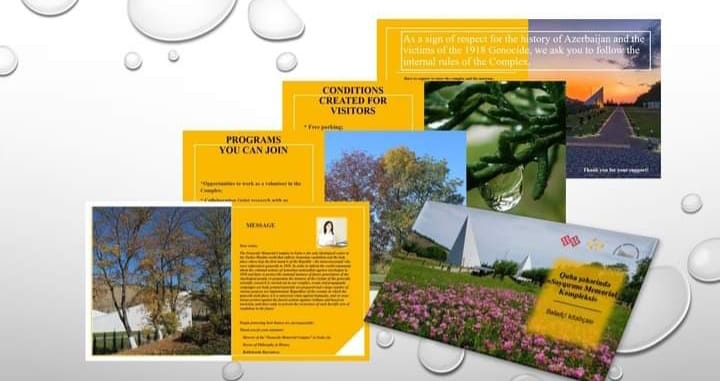
Note: the last part of the article provides detailed information about the Guba Genocide Memorial Complex and its history.
We thank our valuable scientist, Doctor of Historical Sciences, Professor Solmaz Tohidi.

Note: the last part of the article provides detailed information about the Guba Genocide Memorial Complex and its history.
We thank our valuable scientist, Doctor of Historical Sciences, Professor Solmaz Tohidi.
Nargin Island (Boyuk-Zira Island), known in Azerbaijan as the “Island of Hell” or “Snake Island” in the Caspian Sea, is located in Baku Bay, ten kilometers south of the city, in a very small area – about three square kilometers.In the 17th century, the Russians, especially the Cossacks, renamed most of the islands belonging to the Baku archipelago. In 1719, Russian Emperor Peter I gave the island its name because it resembled the island of Nargin in the Gulf of Finland.
Known as the site of various snakes, the island has been turned into a death camp by Russia.During the First World War, first by Tsarist Russia and then by the Soviet Union, more than 10,000 people captured from Turkish-Muslim villages were brutally tortured on the island.
Documents about the forcible hostage-taking of Turkish-Muslim children aged three years and adults up to 80 years old from Anatolian villages in the battles of Sarikamish 1914-1915, as well as photographs of people who died of hunger, disease, snake bites and mental illness, appear in various Russian archives.
Some of the tens of thousands of prisoners captured on Nargin Island were rescued by Azerbaijanis. In this regard, the activities of the Muslim Charitable Society, Haji Zeynalabdin Tagiyev, Ismail bey Safaraliev, Murtuza Mukhtarov and Azhdar bey Ashurbekov should be especially noted.Although the Caucasian Islamic Army, which entered Baku in September 1918, freed the prisoners, the bloody history of Nargin prison did not end there. After the seizure of power in Baku by the Bolsheviks in 1920, a number of Azerbaijani statesmen and public figures, activists and victims of Stalinist repression were shot on the islands of Nargin and Bulla. After the restoration of the state independence of Azerbaijan in 1991, its name was restored and renamed “Boyuk-Zira”.
Historically, Armenians settled on fertile lands that did not belong to them, and then, acting as owners of this place, in various ways displaced the local population from their native lands, destroying or changing historical and cultural monuments. Many Russian historians wrote about the resettlement policy and vandalism of this people in their works. For example, Russian ethnographer L.P. Zagursky in his book “Notes of the Caucasian Department-1873” on the settlement of Armenians in Javakheti writes: “In general, Javakhetia, during Turkish rule, was poorly populated. Upon the conquest by the Russians of the current Akhaltsikh district, the Erzerum immigrants, attracted by the benefits that the described country represented, poured on it in such an amount that they made up the predominant population of the country. Here it should be noted that Armenians, who have acquired a habit (even since their loss of political independence), easily leave their homeland, willingly settle in a country that promises to deliver material benefits to them. According to the construction in it, immigrants build churches in which they usually place images and ancient church books taken out of their former homeland; then they build up around churches, acquire immovable estates, take possession of trade and made quite settled residents of the new country. Due to their strong community spirit, they form an isolated community, not assimilating with the native population, but retaining the main features of its national character. Therefore, it is not surprising if the country in which this active and colonizing people has established itself in a significant number takes such a form little by little, as if Armenians inhabited it. We could, as well as possible, trace this phenomenon in Javakhetia. ”
According to historians, Peter I laid the foundations of the large-scale resettlement of Armenians to the lands of Azerbaijan. This is also mentioned in the collection of documents “Russian Herald,” published in 1867 (Русский Вестник [1867]. Т. 68. [№ 3-4. Март-апрель], с. 596-597)..
Thus, Peter I clearly stated the importance of resettlement of Armenians in Azerbaijan, especially around Baku and in the center of Derbent. The goal was to use Armenians to create internal unrest and political tension for the implementation of the policy of the Russian Empire in the east and future occupation.
Source: “If Armenian traders, craftsmen and IDPs settle in Derbent and Baku next summer (God willing, we will take the areas) and if they accept them, they could be located in settlements near Baku and on the island of Asalin. … “.
Note: This is a painting depicting the arrival of Peter I to Derbent in 1722.
Hatem agha Chagarvi was mentioned in the list of Kure and Samur districts compiled by Major-General Komarov on August 20, 1871. Hatem Sarkarov, who received military training in Russia and rose to the rank of colonel, fought with the Red Guards in 1918 together with Mohubali Kuzunvi to restore the territory of the Azerbaijan Democratic Republic. Hatem agha, together with the detachments of Mohubali efendi and Ali bey Ziziksky, repeatedly fought against the Armenian Dashnaks , who caused misfortune to the local population in the accidents of the Baku province. In May 1918, they defeated Hamazasp’s Armenian army in the “Bloody Valley” in the village of Digah, Guba region. After the victory of the Soviet government, the struggle against the Bolsheviks continued. He made a special decision to disband the “counter-revolutionary movement” and sent two regiments to Gusar to capture Hatem agha. However, the Reds failed with 300 warriors led by Hatem agha. In this case, the Soviet government appointed Hatem agha as the head of the militia department in Guba district. However, seeing the injustices of the new structure, Hatem agha resigned from that position in 1922 and again fought against the Bolsheviks. He heroically died, in battle with the 3000 thousand Soviet army, which lasted two months
Ismayil khan Ziyadkhanov deeply felt the pain of the Azerbaijanis who were subjected to the terrible massacres committed by the Armenian Dashnaks in 1905 and joined the political activity. He was one of the active members of the national independence movement of Azerbaijan and in 1906 was elected a deputy of the 1st State Duma of Yelizavetpol (Ganja) province. Ismayil Khan, a member of the Duma’s Muslim faction bureau and a member of the People’s Freedom Party, sharply criticized the tsarist policy of resettlement in the Duma, the genocides committed in the Caucasus, and the tragedies caused by the Armenian Dashnaks. On March 28, 1918, the militia groups led by Ismayil khan Ziyadkhanov, which had come to the defense of Shamakhi, liberated Shamakhi from the Russian and Armenian detachments in a short time. It should be noted that Ismayil khan Ziyadkhanov was appointed Commissioner for Military Affairs in the 2nd government of the Azerbaijan Democratic Republic, and then the First Deputy Minister of Foreign Affairs.
Defender of Guba district – Hamdulla Efendi Ismayil oglu Efendizadeh, one of the first members of the Parliament of the Democratic Republic of Azerbaijan, was born in 1888 in Galagah village of Devechi district of Guba region. One of the prominent intellectuals of his time, the public figure received his first education in a village mollakhana, then in a madrasah in Guba, and in 1906 graduated from a two-grade Russian school. He was fluent in Arabic, Persian, Turkish and Russian. Hamdulla Efendi was one of the people who rendered special services in preventing the genocide committed by the Armenian-Bolshevik Dashnaks against the Azerbaijanis in Guba district in 1918. He fought with his troops in the struggle against the Armenians together with the Guba area commissioner Ali Bey Ziziksky. In those days, a group of 50 people, including the active Bolshevik A. Najafov, returned from Amirkhanli village of Davachi on horseback and fought with Hamdulla Efendi’s group. The Bolsheviks were defeated and retreated to Khachmaz. Hamdulla Efendi was also distinguished by his political views and participated in the socio-political life of the country after the establishment of the Azerbaijan Democratic Republic, was one of the active members of the “Ittihad” party. According to the “Law on the Establishment of the Azerbaijani Parliament-Prisoner” of the National Council of Azerbaijan (November 19, 1918), he was included in the Republican Parliament from Guba district and was a member of the “Ittihad” faction. The struggle against the Bolsheviks in 1920-1928 was led by well-known figures of the region, such as Hamdulla efendi and his brother Shamsaddin Efendi in Devechi district. About 12,000 local fighters are said to be in the armed groups led by them. After the congress of the Soviet government in Azerbaijan, Mr. Hamdulla was arrested on October 25, 1928 and repressed in 1928, exiled to Siberia, where he died.
Despite the genocide of Azerbaijanis in Armenia in 1918-1920, mass repressions and deportations in 1930-1938, Azerbaijanis still lived along the borders of Armenia, Turkey and Iran, as well as Azerbaijan and Georgia.
Mass deportation of Azerbaijanis from the historical and ethnic lands of the Armenian SSR in 1948-1953 became the next stage in the policy of Armenians and their supporters to take advantage of the domination of the Soviet Union at the end of the Second World War.
On May 15, 1945, the first secretary of the Central Committee of the Communist Party of Armenia G. Arutinov sent a letter to the chairman of the Council of People’s Commissars of the USSR I. Stalin with a request to make a decision on the “return” of Armenians living abroad to Soviet Armenia. On June 6, Stalin had meeting with Arutinov in the Kremlin. G. Arutinov presents I. Stalin a letter on the restoration of borders with Turkey in accordance with the situation in 1914.
At the next meeting of Arutinov and Stalin on October 27, Stalin told him that the territorial claims of the Soviet government against Turkey were still on the agenda. G. Arutinov claimed to Stalin that more than 300,000 Armenians gave their lives for the Soviet power, but primarily to eliminate the “existing injustice,” namely to unite the Nagorno-Karabakh Autonomous Region with Armenia.
On November 21, 1945, the Council of People’s Commissars of the USSR signed a decree “On measures for the return of Armenians from abroad to Soviet Armenia.” A week later, the second secretary of the Central Committee of the Communist Party, G. Malenkov, sent a petition to the first secretary of the Central Committee of the Communist Party of Azerbaijan M. Bagirov, on the inclusion of Nagorno-Karabakh in Soviet Armenia. After a harsh reply letter from M. Bagirov, the issue was closed and instead the question of deporting Azerbaijanis from Armenia arose.
In accordance with the decree of the Supreme Soviet of the USSR of October 19, 1946, Armenians “repatriated” to Armenia from abroad received the status of citizens of the USSR from the moment they entered the territory of the Soviet Union. In 1946-1949, 96,000 Armenians were resettled in Armenia from other countries, many of whom settled in Yerevan, mainly in the suburbs of Nor Aresh, Olive, Nor Cilicia.
On December 23, 1947, the Council of Ministers of the USSR signed a decree “On the resettlement of collective farmers and other Azerbaijanis from the Armenian SSR to the Kur-Araz lowland of the Azerbaijan SSR.” The decree indicated that 100,000 collective farmers and other Azerbaijanis who lived in the Armenian SSR in 1948-1950 were to be resettled in the Kura-Araz lowland of the Azerbaijan SSR on a voluntary basis. The first paragraph provided for the resettlement of 10,000 people in 1948, 40,000 in 1949 and 50,000 in 1950. Paragraph 11 stated that the Council of Ministers of the Armenian SSR should be allowed to use buildings and houses vacated by the Azerbaijani population in connection with the resettlement of the Azerbaijani population in the Kura-Araz lowland of the Azerbaijan SSR to accommodate Armenians arriving in Armenia from abroad.
The decisions of the USSR government to resettle Azerbaijanis gave the Armenian government the opportunity to relocate existing Azerbaijani settlements around Yerevan and along the external borders of Armenia. Representatives of the Armenian government spread various rumors in order to prepare psychologically the Azerbaijani population for resettlement. In a letter addressed to M.K.Bagirov on May 3, 1948, by the Minister of Internal Affairs of the Armenian SSR, Major General Kh. Grigoryan “Certificate of the mood of the Azerbaijani population of Armenia in connection with the forthcoming resettlement to the Azerbaijan SSR”, not only the discontent of the population, but also the words of the Armenians were reflected who were interested in joining Nagorno-Karabakh and Nakhchivan to Armenia.
The archival documents also contain the facts of the deportation of Azerbaijanis from the city of Yerevan. For example, 64 Azerbaijani families (253 people) were relocated from Yerevan in December 1948, and 400 families were to be relocated in 1949.
Out of 81,010 families resettled from Armenia in 1948-1950, only 3232 were provided with housing. In 1950, it was decided to build 3,500 houses for the resettled, but only 470 houses were built. Only 1,488 families were provided with homesteads. Although it was planned to build 5,000 houses in 1951, a total of 3,074 houses were built and commissioned. In 1952, it was planned to move 600 farms from the Armenian SSR to the Kur-Araz lowland, and the plan was exceeded (124.6 percent).
After the deportation of Azerbaijanis from Armenia, under the pretext of reducing the Azerbaijani population living there, the replacement of Azerbaijani personnel holding certain posts at the regional and national levels with Armenians began.
The first Azerbaijani secretaries of the party committees of the Karabakh, Vedinsky, Zangibasar and Krasnoselsky districts, as well as the second and third secretaries from 10 other regions were dismissed and replaced by Armenians. With the exception of the districts of Amasya, Basarkechar and Krasnoselo, Azerbaijani newspapers were closed in other areas. In 1949, the Yerevan State Azerbaijan Drama Theater named after J. Jabbarly was moved to the center of the Basarkeshar region, where Azerbaijanis did not live, and closed in 1952 due to lack of funding. Only in 1967 the Yerevan Theater resumed its activity in Yerevan.
Since 1937, the departments of education in the Azerbaijani language at the H. Abovyan Pedagogical Institute in Yerevan – linguistic, literary, historical, geographical, physical and mathematical faculties and faculties of the same name at the Armenian State Correspondence Pedagogical Institute were closed and transferred to the corresponding institutes in Azerbaijan in 1948. In 1924, the Yerevan Azerbaijan Pedagogical College was closed, and its faculties were moved to the center of the Khanlar district.
As a result of deportation in 1948-53, the Azerbaijani population of Yerevan was halved. In 1939, during the census, 6,569 Azerbaijanis were registered in Yerevan, and in 1959, 3,413 Azerbaijanis were registered (the census was not conducted in 1949).
Along with the deportation of Azerbaijanis from Armenia, an operation was carried out to rename settlements. In 1947-1953 alone, the names of more than 60 Azerbaijani settlements were borrowed by Armenians.
In order to provide a legal and political assessment of this situation, which is considered a historic crime against our people, and to convey it to the international community, On December 18, 1997, President of the Republic of Azerbaijan Heydar Aliyev signed a decree “On the mass deportation of Azerbaijanis from historical and ethnic lands in the Armenian SSR.”
Nazim Mustafa,
Researcher at the Institute of History. A.A. Bakikhanov of ANAS
Ali bey Zizikski, one of the defenders of Guba district, was an active participant of the national independence movement of Azerbaijan and a member of the parliament of the Azerbaijan Democratic Republic. After the February Revolution, Captain A. Zizikski was appointed commissioner of Guba district by the Special Transcaucasian Committee. After the October 1917 coup, Ali Bey tried to prevent the area from falling under the control of the Baku Soviet. During the March 1918 genocide, Ziziksky joined the regiments of Najmeddin Gotsinsky, who came to the aid of Baku from Dagestan with his troops.
In April 1918, the Baku Soviet sent an army of Dashnak Armenians to Guba under the name of Bolsheviks. A few days later, these groups were pushed away from Guba by Muslim groups led by Ali bey Zizikski, Hamdulla Efendi Efendizadeh and others. Then, in early May, on the instructions of S. Shaumyan and G. Korganov, 3,000 Dashnak-Bolshevik forces led by Dashnak Hamazasp were sent to Guba. The national forces of the accident, led by Ziziksky, were forced to cross into Dagestan, unable to resist the overwhelming and well-armed enemy forces. Ziziksky, who organized the formation of new military units in the Caucasus with the help of the Islamic Army and the local population in Dagestan, organized a strong attack on the Dashnak-Bolshevik forces of Hamazasp and took part in the liberation of Guba. When the Azerbaijan Democratic Republic was established, most members of Ziziksky’s gang joined the newly formed National Army.
After the April occupation, Ali Bey Zizikski was persecuted by the Bolsheviks, arrested and subsequently executed.
On 15th July 2020 there was held webinar with the support of the State Service for the Protection, Development and Restoration of Cultural Heritage under the Ministry of Culture of the Republic of Azerbaijan, with the initiative and organization of the “Genocide Memorial Complex” in Guba city, with the participation of students from the universities of Al-Azhar, Ein-Shams, in Cairo and Alexandria, Republic of Egypt. The workshop was moderated by Seyid Jabbarov, a specialist in Arabic from the Genocide Memorial Complex. At the seminar, reports were made by Doctor of Philosophy in History, teacher of the Faculty of History and Geography in APU Sevil Bakhramova, Director of the Genocide Memorial Complex, Doctor of Philosophy in History Rakhshanda Bayramova, teacher of the Alnur Language Center in Cairo Isra Adil, author of the book “Grammar of the Azerbaijani language “For Arabs, researcher, author of a number of articles on the history of Azerbaijan, as well as the book” The Road to Peace in the Karabakh Caucasus “(2014) Dr. Ahmed Abdukh Tarabik. Also hre participated specialists and students interested in topicof the seminar “Historical and Cultural Monuments of Azerbaijan” and a student of APU Hafiz Mammadov made a speech.