ABOUT THE COMPLEX

Quba Genocide Memorial Complex

The complex was erected in memory of the tens of thousands of Azerbaijanis who were killed as a result of the genocides committed on Azerbaijani lands in 1918 by the armed Bolshevik-Armenian units. In order to convey these truths to the international community, preserve the national memory of future generations of the Azerbaijani people, and perpetuate the memory of the victims of genocide, the President of the Republic of Azerbaijan, Mr. Ilham Aliyev, signed Decree No. 673 dated December 30, 2009. In accordance with this decree, the “Genocide Memorial Complex” was built in the city of Quba in 2012–2013 with the support of the Heydar Aliyev Foundation, and was inaugurated on September 18, 2013 with the participation of President Ilham Aliyev and his wife Mehriban Aliyeva.
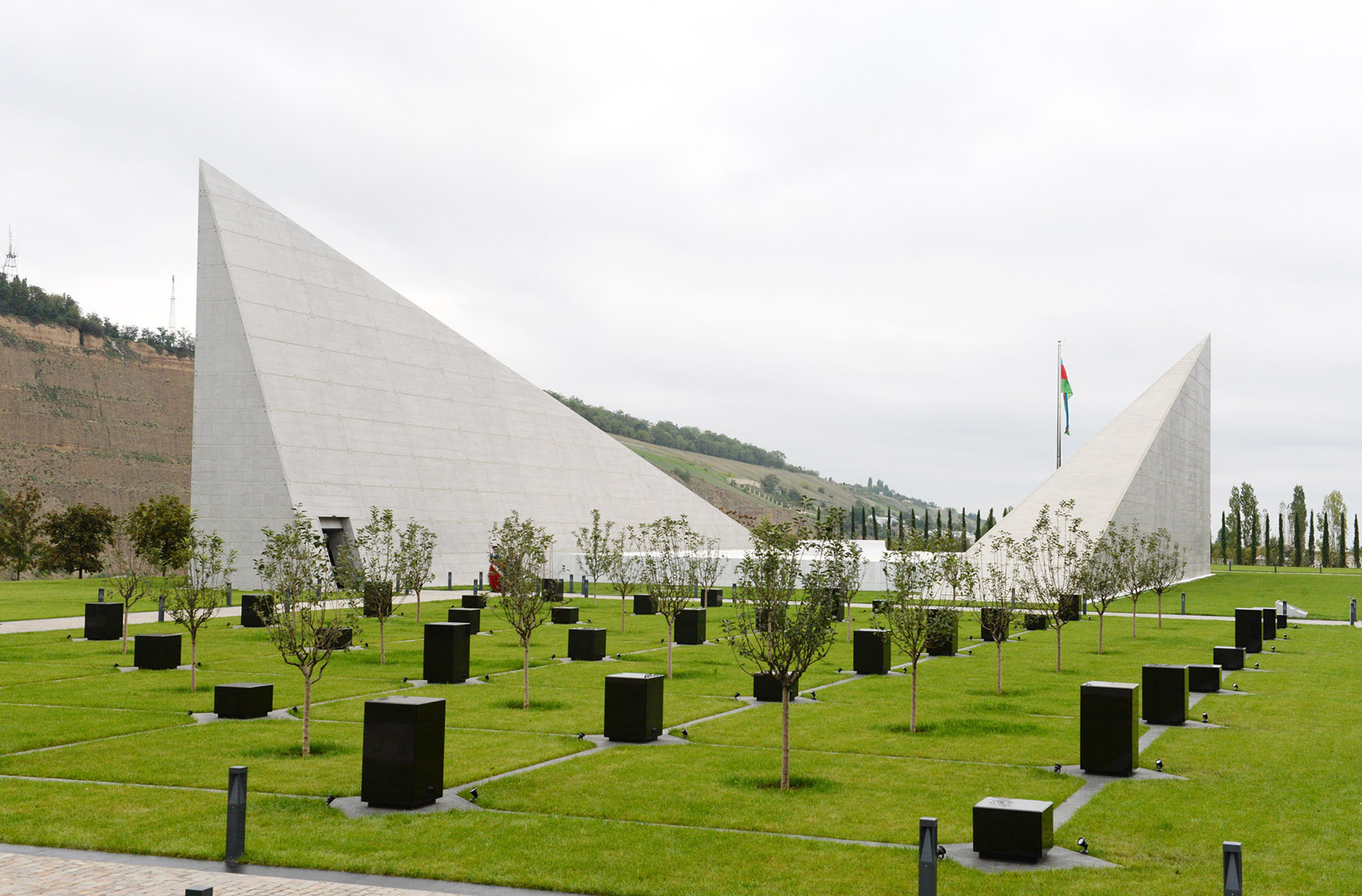
The total area of the complex is 3.5 hectares, and it consists of 5 parts.

Structure

5 parts of the complex

Memorial monument - mass grave
Memorial monument - additional view
Part I

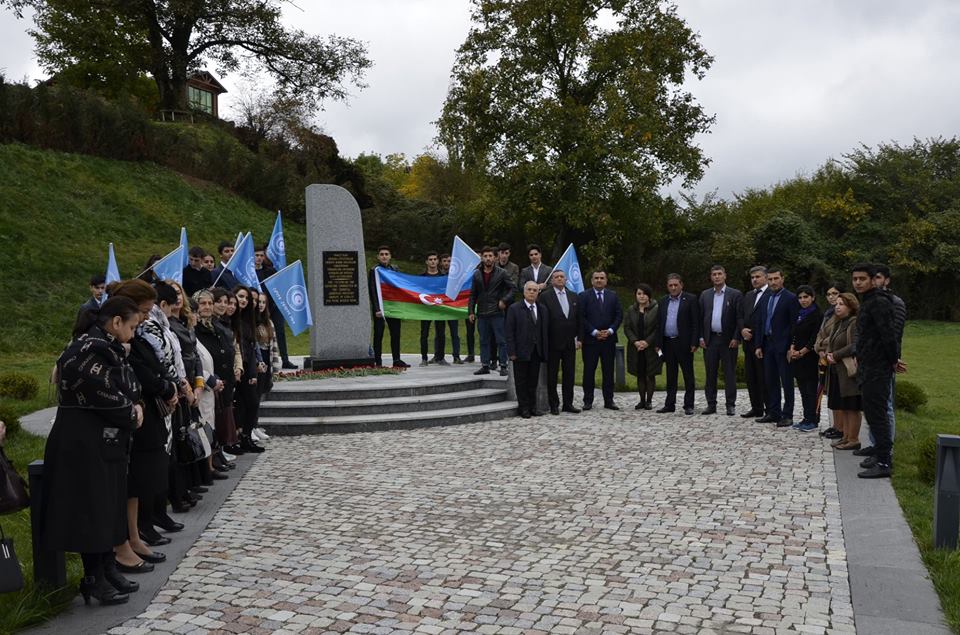
Memorial monument (mass grave)

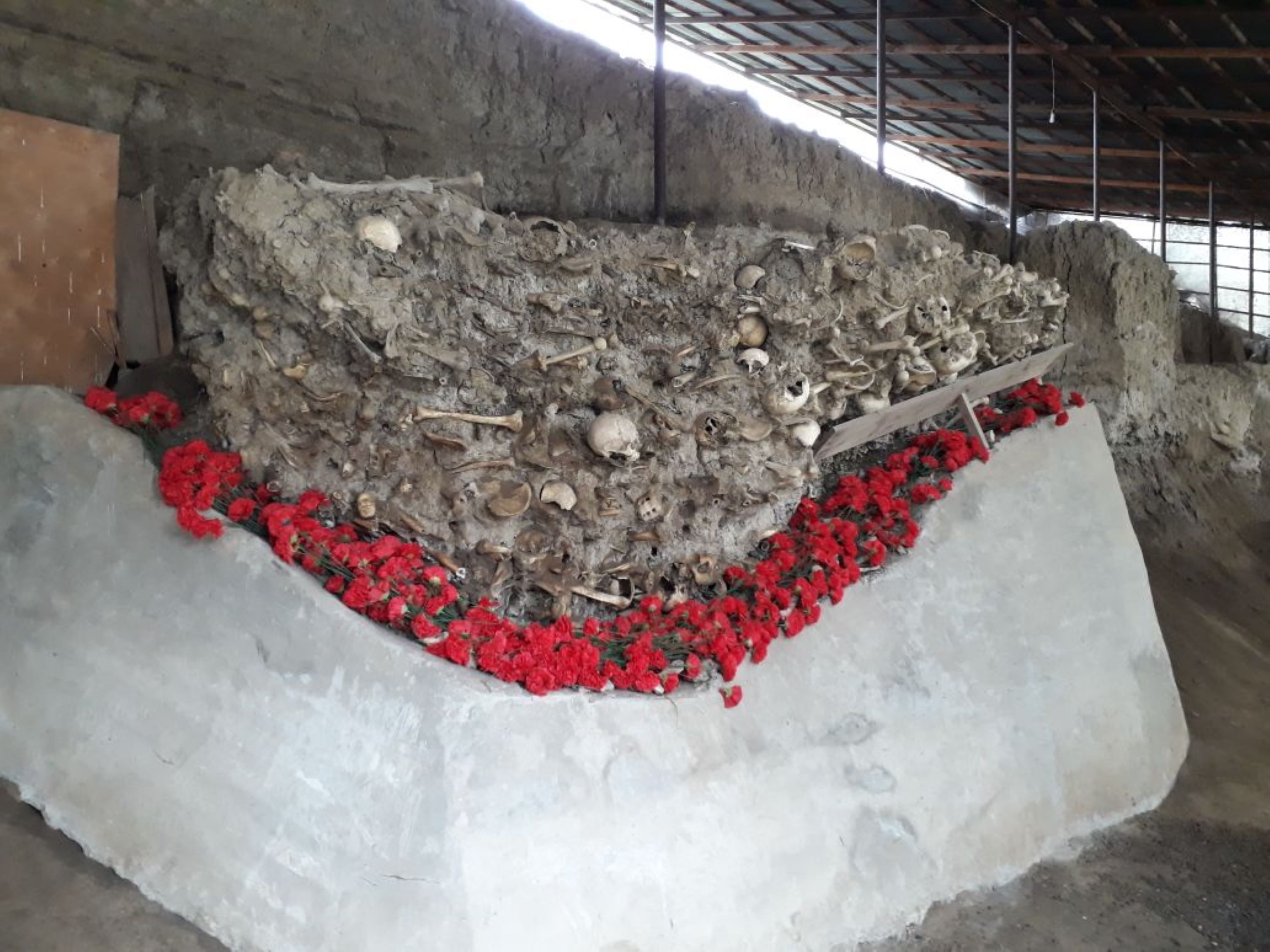
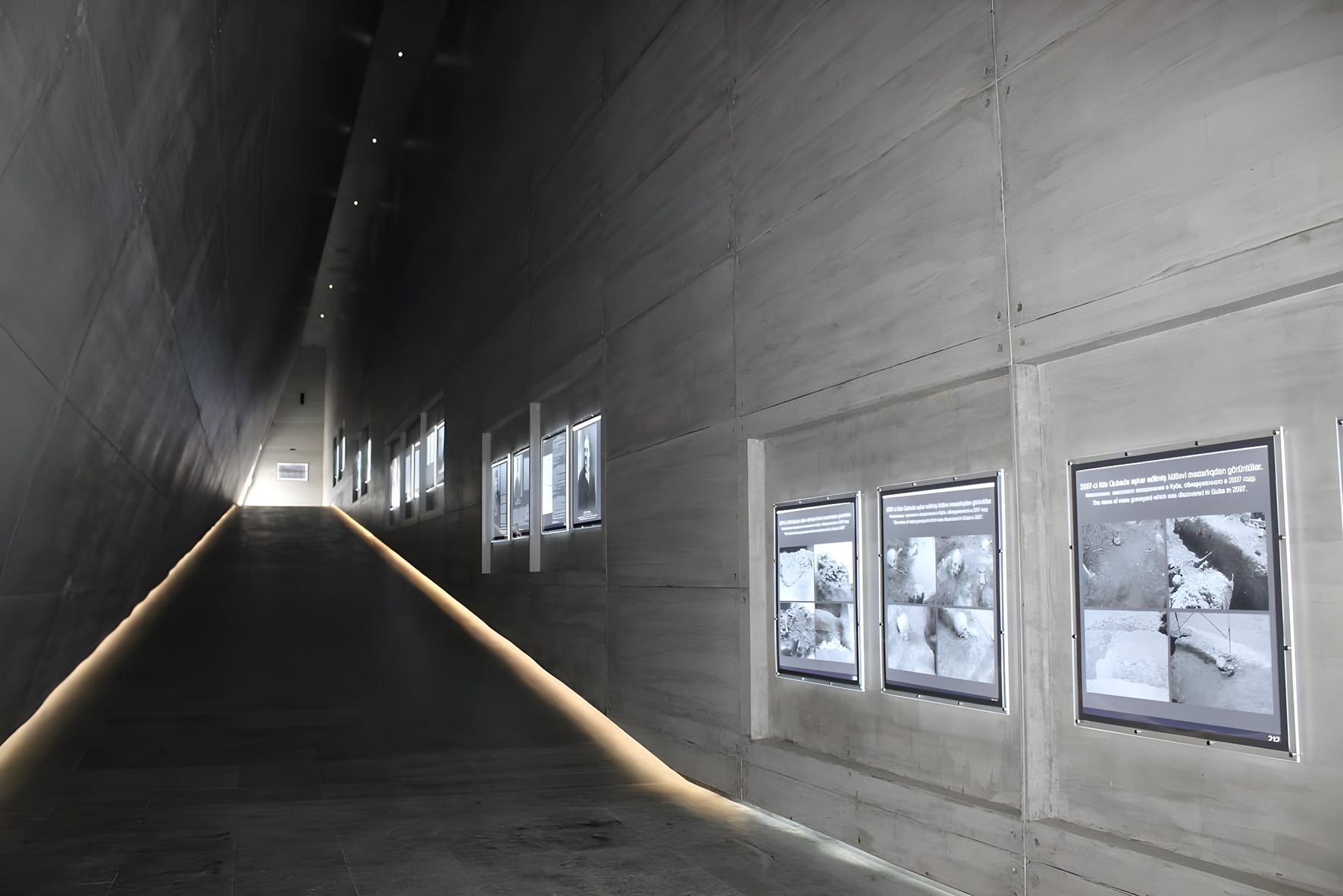
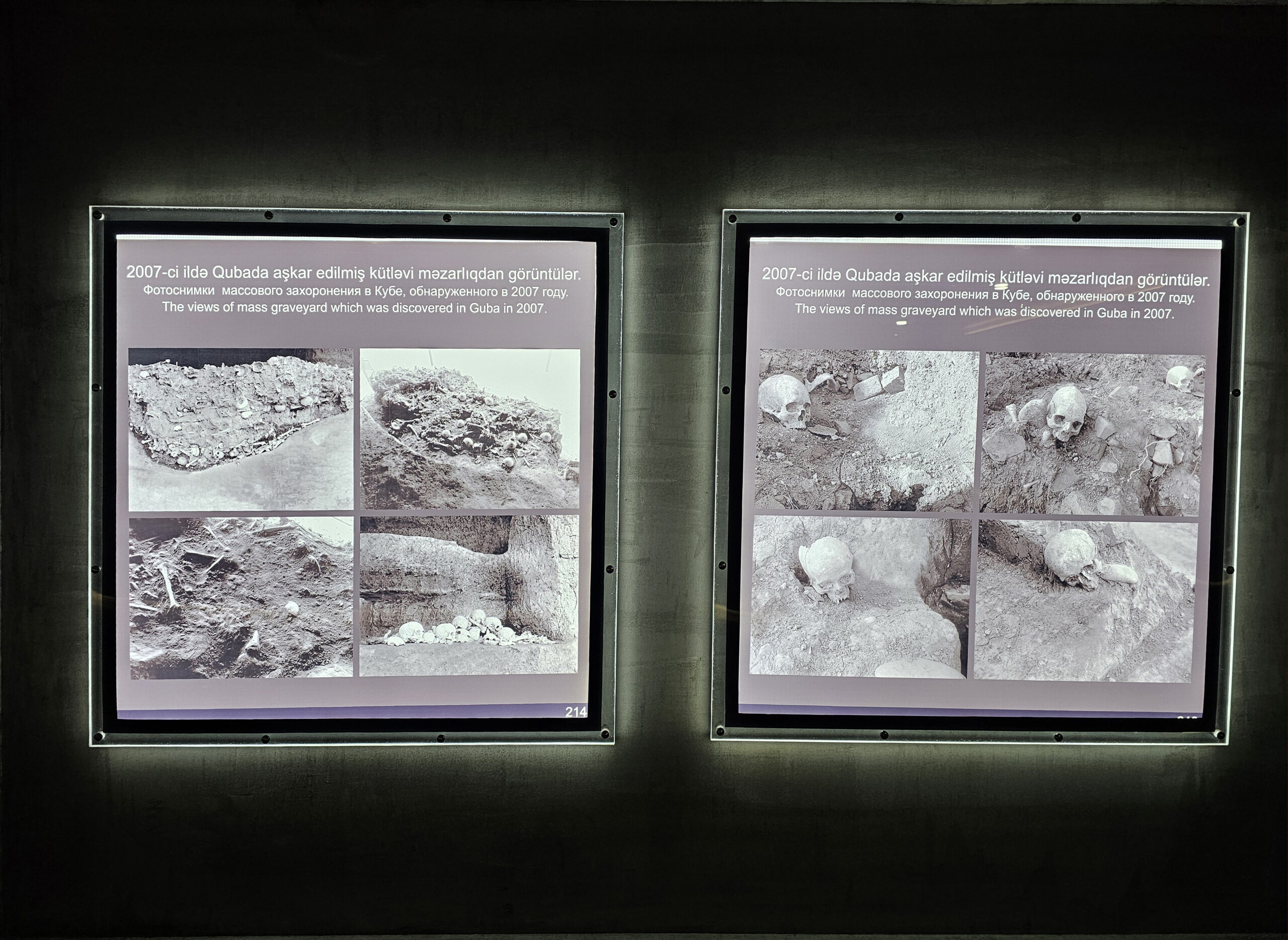
In April 2007, while renovation and excavation works were being carried out at the city stadium located in the northwestern part of the city of Quba, on the right bank of the Gudyalchay River, a mass grave was discovered. The Scientific Council of the Institute of Archaeology and Ethnography of the Azerbaijan National Academy of Sciences deemed it necessary to conduct broader research at the burial site in order to fully clarify the matter. Beginning in July 2007, a scientific team of 7 members from the Institute of Archaeology and Ethnography of the Azerbaijan National Academy of Sciences started research at the mass grave, and the work was completed in September 2008. Medical examinations and anthropological studies were carried out on the human remains found in the grave. As a result of the investigations, it was determined that the discovered mass grave belonged to local civilians who had been subjected to genocide in 1918 by Bolshevik-Dashnak Armenian bandit military units. Nearly 500 human skulls were found in the grave, more than 50 of them belonging to children and more than 100 to women. The discovered mass grave was clear evidence of the criminal acts committed throughout the country in 1918 by Armenian nationalists in connection with territorial claims against Azerbaijan.

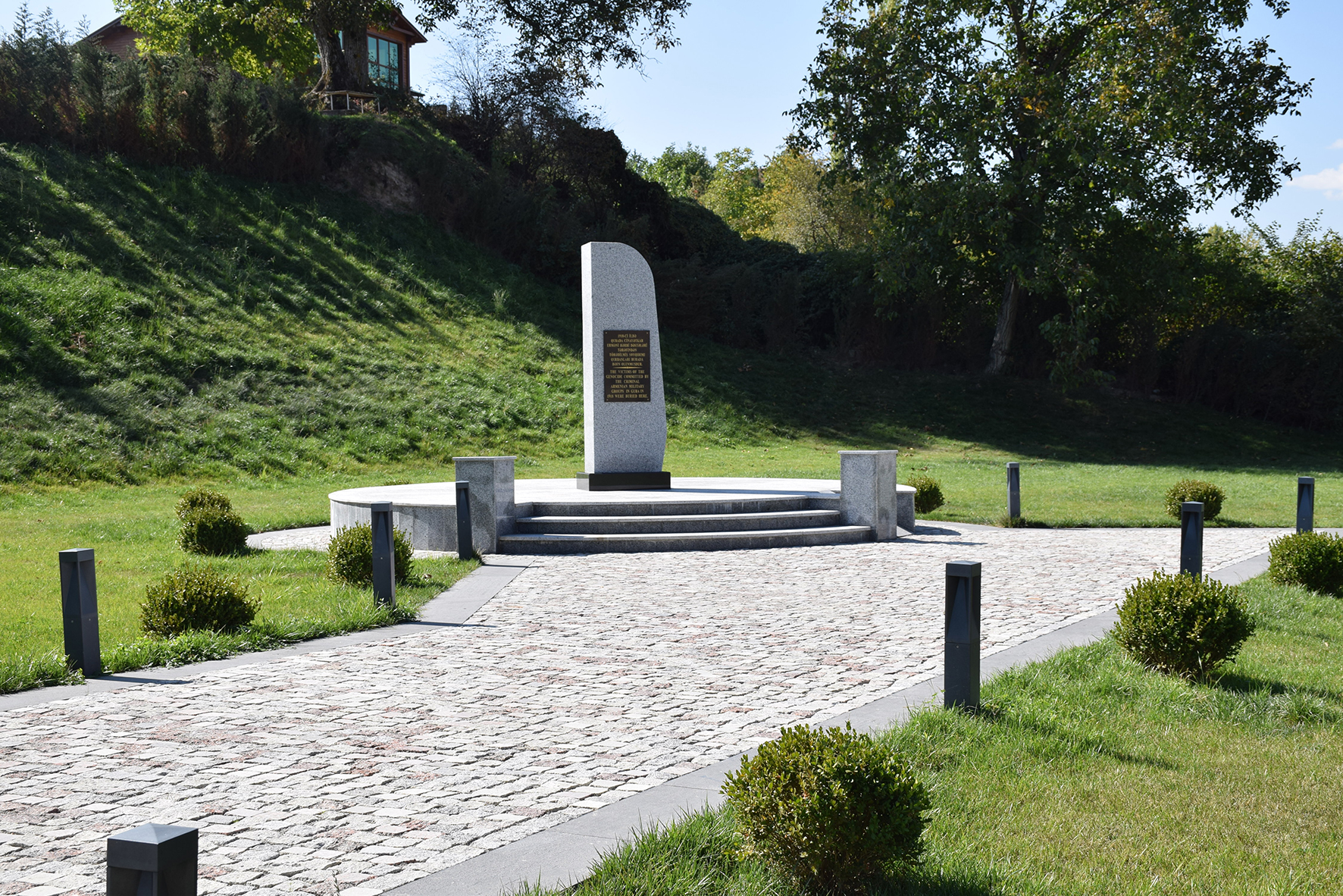
Due to the activation of landslides, erosion, and the decomposition of human bones as a result of natural processes in the openly displayed mass grave, the remains were buried in accordance with Sharia rules in March 2018, and a memorial monument was erected over them.

Symbolic cemetery
Part II

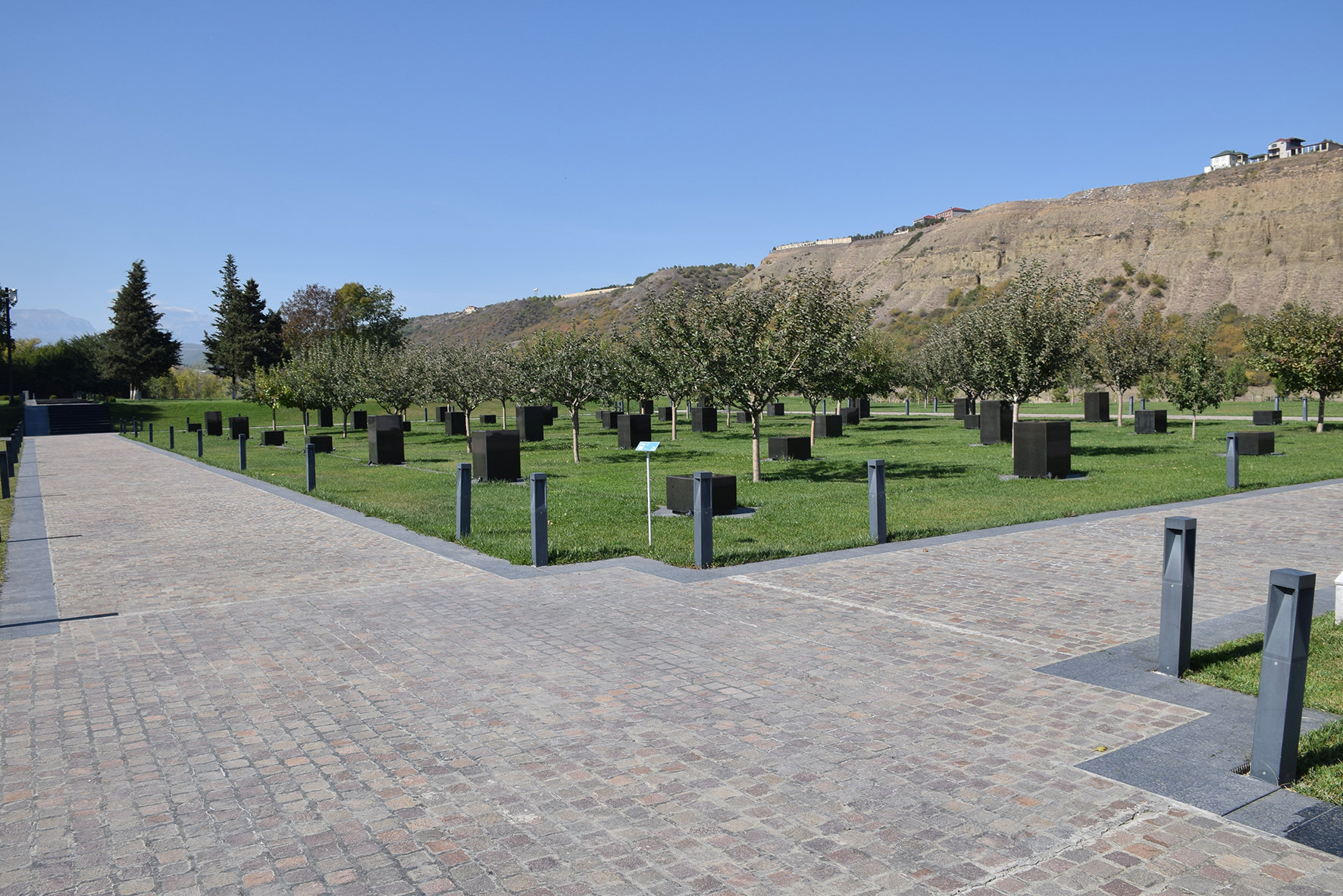
Symbolic cemetery

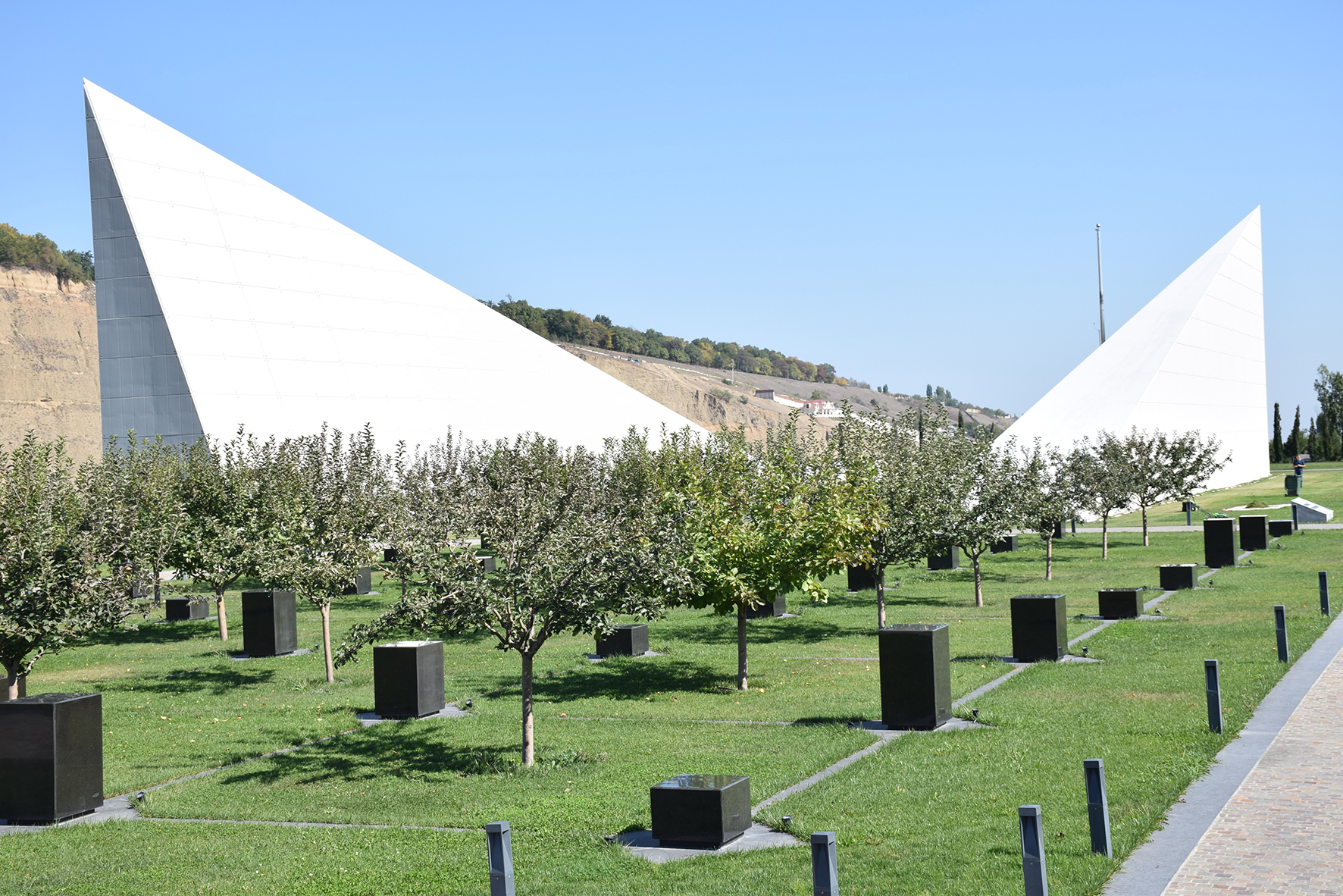
In this part of the complex, apple trees—regarded since ancient times as the symbol of Quba and of life—were planted. In the apple orchard, 40 symbolic marble stones of three different sizes were installed according to three age groups (young, middle-aged, and elderly) as a sign of respect for the memory of the victims of the 1918 tragedy—women, youth, children, and the elderly.

Genocide museum
Part III

Genocide museum

The museum consists of 3 parts:

The architectural style of the complex with its striking design, as well as the exhibits displayed in the museum, carry great symbolic meaning and reflect the rich history of our people.

As a profound sign of respect for the memory of the genocide victims, the scale, burden, and pain of the tragedy were expressed by architect Vahid Kasimoglu in a simple and unadorned form, thereby embodying mourning silence. The museum’s appearance emerging from beneath the ground symbolizes the impossibility of concealing history, while the sharp knife-like elements symbolize the heart-rending violence.

Museum entrance
Part III / 01

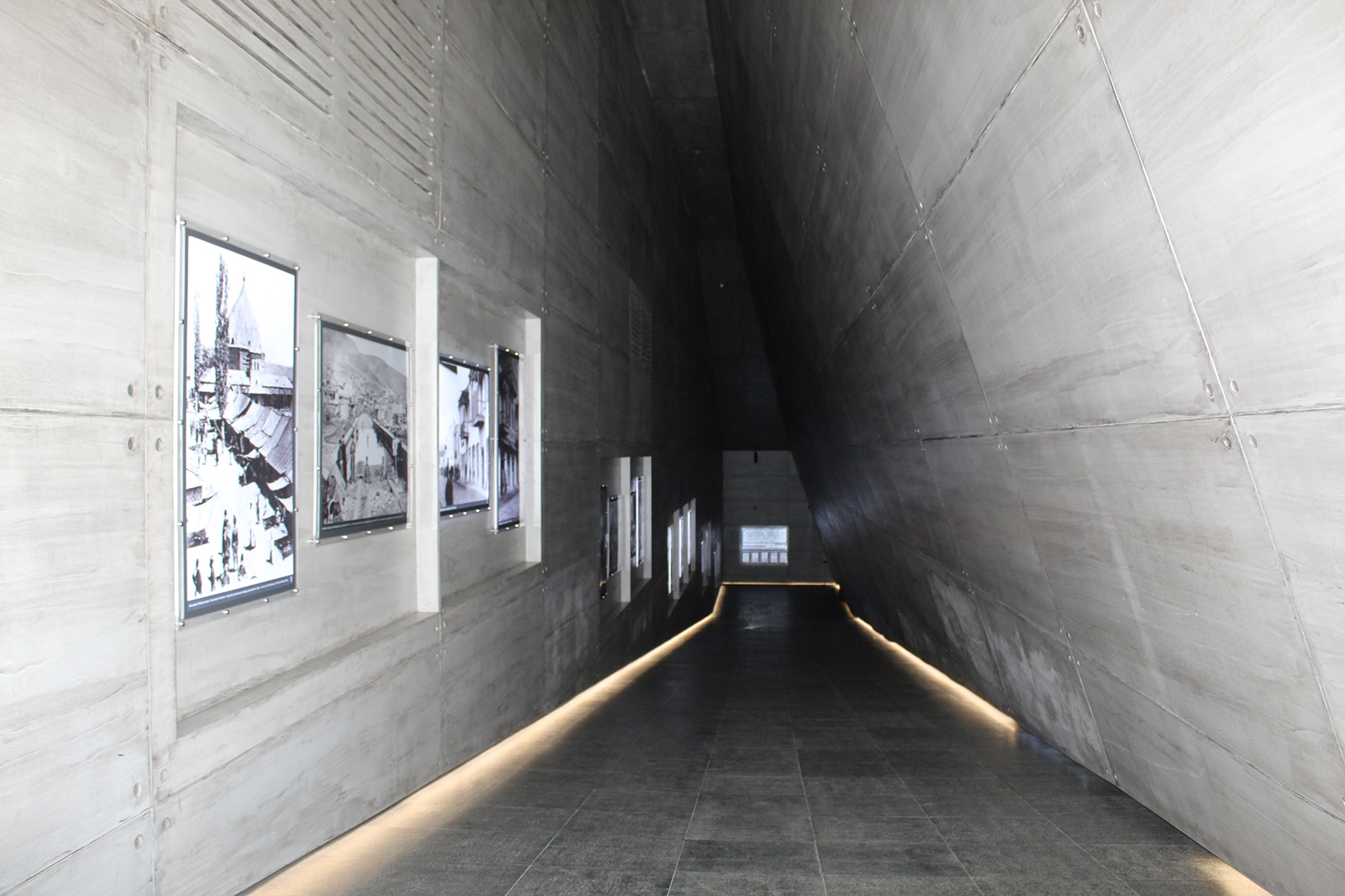
Entrance – Peaceful Quba

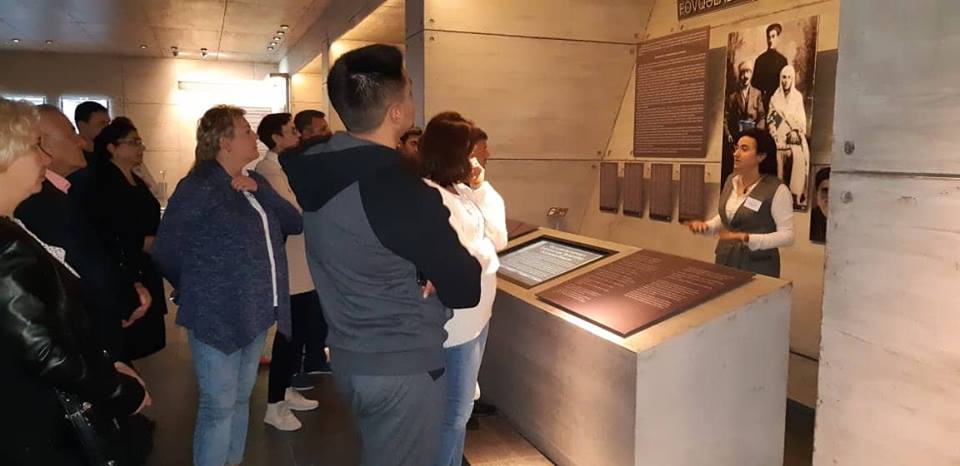
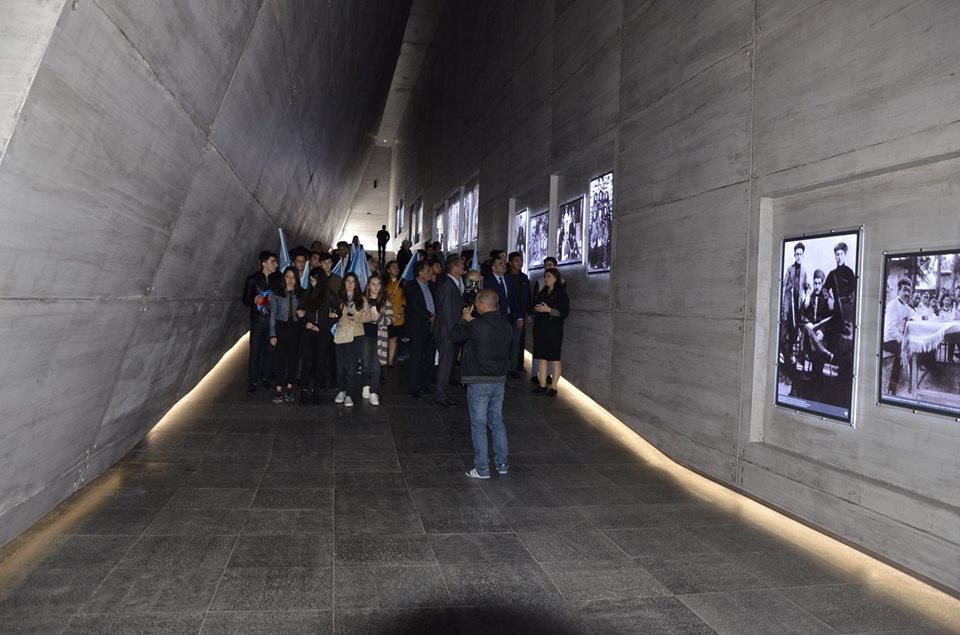
The exhibition located at the entrance of the museum is called “Peaceful Quba.” This section presents images of the residents of Quba district and views of the city from the early 20th century. The photographs depict civil servants, religious figures, schoolchildren, women, and residents of other districts and villages of Quba district at work, in daily life, with family, and during leisure time. Alongside Azerbaijani Turks, representatives of other nations and ethnic groups also lived compactly in Quba district. Peaceful neighborly relations among the district’s diverse national-ethnic and religious populations were preserved for centuries.

This is evidence that our people have always remained faithful to the tradition of multiculturalism. The entrance section concludes with an epigraph from the newspaper “Azerbaijan” dated December 8, 1918.

Memorial stone
Part III / 02

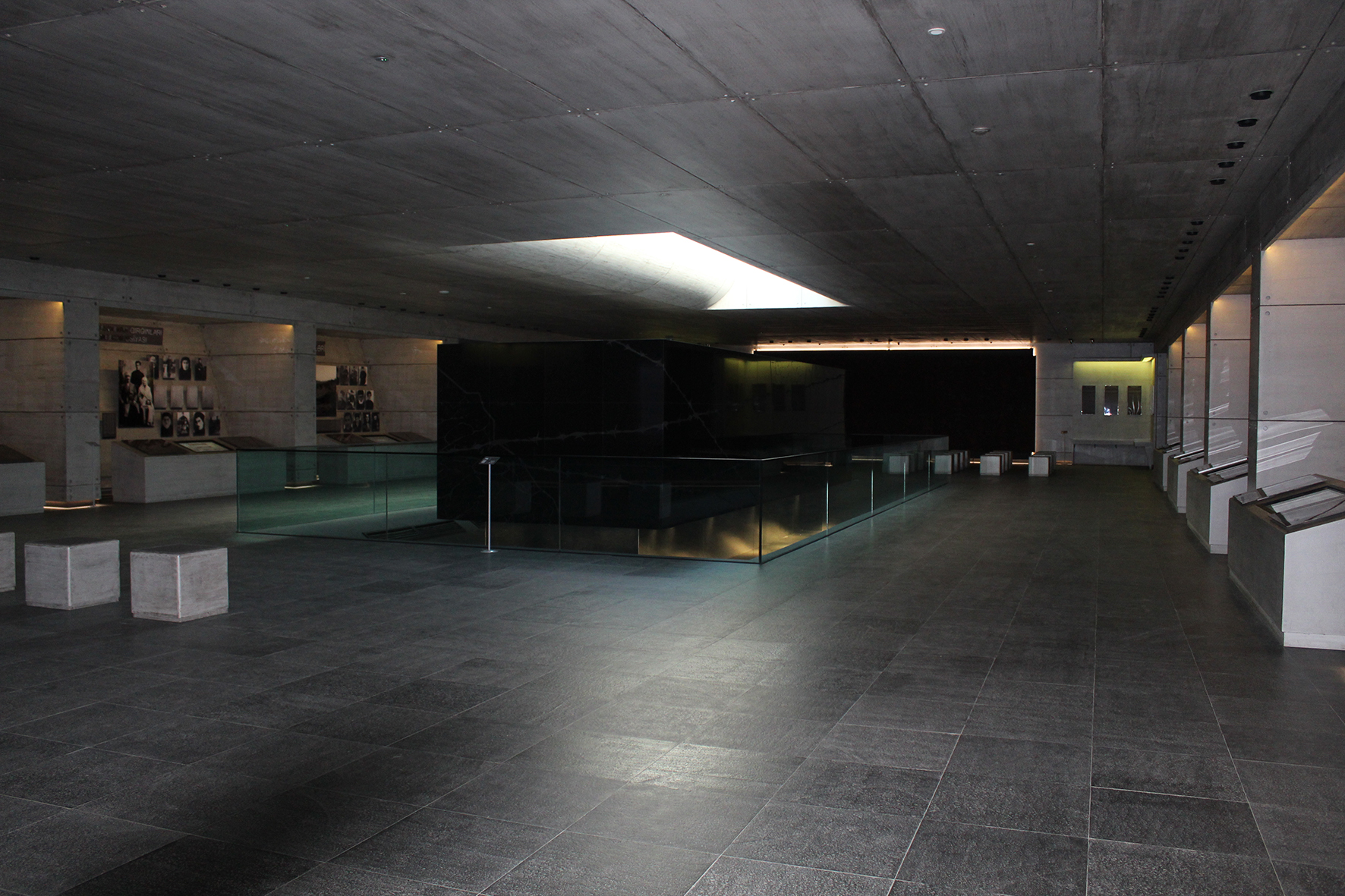
Main hall – Memorial stone

The monument erected in the center of the hall from black marble is a symbol of deep respect for the victims of the tragedy and was created to immortalize the memory of people who were brutally murdered during genocides committed in various districts of Azerbaijan, most of whom were burned, thrown into the sea or wells, and left unburied.

In addition, in the museum’s main hall, based on documents collected by the Extraordinary Investigation Commission, exhibitions are displayed reflecting the genocides that took place in the city of Baku and in various districts of Baku Governorate, as well as in Shamakhi, Quba, Javad, Goychay, and other territories.

Main hall

Exhibitions

Extraordinary Investigation Commission
Main hall exhibition

Extraordinary Investigation Commission

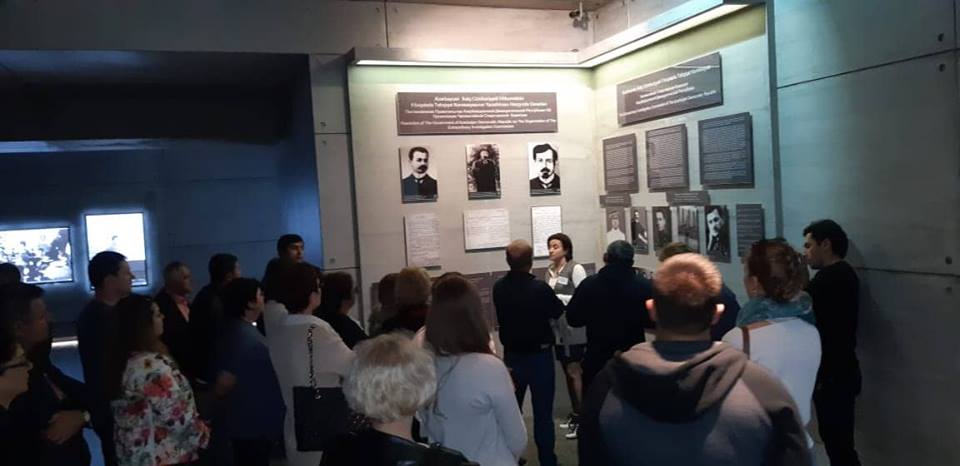
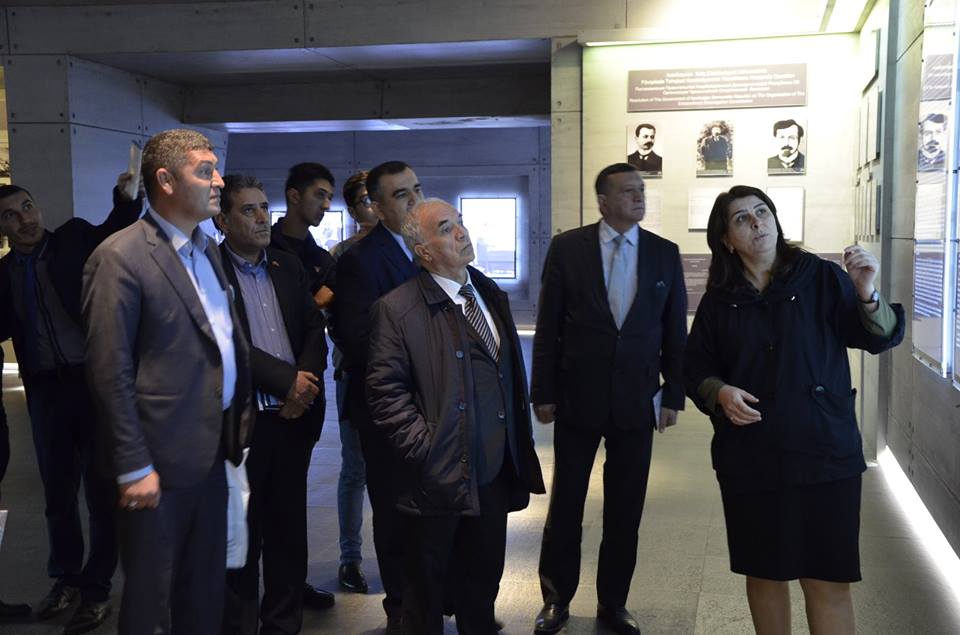
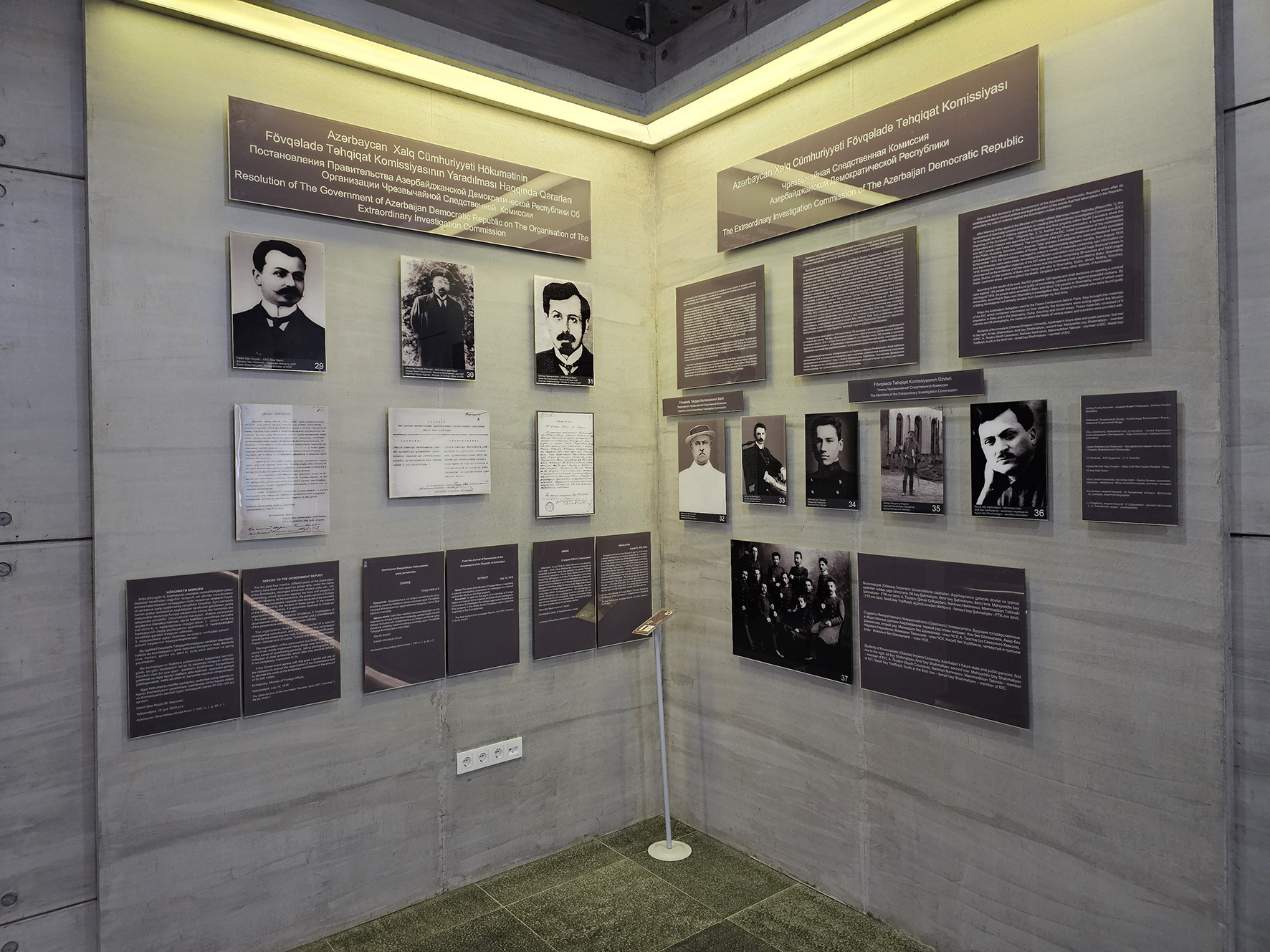
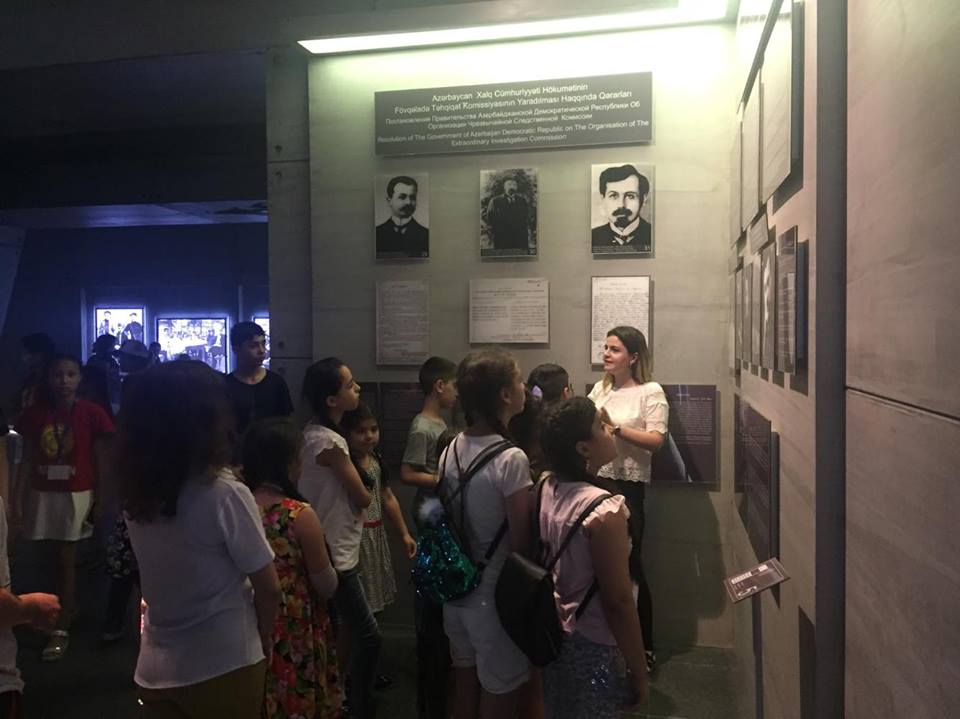
At the entrance of the hall, photographs of the members of the Extraordinary Investigation Commission (EIC) (F. Khoyski, M. Hajinski, Kh. Khasmammadov, A. Khasmammadov, I. Shahmaliyev, M. Tekinski, N. Mikhaylov, A. Khanbudaqov) and documents are displayed. The government of the Azerbaijan Democratic Republic (ADR) considered it necessary to respond to the bloody events taking place in the country and, on July 15, 1918, adopted a decision to establish the Extraordinary Investigation Commission in order to investigate acts of violence committed against the Muslim population and their property by Armenian bandit groups acting under the Bolshevik name since the outbreak of the First World War. The chairman of the EIC was the well-known lawyer Alakbar bey Khasmammadov. Although the commission was established with 7 members, later other representatives of the investigative, prosecutorial, and judicial bodies of the cities of Baku and Ganja were involved in the work. The EIC had a multinational composition, consisting mainly of Poles, Russians, Germans, Lithuanian Tatars, and Azerbaijani lawyers educated in Russia. During its period of activity, from July 15, 1918 to November 1, 1919, the EIC collected 36 volumes of investigative materials. Brutal crimes committed by Armenians in Baku, Shamakhi, Quba, Goychay, Javad, Nukha, Lankaran, Ganja, Karabakh, and Zangezur were investigated. As a result of the EIC’s work, 128 reports and draft decisions were prepared, and on their basis criminal cases were brought against 194 individuals found guilty of various crimes.

Map
Main hall exhibition

Map

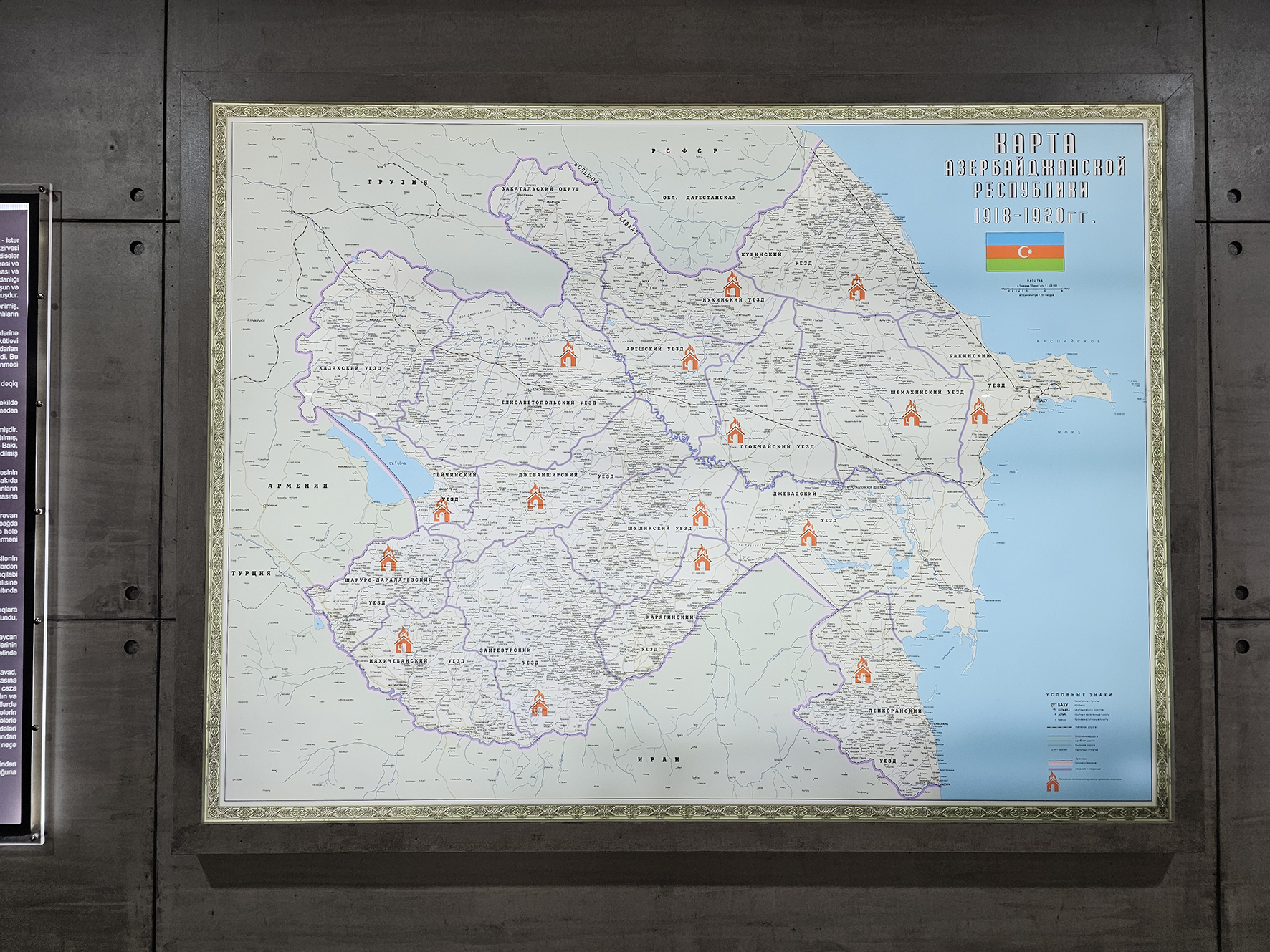
The next exhibition displays a map of Azerbaijan covering the years 1918–1920, with the regions where genocides were committed in 1918 marked with red symbols. In addition, boards providing brief information about the history of Azerbaijan are presented to visitors in Azerbaijani, Russian, Turkish, and English.

Decree
Main hall exhibition

Decree

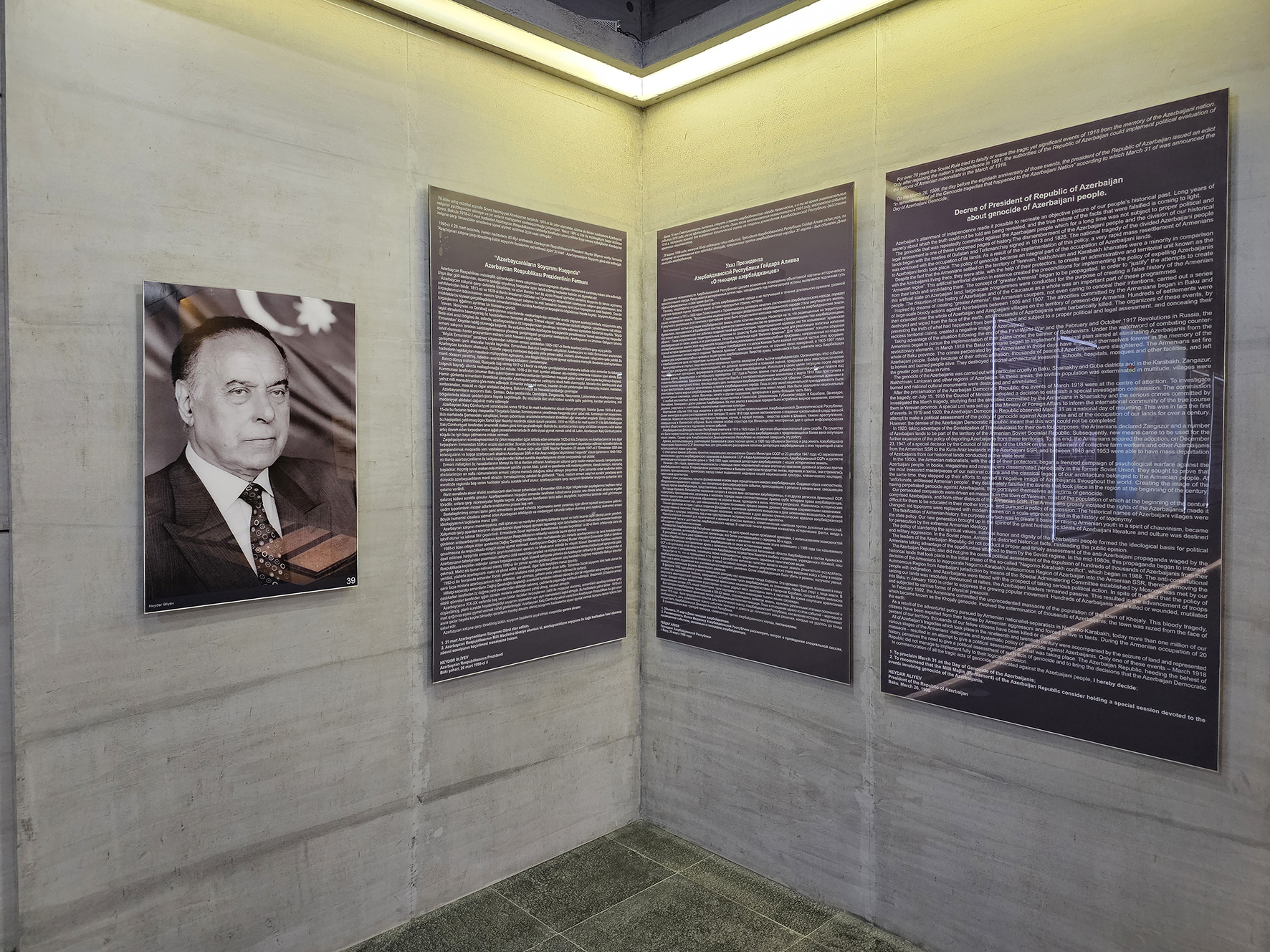
The following exhibition reflects the fact that the Republic of Azerbaijan, as the successor of the ADR, accepted it as a decree of history to give a political assessment to the genocide events as a logical continuation of the unfinished task of the past. It includes a photograph of the National Leader Heydar Aliyev, the founder and architect of the modern Azerbaijani state, and the decree he issued on March 26, 1998 “On the Genocide of Azerbaijanis on March 31” in three languages (Azerbaijani, Russian, English).

Quba district
Main hall exhibition

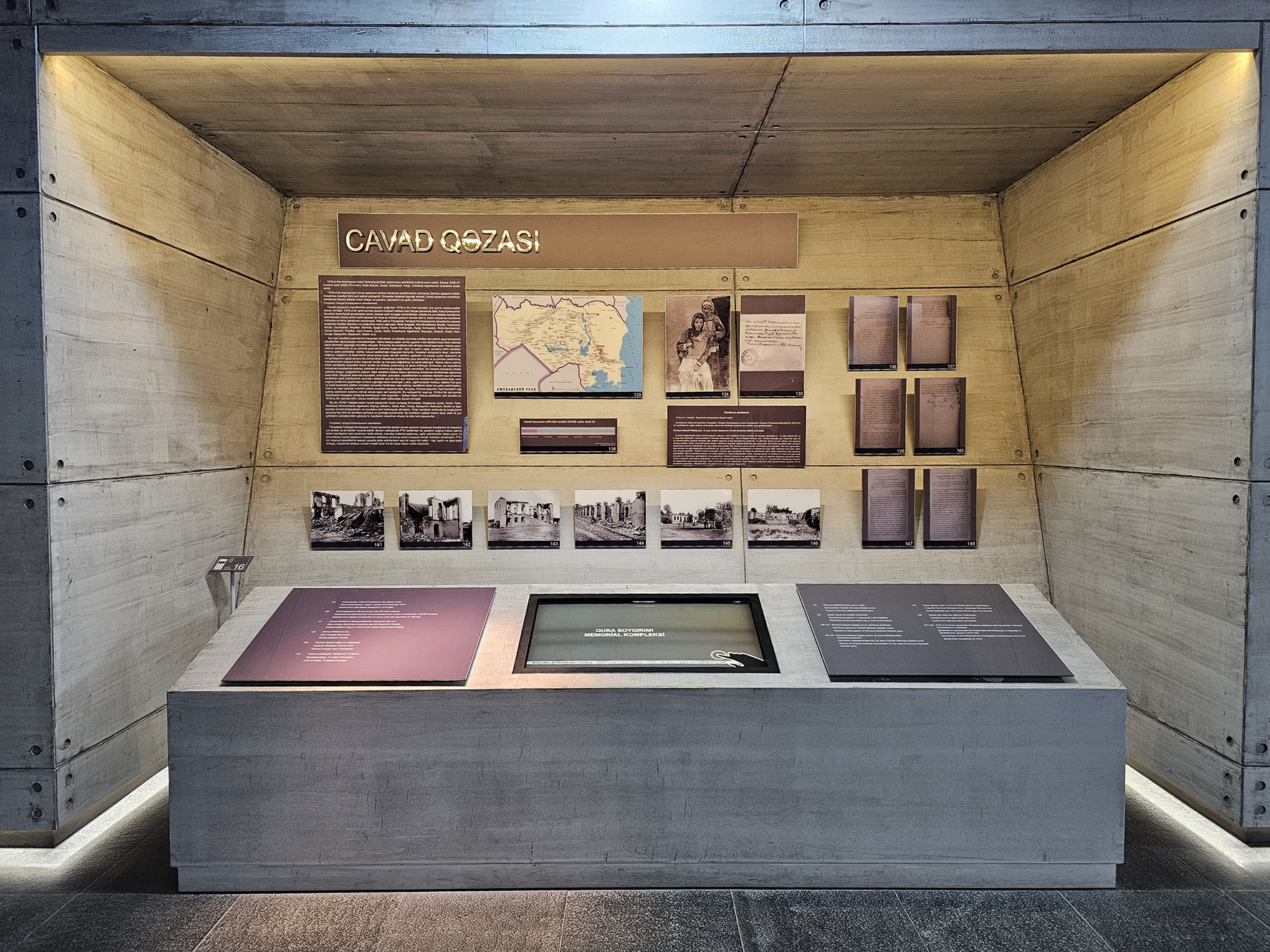
Quba district

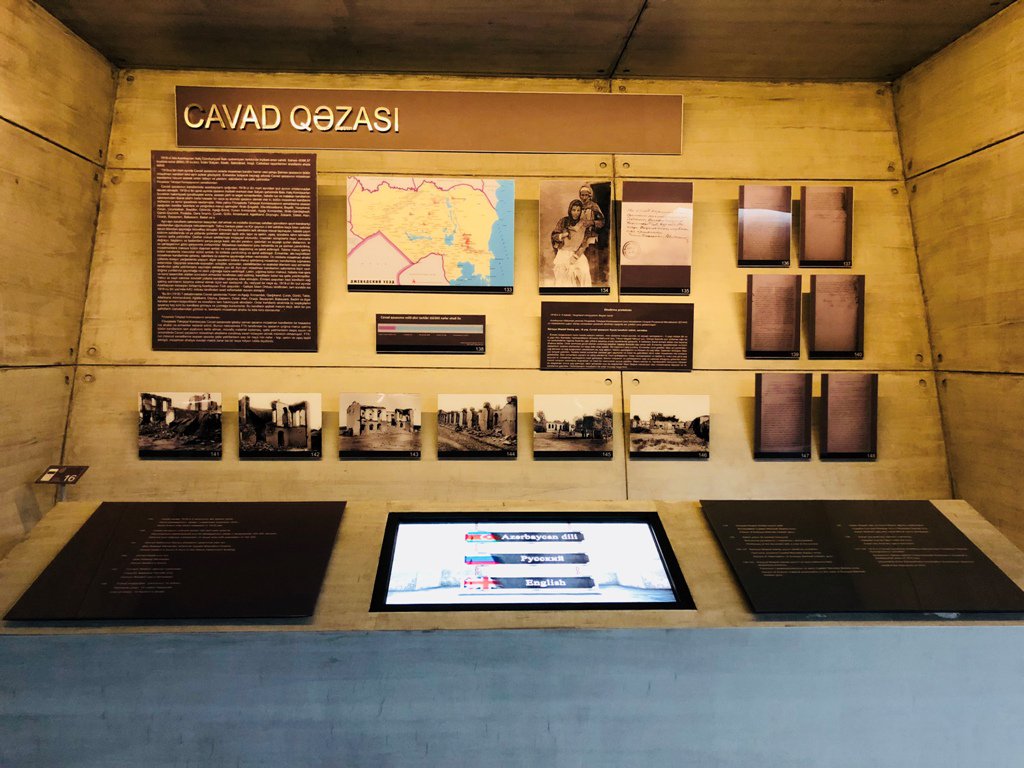
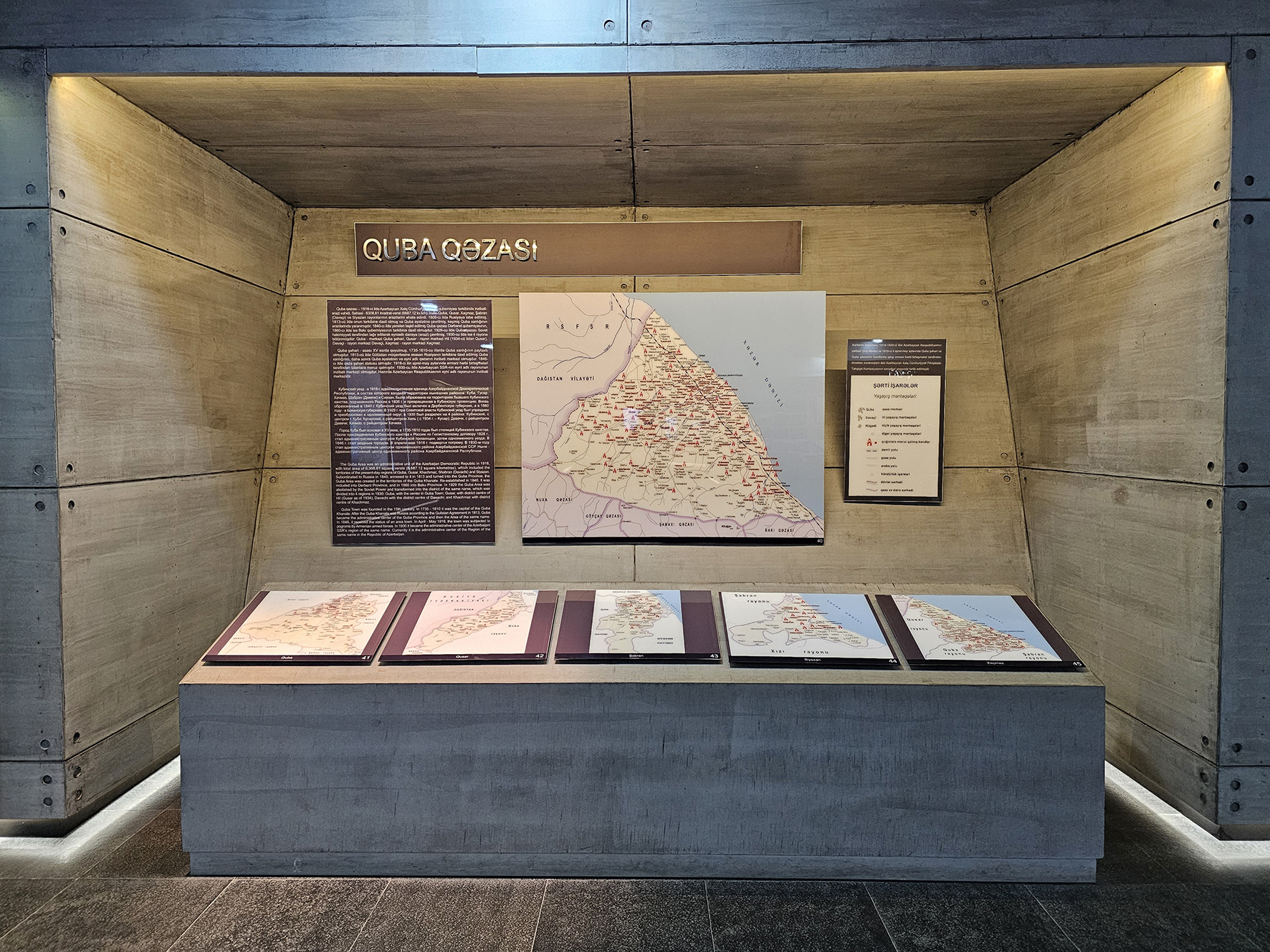
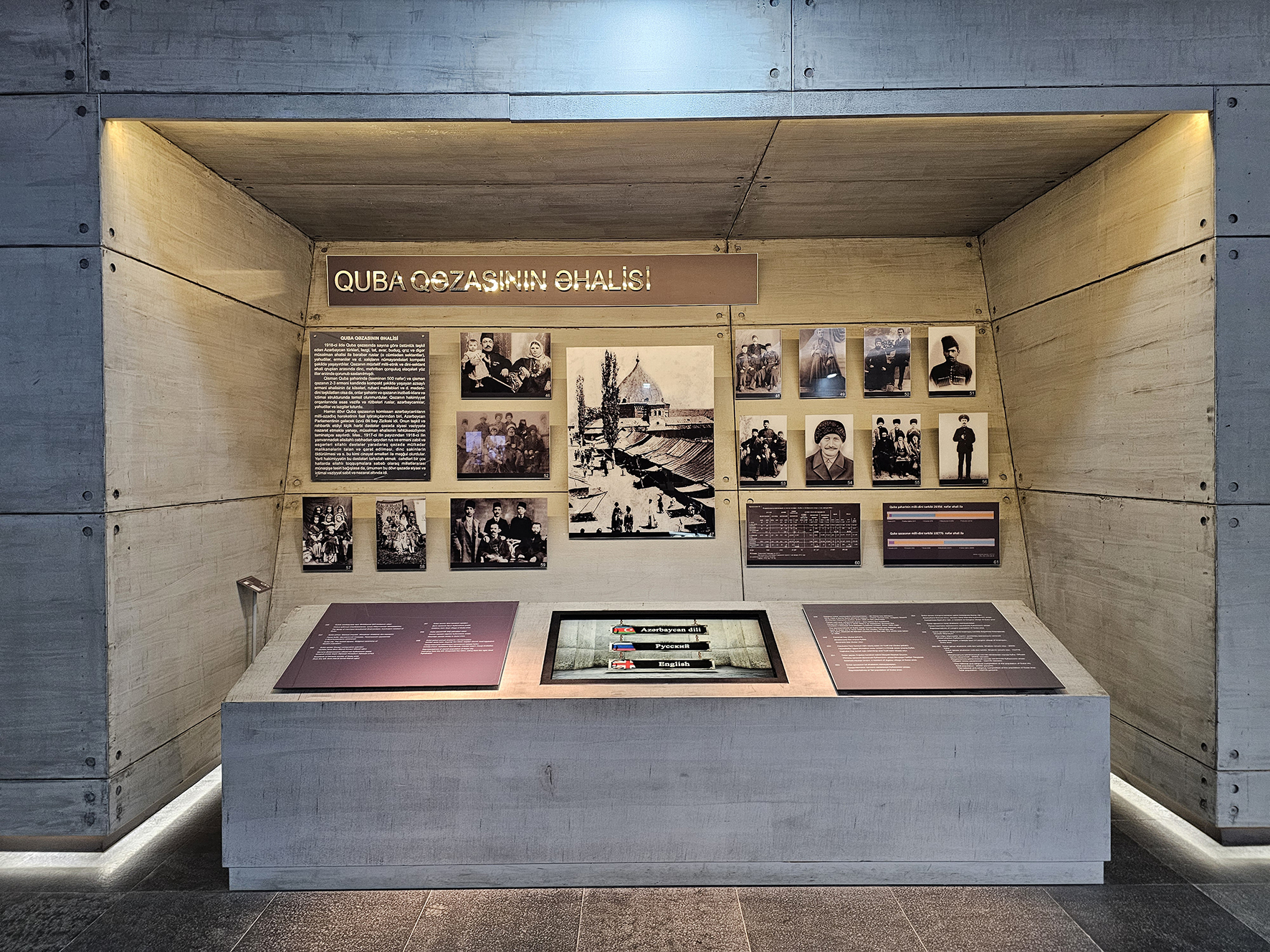
An entire wall of the museum gallery is dedicated to exhibitions about Quba district, consisting of 4 sections. The first section reflects the condition of Quba as an administrative-territorial unit in 1918. Quba district (Quba, Qusar, Shabran, Khachmaz, Siyazan) existed until 1929 during the periods of Tsarist Russia, the ADR, and the Azerbaijan SSR. The genocides committed in Quba district in 1918 are marked on the map with special red signs. According to initial information, it was noted that 122 villages in the district were subjected to looting and destruction, but as a result of more precise investigations, it was proven that the number of these villages was 167. A total of 38 settlements in Quba city and surrounding villages, 27 in Qusar, 65 in Khachmaz, 21 in Shabran, and 16 in Siyazan were destroyed.

Population of Quba district
Main hall exhibition

Population of Quba district

Extensive information is provided about the life of the population of Quba district before 1918. According to 1916 data, of the 198,204 inhabitants of Quba district, 64.15% were Azerbaijanis and Tats, 24.72% were Lezgins, Gryz, Budugh, Jek, Avars, and others, 7.58% were Jews, 2.71% were Russians, and 0.76% were Armenians. This section features photographs of various nationalities and ethnic groups.

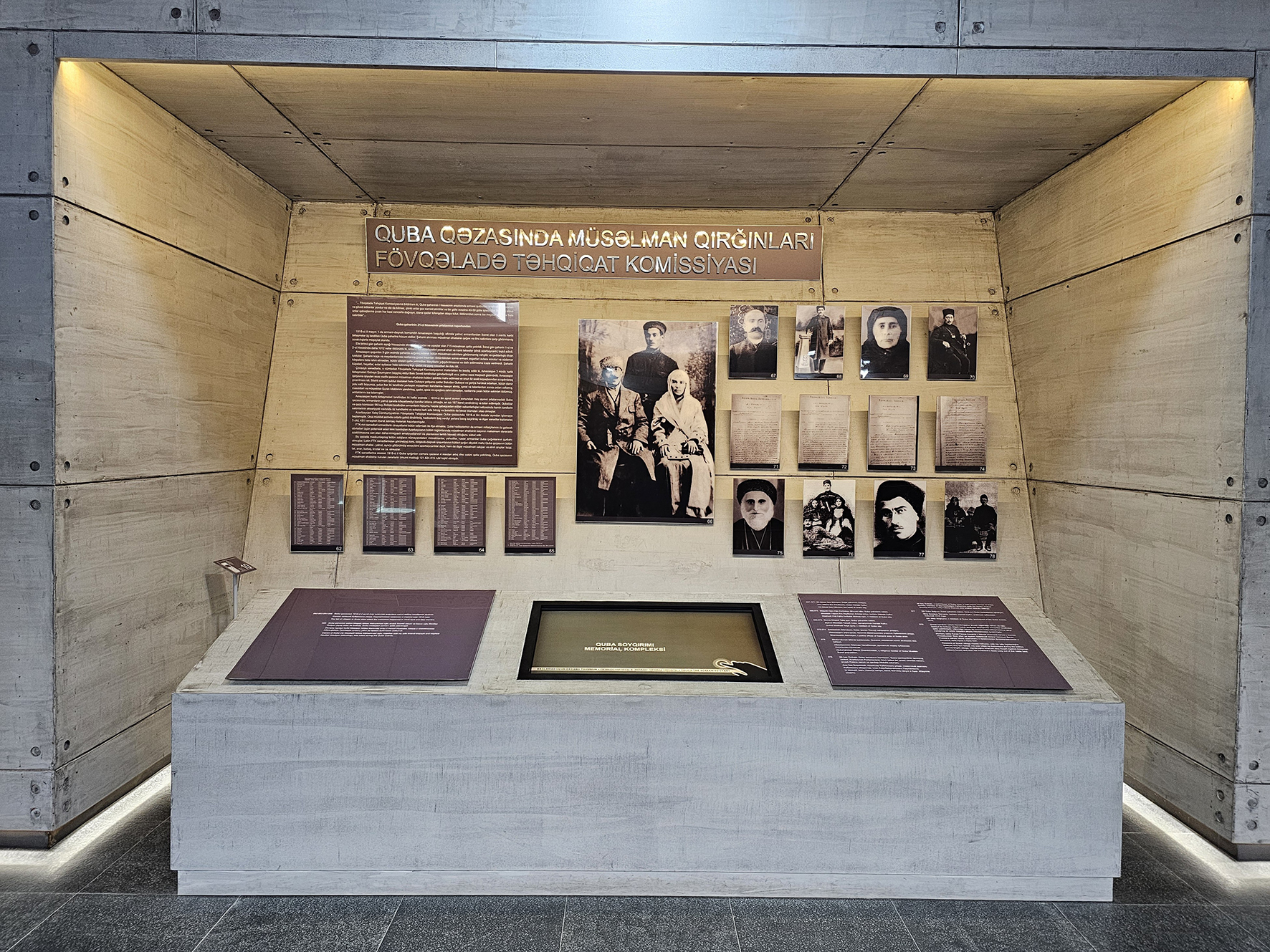
EIC
Main hall exhibition

Witness testimonies

A brief description of the destruction, violence, and genocide committed in Quba district, as well as documents, photographs of living witnesses, and interrogation records of these events collected by the Extraordinary Investigation Commission, are displayed.

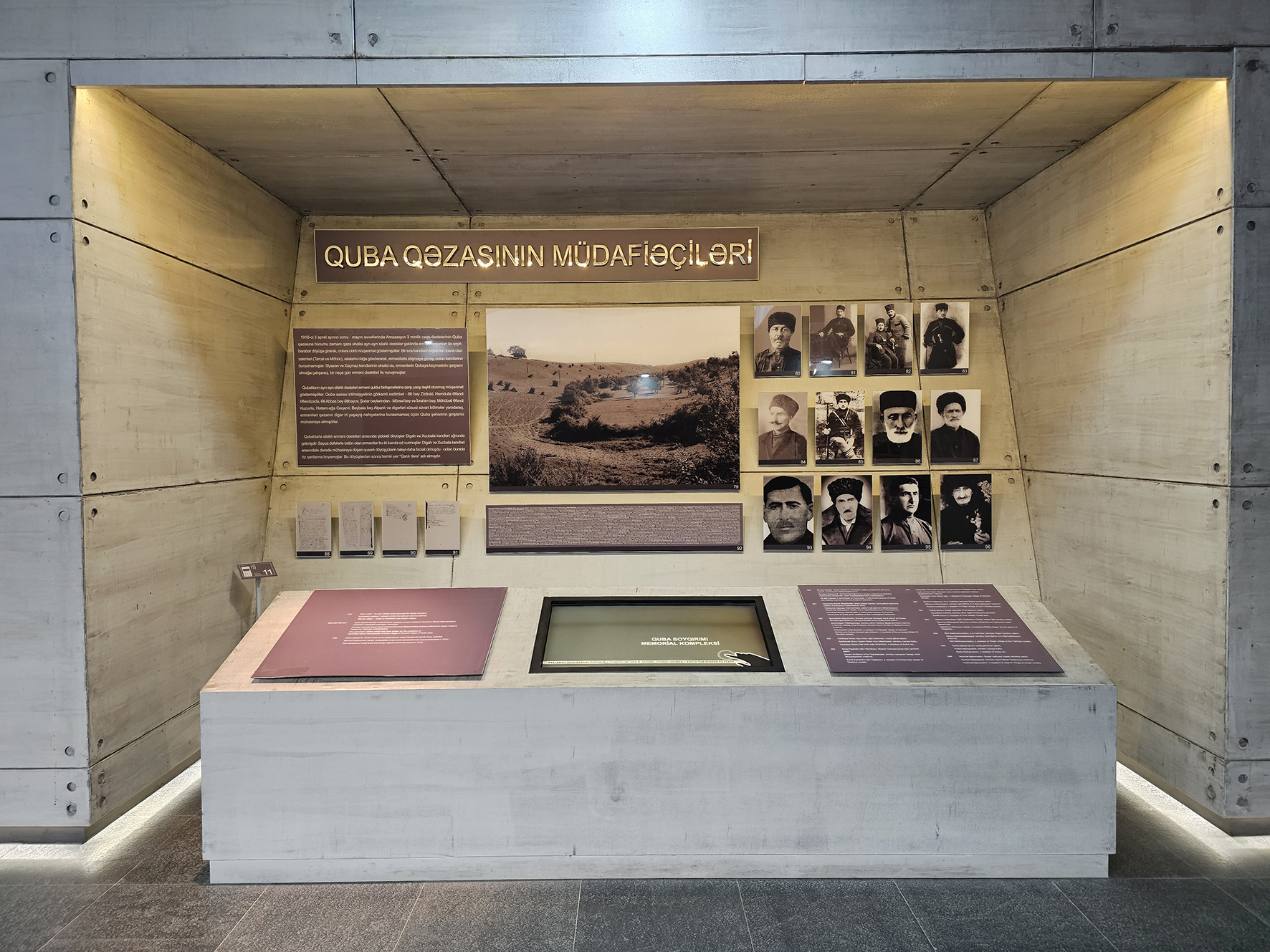
Defenders
Main hall exhibition

Defenders

The fourth section provides information about the defenders of Quba district. On the orders of Baku Soviet leader S. Shaumyan, Hamazasp’s 3,000-member Armenian bandit force committed brutal killings and robberies in Quba district over a two-week period, from late April to mid-May 1918. Hamazasp, who harbored a particular hatred toward Turks, aimed primarily to carry out punitive measures and deliberately reduce the Muslim population. His detachments cruelly murdered people regardless of whether they were children, women, or elderly, mutilated the bodies, and did not even allow the dead to be buried.

The exhibition also includes a document reflecting that Azerbaijanis, even under the most difficult and tragic circumstances, remained faithful to their humanistic values and demonstrated tolerance. This document, signed and sealed by 90 Armenian residents of Kilvar village in Devechi (present-day Shabran district), confirms that Hamdulla Efendi Efendizade protected them and saved their lives from danger, and is presented as an example of humanity.

Photographs of the defenders of Quba district—A. Zizikski, H. Efendizade, Sh. Efendizade, M. Ibrahimov, and others—are also presented here. The struggle of the defense units against Dashnak Armenians is described, and a view of the “Bloody Valley” between the villages of Digah and Xucbala, where fierce battles took place, is shown.

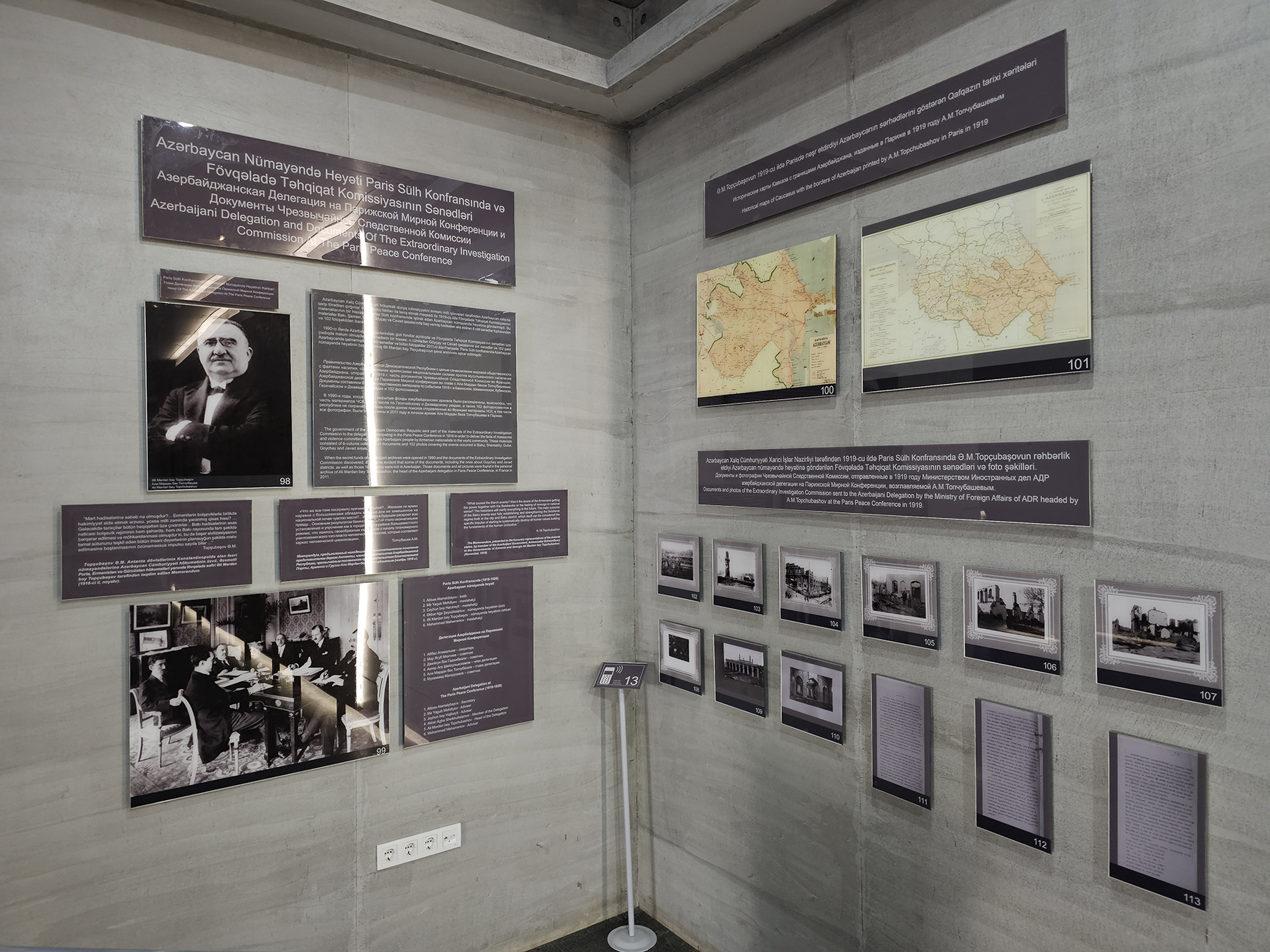
Paris Peace Conference
Main hall exhibition

Paris Peace Conference

The next exhibition presents photographs of the delegation that participated in the 1919 Paris Peace Conference (A. Topchubashov—chairman, A. Atamalibeyov, Y. Mehdiyev, J. Hajibeyli, A. Sheikhulislamov, M. Maharramov), as well as historical maps of the Caucasus showing the borders of the ADR (in French and Ottoman Turkish). The delegation’s main objective was not only to present Azerbaijan as an independent state, but also to inform the international community about the crimes committed against the Azerbaijani people by Armenian-Dashnak forces in 1918. For this purpose, part of the EIC materials was sent to Paris through the Ministry of Foreign Affairs of Azerbaijan along with the delegation. These materials consisted of a 6-volume collection of documents and 102 photographs reflecting the genocides committed in Baku, Shamakhi, Quba, Goychay, and Javad in 1918. The Azerbaijani delegation fulfilled its mission, and copies of the documents were presented to the heads of major powers and various international organizations. All the materials sent from Baku to Paris were discovered in 2011 in Topchubashov’s personal archive in France by Doctor of Historical Sciences, Professor Solmaz Rustamova (Tohidi), and were returned to the homeland 94 years later. Copies of those documents and photographs are presented in the museum exhibition exactly as in the originals. A documentary film reflecting the genocide events is continuously shown in the hall.

Iron panel
Main hall exhibition

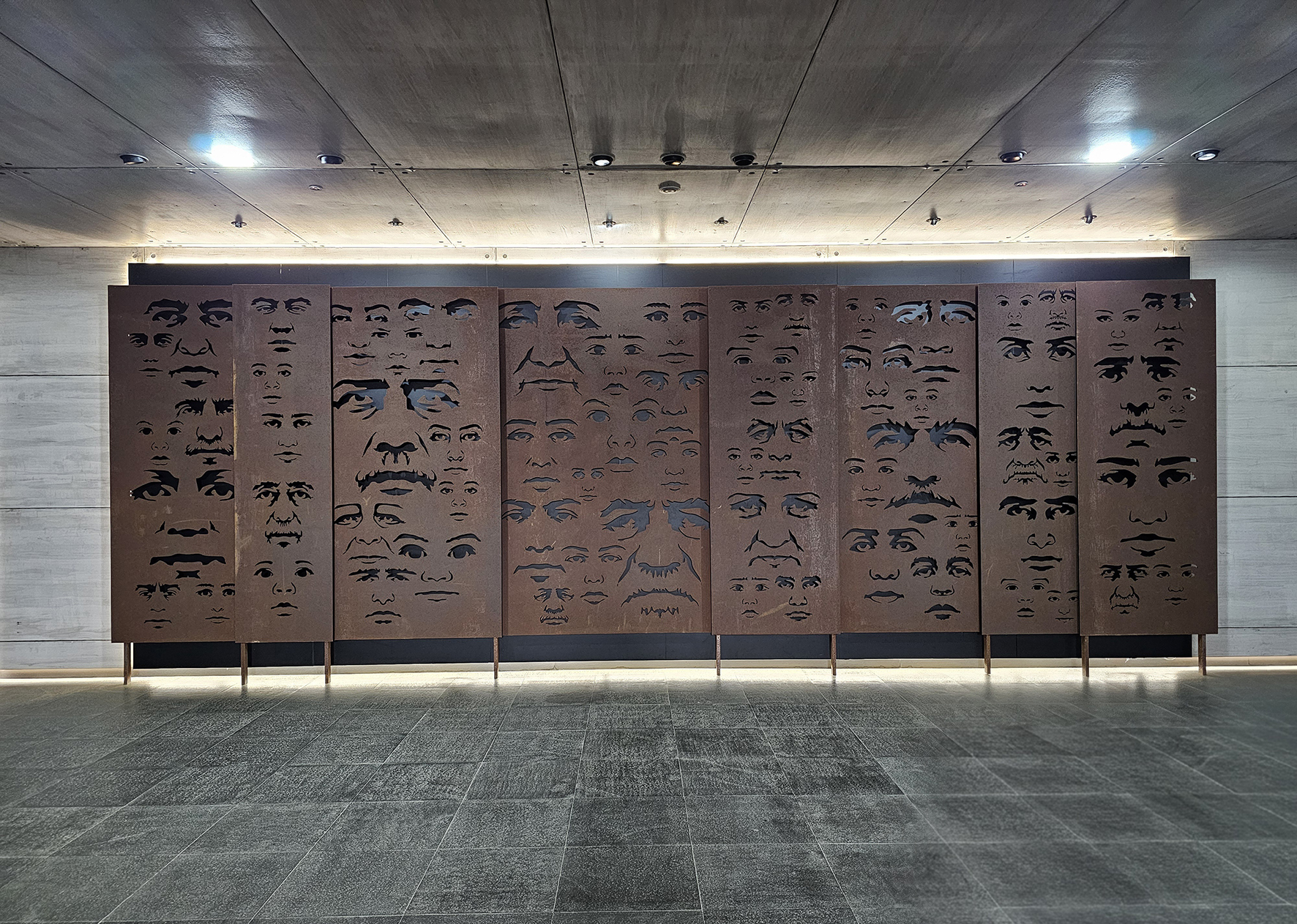
Faces

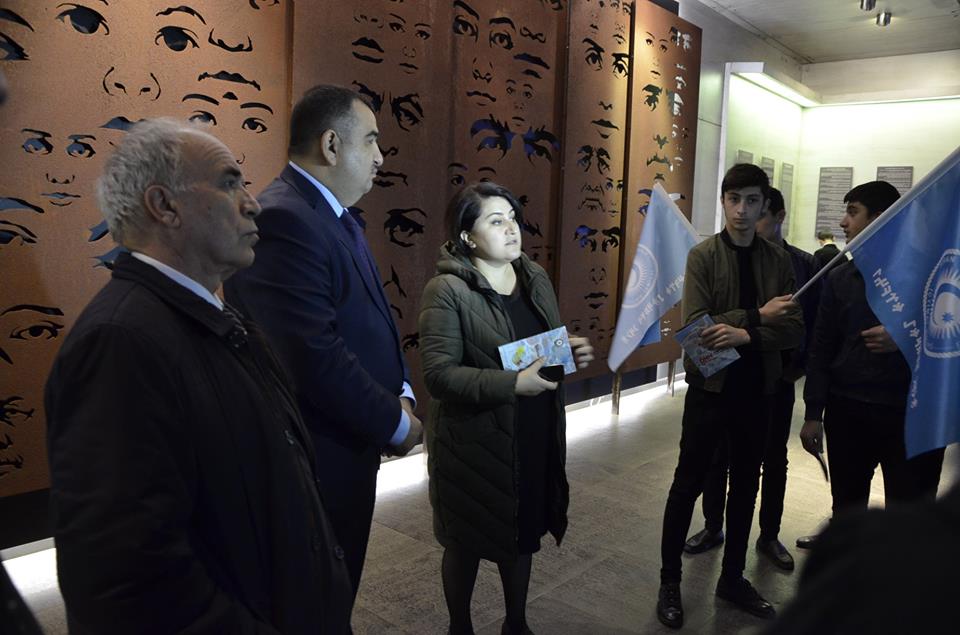
The next exhibition represents the emotions and feelings of modern Azerbaijani people in response to this tragedy. These faces, displayed on a rusty iron panel, reflect what this tragedy evokes within both the young and older generations of the Azerbaijani nation. While surprise, astonishment, and fear can be seen in the faces of the young, the faces of the older generation reflect anger, grief, and pain to the same degree.

Information
Main hall exhibition

Perpetrators of the genocide

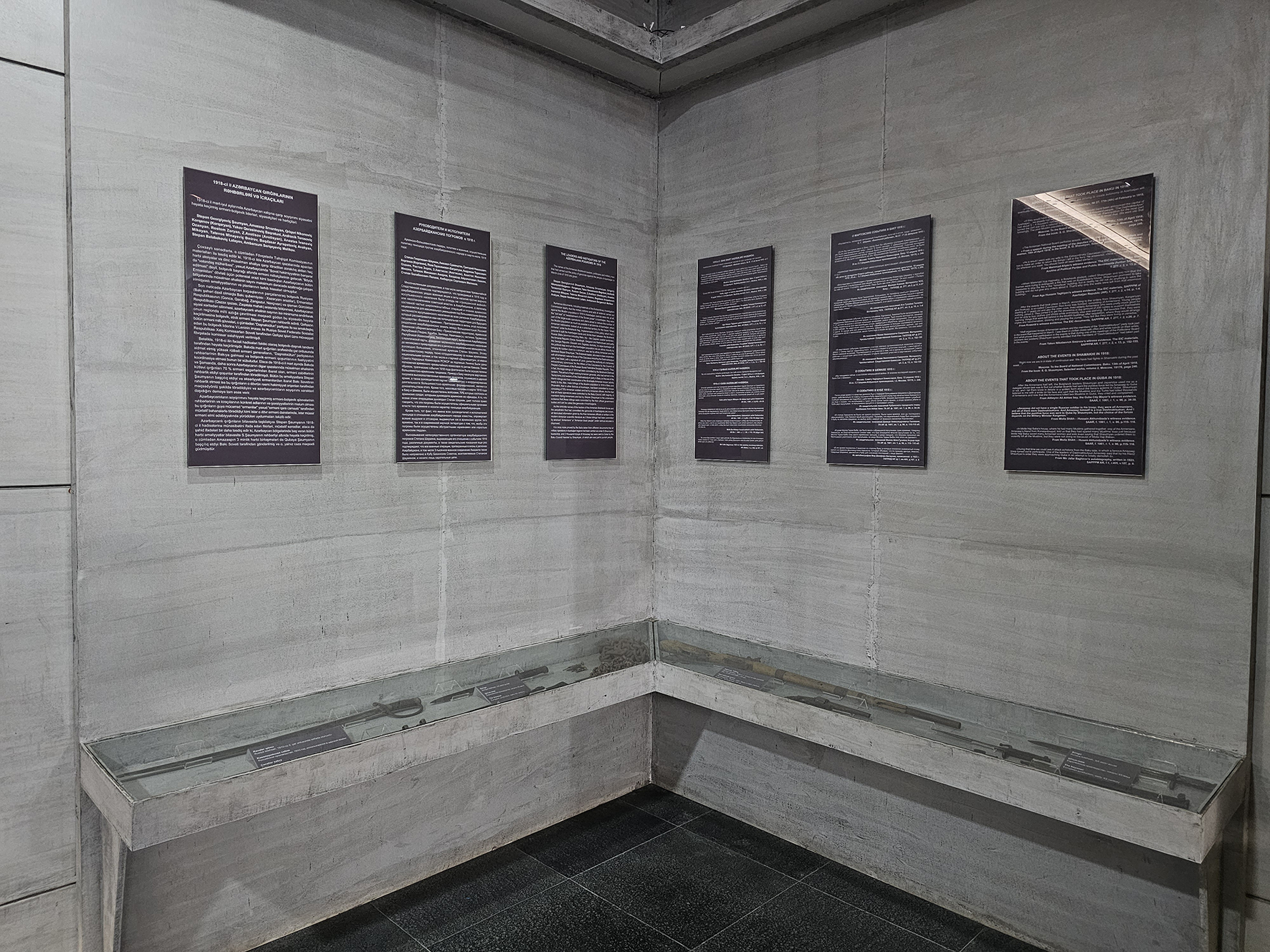
The following exhibition provides information about the names of the leaders and perpetrators of the genocides committed in 1918 (Shaumyan, Hamazasp, Korganov, Andranik, Lalayan, Mikoyan, etc.) and about the essence of the genocide policy they carried out.

Weapons
Main hall exhibition

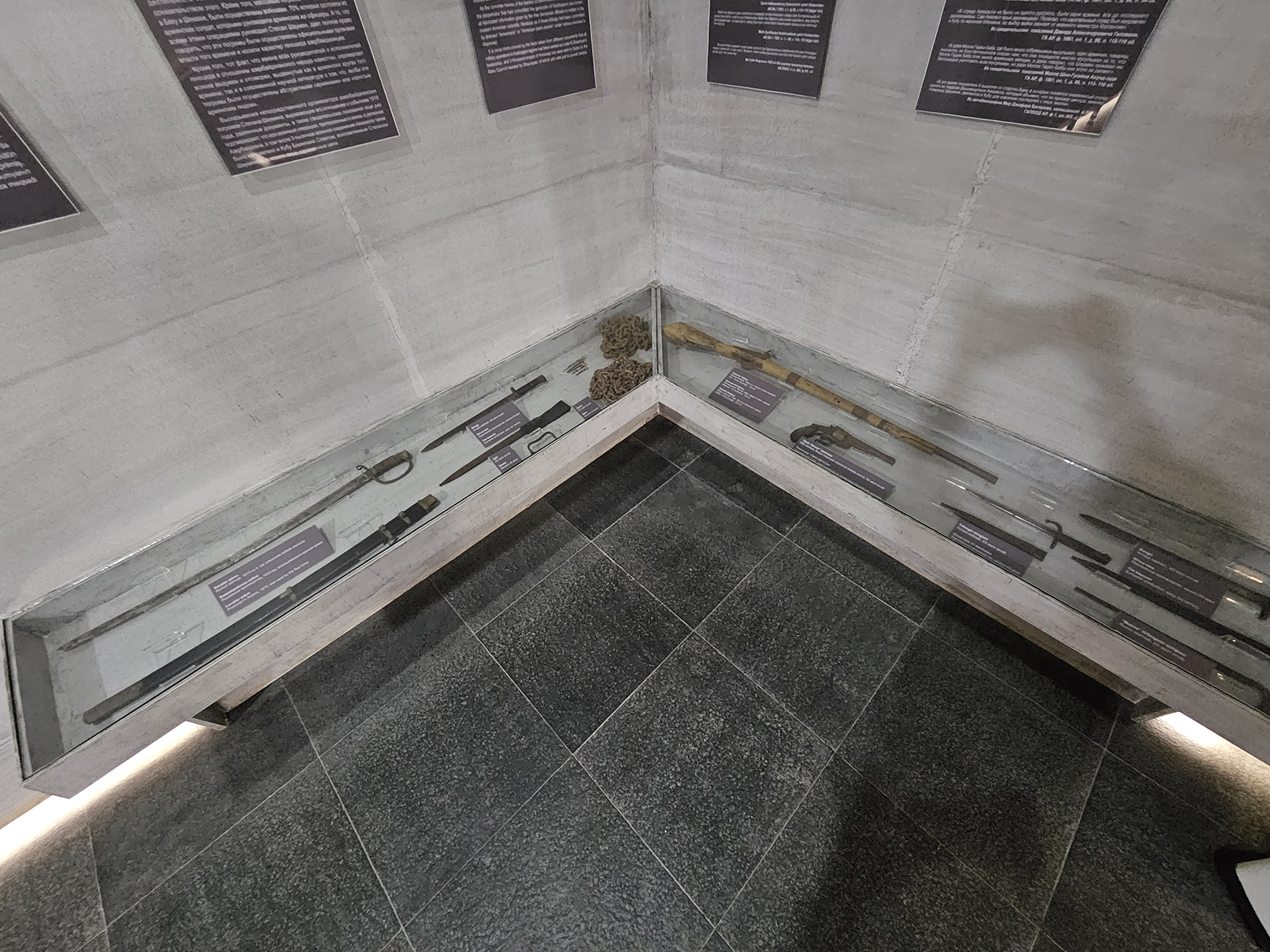
Weapons

Armenians who viewed Azerbaijan as a potential territory for the state of “Greater Armenia” and at the same time sought to reduce the Muslim population in the region as much as possible through genocide used every means to achieve their aims. Baku Soviet leader Shaumyan, who was trying to implement this plan, cooperated closely with all Armenian forces in the Caucasus, including members of the Dashnaksutyun party. Abusing the authority granted to him, he carried out punitive actions with exceptional cruelty in various regions of Azerbaijan. Thus, the tragic events of 1918 were carried out by the Bolshevik-Dashnak tandem. Beginning in March 1918, the mass slaughter of the Muslim population was committed by troops consisting of 70% Armenian soldiers and led by Armenian officers. The fact that the specific identities of the leaders and perpetrators of the Armenian armed units that committed genocide in Azerbaijan are known disproves claims that this tragedy was supposedly carried out by the “Armenian common people.” This section also displays examples of cold and firearms, as well as torture instruments used by Armenian bandits during the genocides of that period.

Javad district
Main hall exhibition

Javad district

The topic of the districts of Baku Governorate continues with the exhibition dedicated to Javad district. Javad district covered the territory of present-day Salyan, Saatli, Imishli, Sabirabad, and Jalilabad districts. The textual part of the Javad district exhibition provides information about the district and the national-religious composition of its population. From March until the middle of June 1918, Armenians carried out genocide against the Muslim population in Javad district, and after Salyan came under Bolshevik control in April of that year, the civilian population of this district was subjected to even greater persecution. This situation continued until our lands were liberated by the Azerbaijani-Turkish troops. During the work of the EIC, part of the Muslim villages was still under Armenian control, so it was not possible to determine the exact extent of the damage inflicted on the villages or the exact list of those killed. However, it was not difficult to imagine the scale of the atrocities and vandalism committed by Armenians against the local Muslim population. In this regard, it is enough to review the interrogation and forensic medical examination protocol of 18-year-old Sureyya Mashadi Dadash gizi, a resident of Khojali village in Javad district, displayed in the exhibition. The killings were accompanied by particular cruelty: people were impaled on bayonets, hacked with daggers, beheaded, and burned.

Goychay district
Main hall exhibition

Goychay district

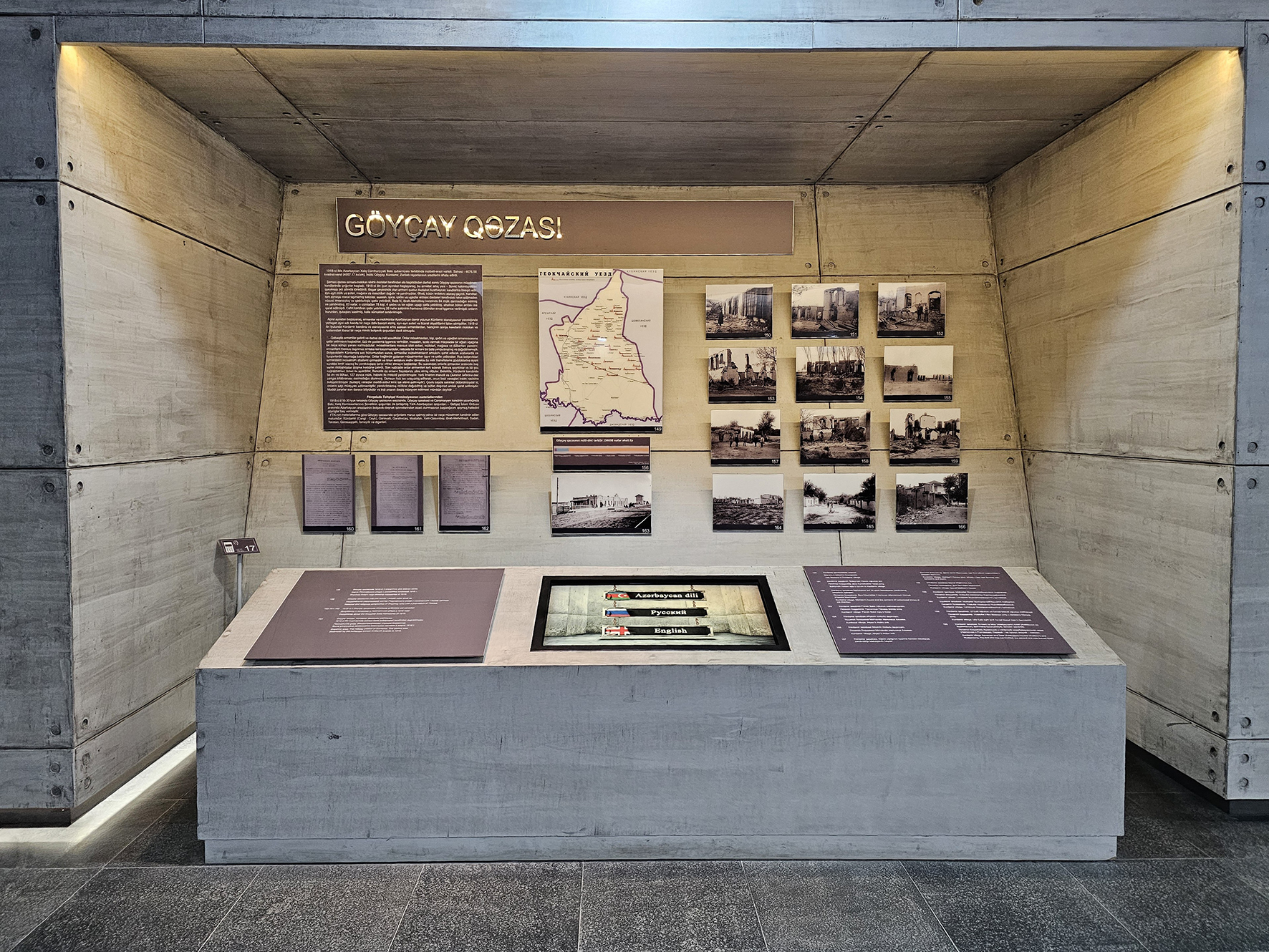
In 1918, as an administrative-territorial unit within the Baku Governorate of the ADR, it covered the territory of present-day Goychay, Kurdamir, and Zardab districts. The exhibition provides information about the national-religious composition of the population of the district’s administrative territory (Muslims, Armenians, Russians, Jews). The presence of several railway stations passing through the Goychay territory made it easier even during World War I for Armenian armed groups moving to and from the front to attack this region. From June 1918, under the pretext of establishing Bolshevik power, the Armenians became even more brutal. Thus, 84 properties were burned in Arab-Mehdibey village, property was looted, and 83 people were killed. Twenty residents of Jahri village were subjected to unbearable torture before being killed. Their noses and ears were cut off, and their skull bones were broken. The same atrocities were committed in Kurdamir village as well. The EIC’s investigation documents from that region, as well as photographs of burned village mosques, private property, homes, and human corpses, are reflected on the display board. Only as a result of the decisive battles fought between June 16 and 30, 1918 in the direction of Goychay settlement and Garamaryam village between the army of the Baku Soviet and the Caucasian Islamic Army did the liberation of our lands from Bolshevik-Dashnak forces begin.

Shamakhi district
Main hall exhibition

Shamakhi district

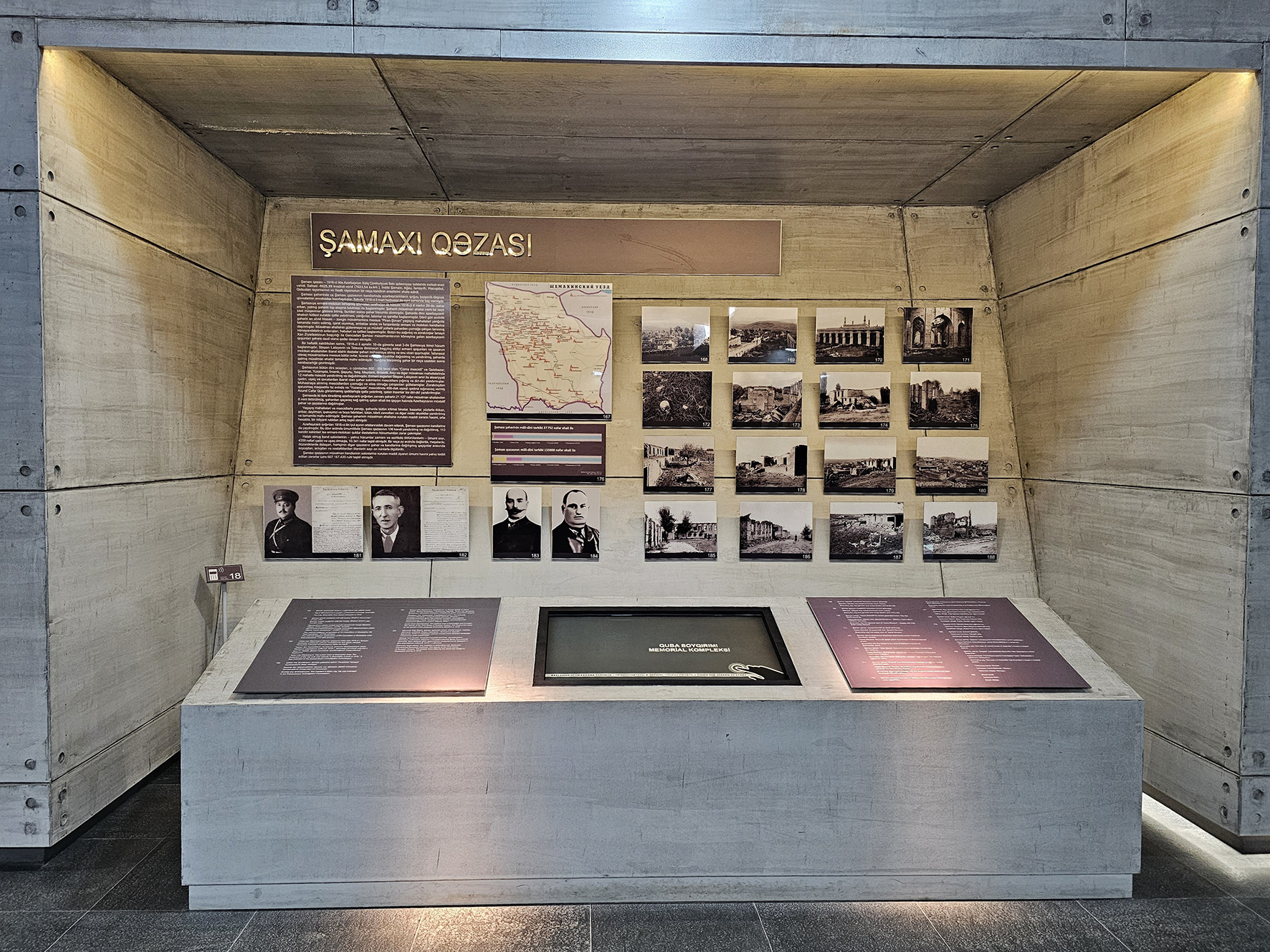
As an administrative-territorial unit, it covered the territories of present-day Shamakhi, Aghsu, Ismayilli, Gobustan, and Hajigabul districts. As in the other districts, the population of Shamakhi district was diverse in its national and religious composition. Despite the fact that Muslims formed the majority of the district population, they were unexpectedly attacked by Armenian-Bolshevik forces and faced unprecedented atrocities. The Shamakhi genocides began at the same time as the events in Baku; in March-April, the city of Shamakhi was plundered twice, while 110 villages of the district were ravaged several times. The genocides committed in the city of Shamakhi by Bolshevik-Dashnak bandits lasted several days, and the wealthy Muslim residential quarter “Piran-Shirvan” was completely destroyed by fire. Not satisfied even after the March massacres, the Armenians again attacked the city on April 10 under the leadership of S. Lalayev and T. Amirov. Shamakhi’s religious centers, including the 8-century-old “Juma Mosque,” were burned and destroyed. During this period, a total of 106 villages of Shamakhi district were devastated by Armenians, and 10,341 people were killed. These facts are presented in the exhibition through photographs.

Baku district
Main hall exhibition

Baku district

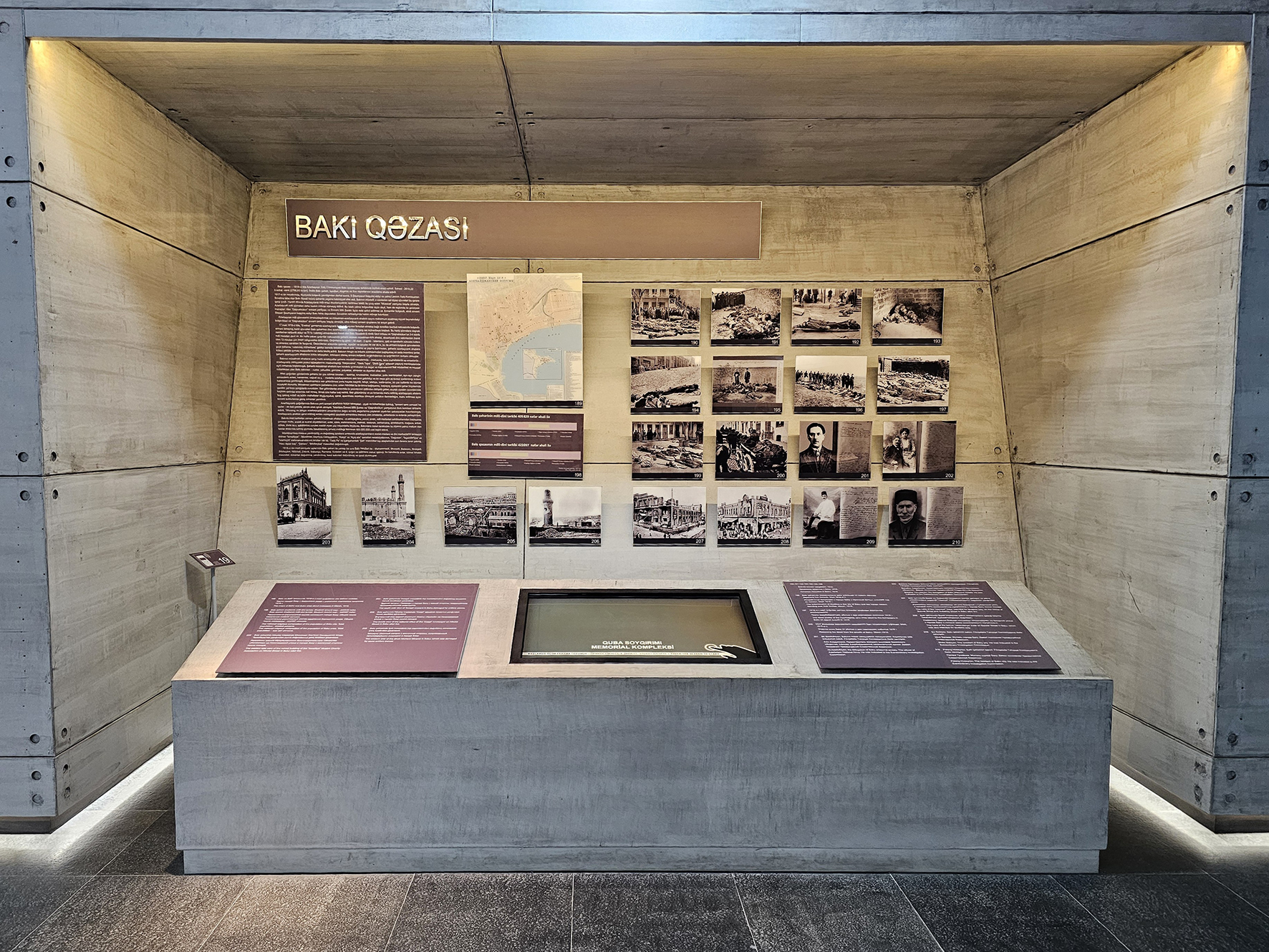
The topic of the districts of Baku Governorate concludes with the exhibition dedicated to Baku district. It provides information about the factors that conditioned the events in Baku city, where the 1918 genocide began, and about the March genocides. With a population of 442,097, Baku district was distinguished by its multinational composition. Although the population of Baku city increased due to incoming settlers in connection with a two-century relocation policy and the development of the oil industry from the second half of the 19th century, Muslims, especially Azerbaijanis, still constituted the majority of the population. The exhibition presents a map of Baku district, a diagram of the population’s national-religious composition, photographs of residents harmed by the genocide, and interrogation records. Seeking to strike a blow against the national liberation movement of the Azerbaijani people, destroy the social base of the Musavat party, and reduce the Muslim population as much as possible, the Bolshevik-Dashnak forces went into action. The provocation connected with the disarmament of the primarily Azerbaijani crew of the “Evelina” ship on March 26, 1918 became the pretext for a ten-thousand-strong Bolshevik-Armenian army to carry out massacres of Muslims. Over 3 days (March 30–April 2), 12,000 members of the city’s peaceful Muslim population were brutally killed. The fact that the victims included women, the elderly, and children refutes claims that a “civil war” was taking place in the city and proves that the massacres were directed en masse against the Muslim population. Under the leadership of the Armenian Dashnaksutyun party, the Armenian National Council, and Bolshevik executioners, all layers of the Azerbaijani population became victims of violence, injustice, and looting. The Baku neighborhoods of “Karpichkhana,” “Mammadli,” and others; the “Tazapir,” “Shah,” “Shamakhi,” “Haji Ajdar bey,” and “Bibiheybat” mosques; the editorial offices of the newspapers “Kaspi” and “Achiq soz”; and the buildings of the “Iskandariyya” and “Islamiyya” hotels were destroyed and burned. The exhibition includes photographs of many of the places mentioned. During March-September 1918, the genocides committed in Baku were also carried out in the villages of Baku (Mammadli, Ahmadli, Balakhani, Zarat, Sabunchu, Khirdalan, etc.). The total amount of damage in Baku district was approximately 400,000,000 rubles.

Exit
Part III / 03

Exit

The exhibition at the museum’s exit presents displays reflecting the attitudes of statesmen, prominent figures, and media outlets toward the genocide events committed in Azerbaijan in 1918 by Armenian bandit groups.

Museum exit

Exhibitions

Mass grave
Exit exhibition

Mass grave

The 1st showcase presents images of the burial site discovered during construction in 2007.

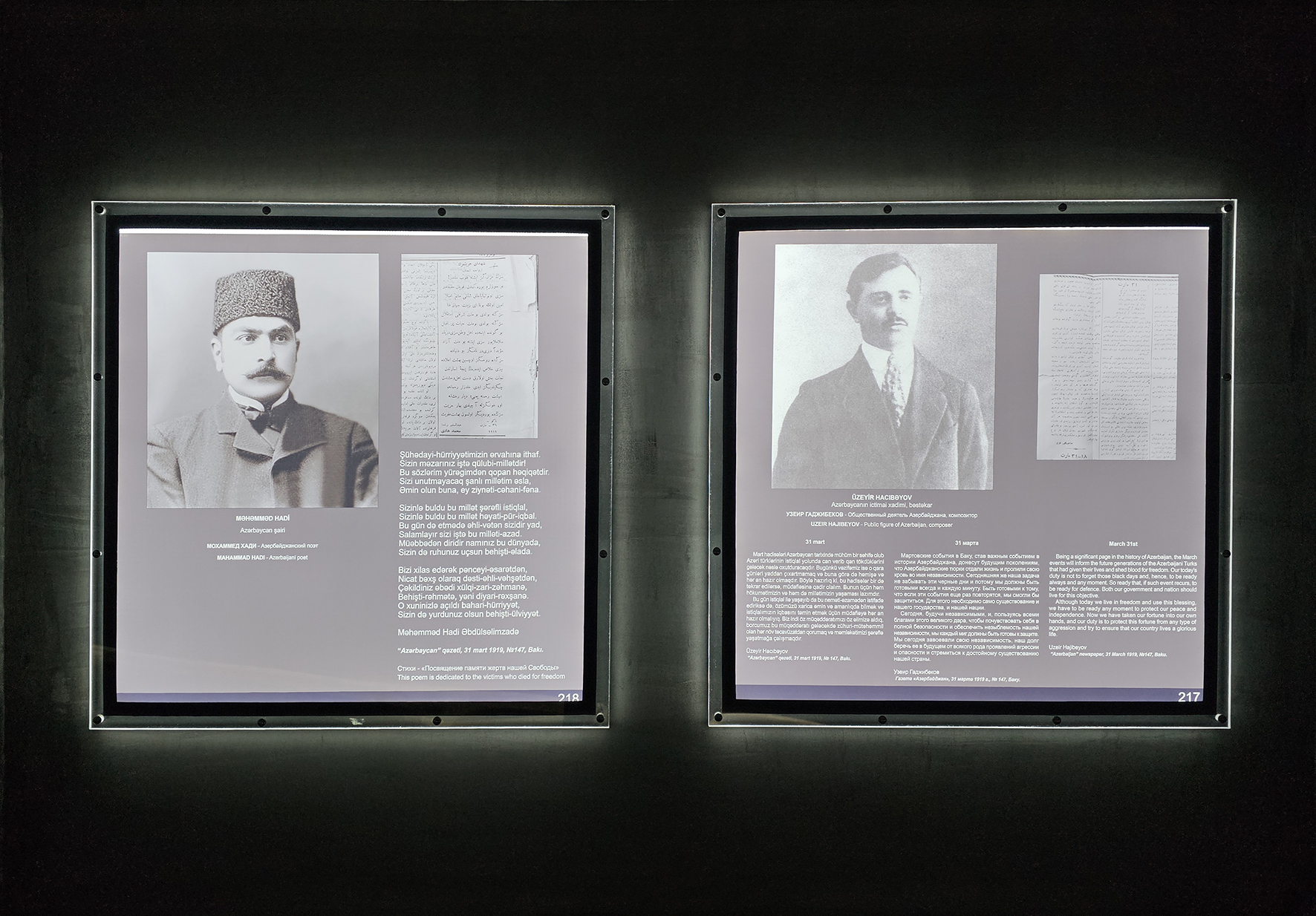
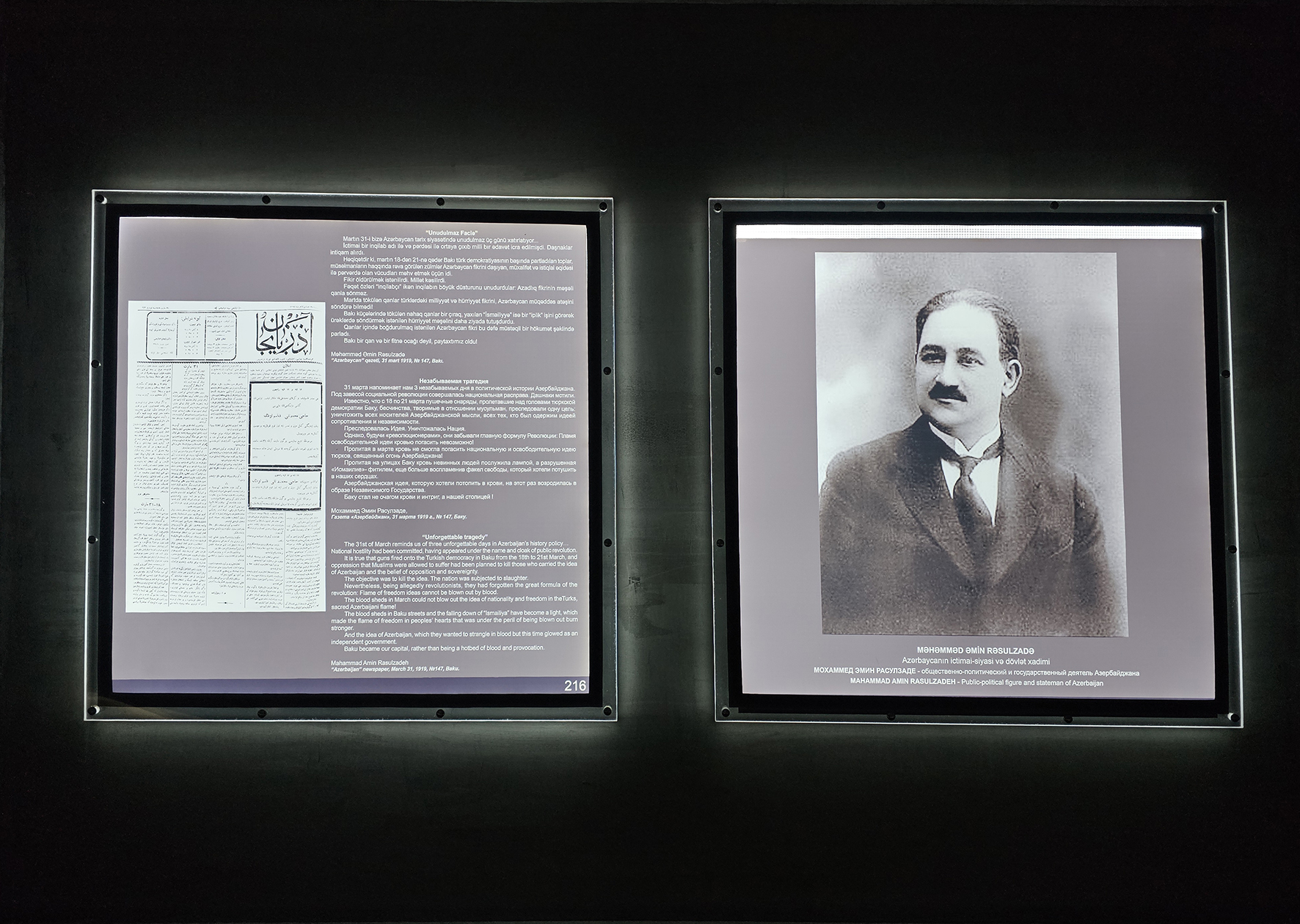
Articles - 1
Articles - 2
 
Exit exhibition

Articles

The 2nd and 3rd wall showcases feature views of information from the press and well-known figures of the period regarding the genocides that took place in Azerbaijan in 1918. An article, poems, photographs, and copied issues expressing views on the events by M.A. Rasulzade, U. Hajibeyli, and M.H. Abdulsalimzade published in issue No. 147 of the newspaper “Azerbaijan” (March 31, 1919) are displayed. Newspapers such as “Istiqlal,” “Qardash qayghisi” (published in Tbilisi), “Nash golos,” and others also covered the genocide events in their pages.

Articles and documents - 1
Articles and documents - 2
 
Exit exhibition

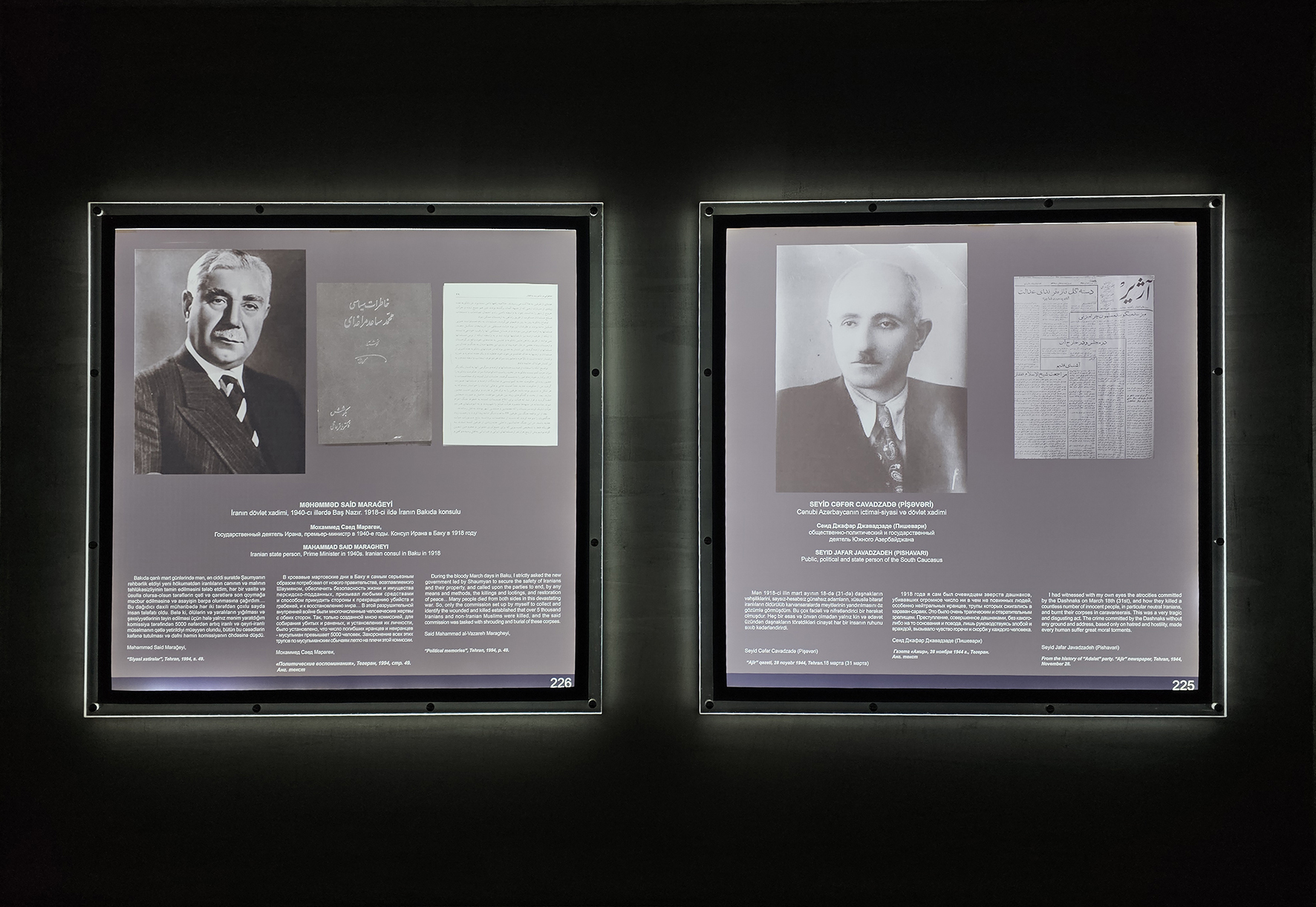
Foreign statesmen

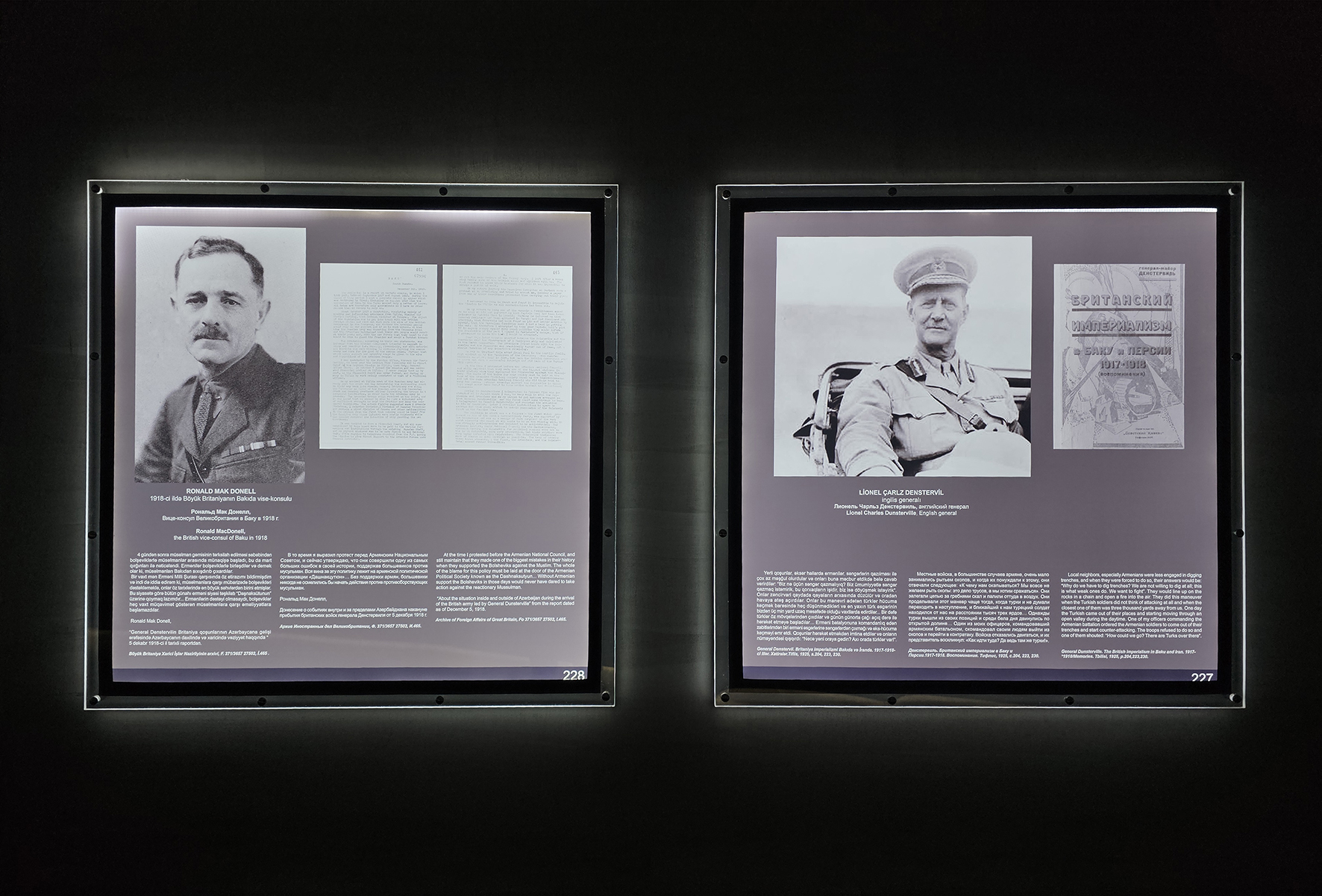
The 4th wall showcase presents part of an article written in the Tehran newspaper “Ajir” by our compatriot from South Azerbaijan, the prominent statesman S.C. Javadzade (Pishevari), as well as the impressions of Iran’s consul in Azerbaijan in 1918, Said Mohammad al-Vazareh Maragheyi, regarding the horrific events. The showcase also contains copies of documents written by British General L.C. Dunsterville and R. Macdonell, the British vice-consul in Baku in 1918, concerning the tragedies that occurred.

Article
Exit exhibition

Caucasian Islamic Army

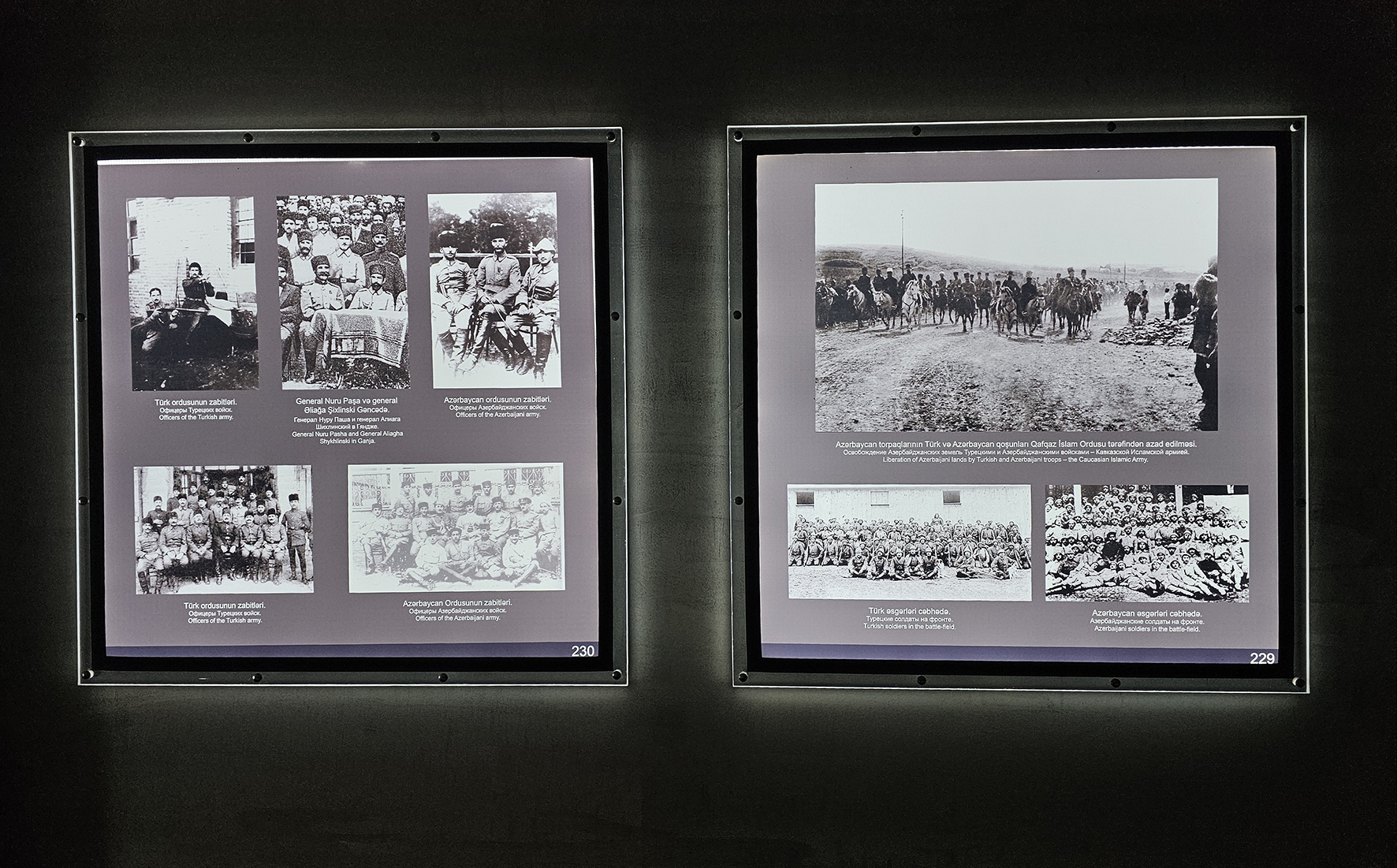
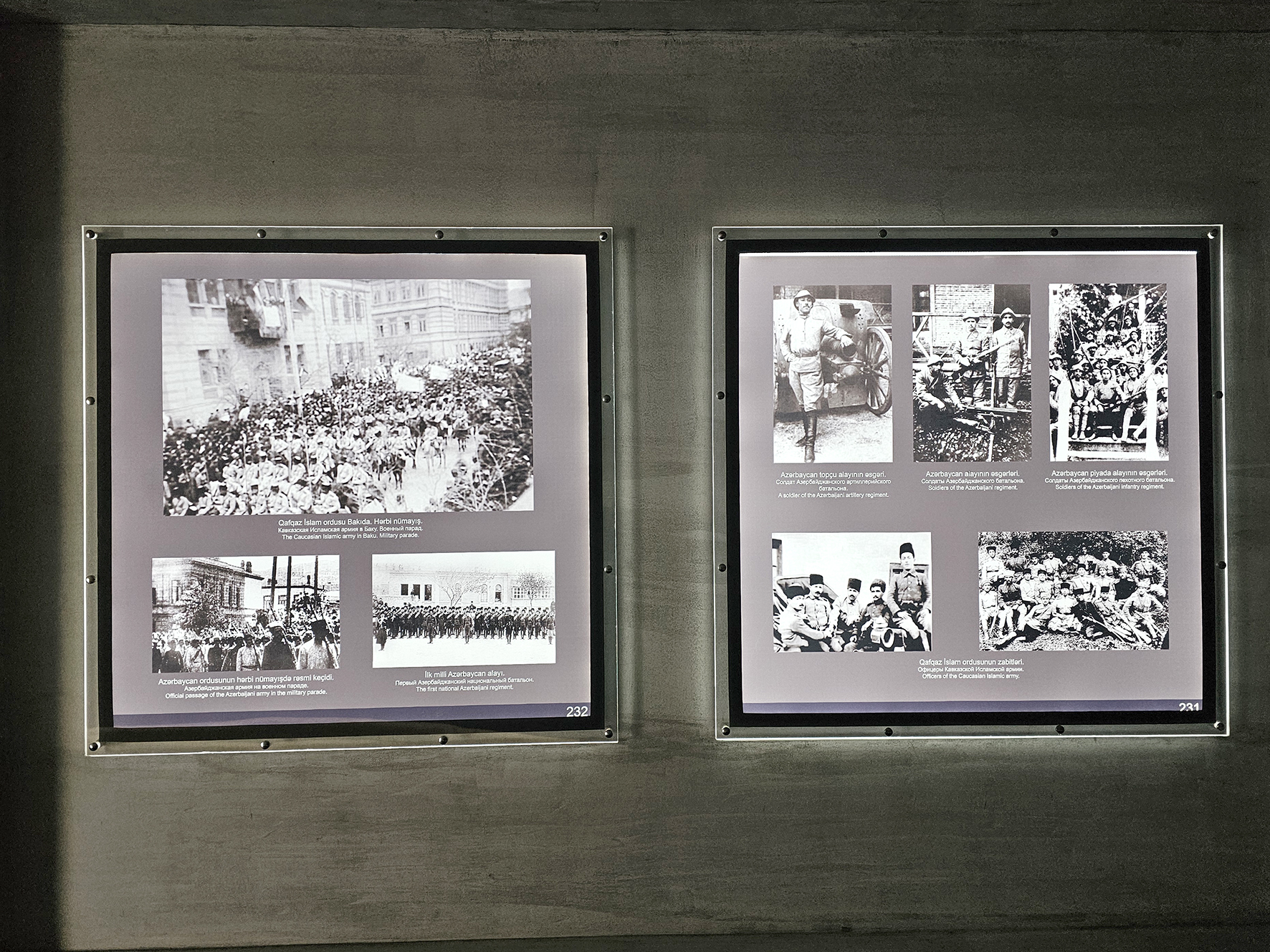
The 5th wall showcase concludes with an exhibition dedicated to the Turkish-Azerbaijani Caucasian Islamic Army. The ADR government took a number of measures to prevent the mass genocide of the Muslim population. The government’s main goal was to establish authority throughout the territory of Azerbaijan and to free our lands from enemy occupation. The Caucasian Islamic Army, organized from the armed forces of the newly emerging Azerbaijani National Army and Ottoman Turkey, quickly launched a counteroffensive in the battles to disarm separatist Armenians in Ganja, in Garamaryam and Kurdamir of Goychay district, in the territory of Shamakhi district, and finally in the battles around Baku, inflicting a heavy defeat on the Bolshevik-Dashnak forces. The victorious march of the Caucasian Islamic Army ended with the liberation of the city of Baku on September 15, 1918. This victory laid the foundation for ensuring Azerbaijan’s territorial integrity and resulted in the liberation of the Azerbaijani people from Armenian-Bolshevik domination. This showcase begins with photographs reflecting the Caucasian Islamic Army’s campaign to liberate Azerbaijani lands. It continues with group, small-unit, and individual photographs of Turkish and Azerbaijani officers and soldiers, as well as photographs of Nuru Pasha, commander of the Turkish troops, and Lieutenant General Aliagha Shikhlinski, commander of the Azerbaijani military formations.

Information
Exit exhibition

Military parade

The exhibition is completed with a photograph reflecting the military parade held on September 15, 1918 on the occasion of the liberation of Baku. The fact that the museum’s final exhibition ends with photo-documents dedicated to the Azerbaijani National Army does not merely conclude with the historical truth that it was precisely the army that put an end to the genocides of 1918. In fact, it once again confirms that the Azerbaijani state must always have a strong army to protect its sovereignty, territorial integrity, and the fearless, secure life of our people. The tragedy that was experienced proved this once again. This lesson drawn from history is an example for future generations.

Flag square
Part IV

Flag square

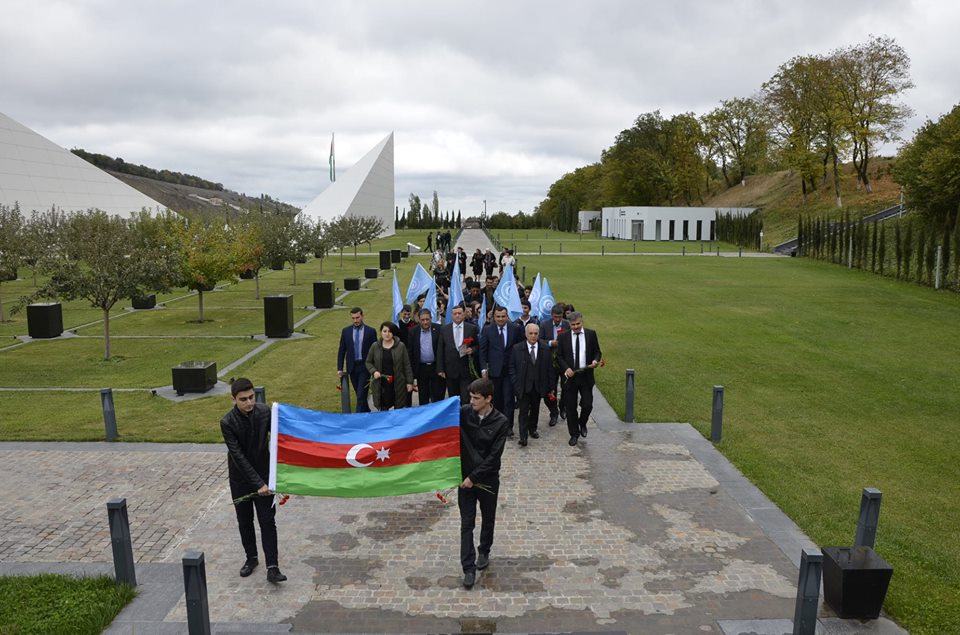
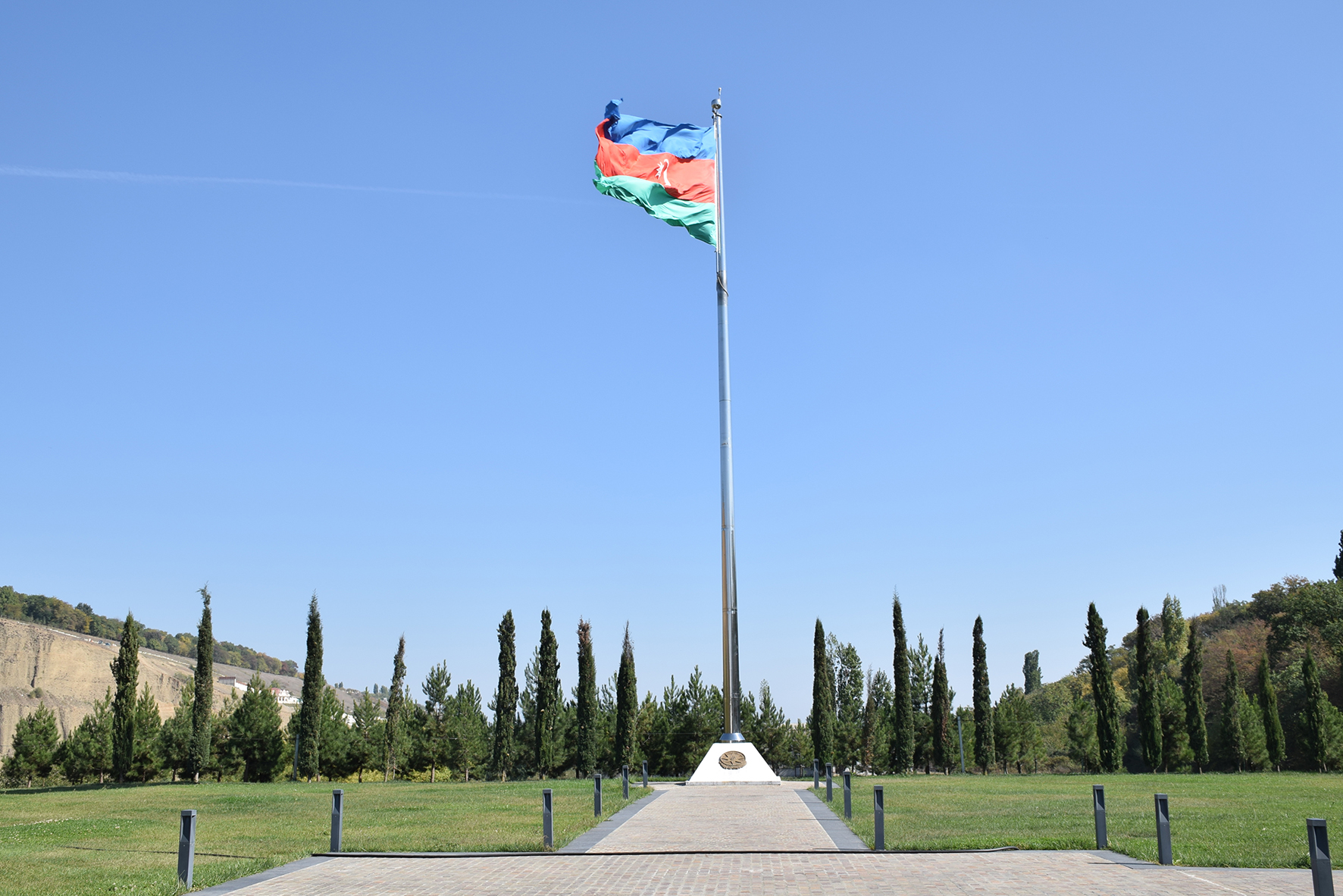
At the “Flag Square” of the Quba “Genocide Memorial Complex,” the tricolor flag of the Republic of Azerbaijan flutters at a height of 20 meters.

Information center - 1
Part V

Information Center

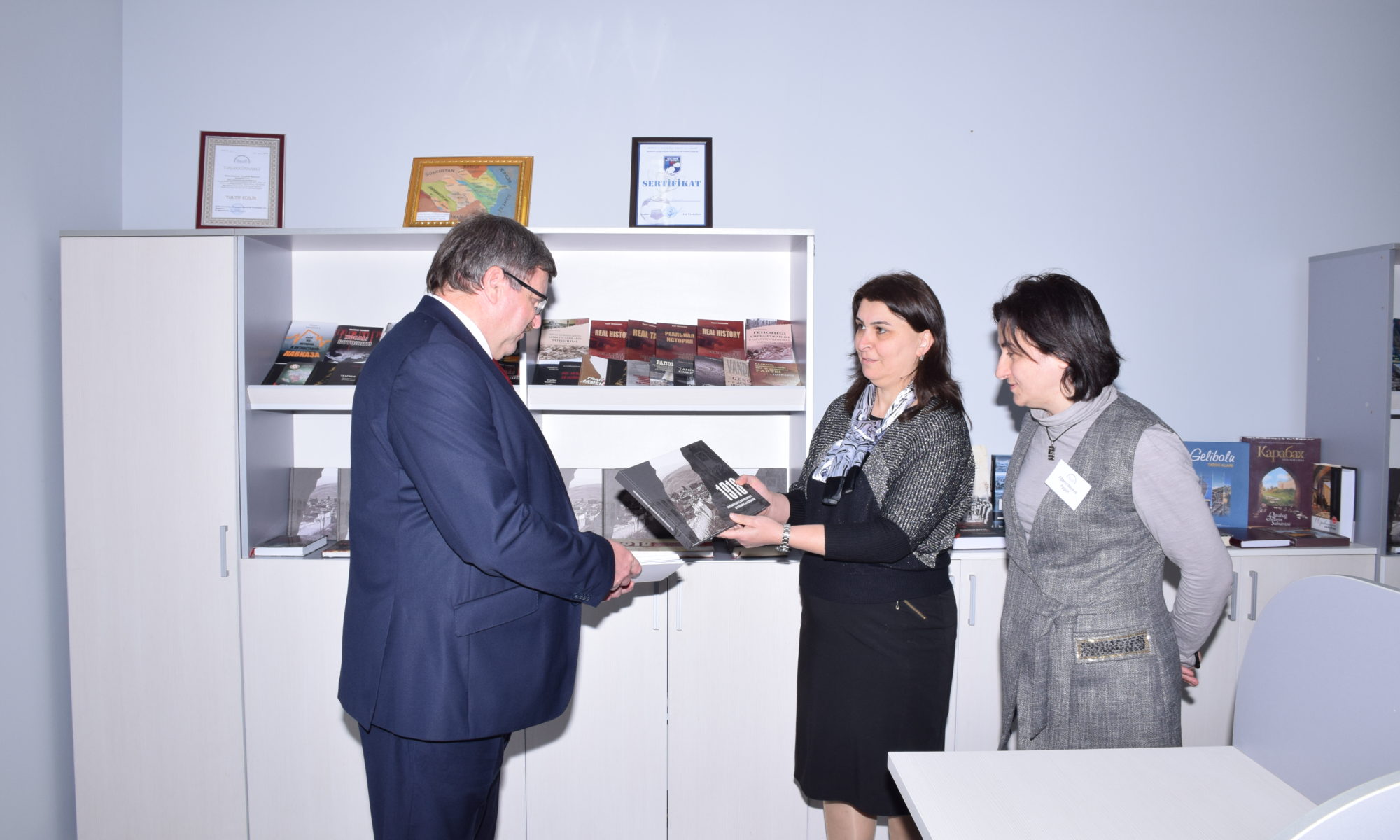
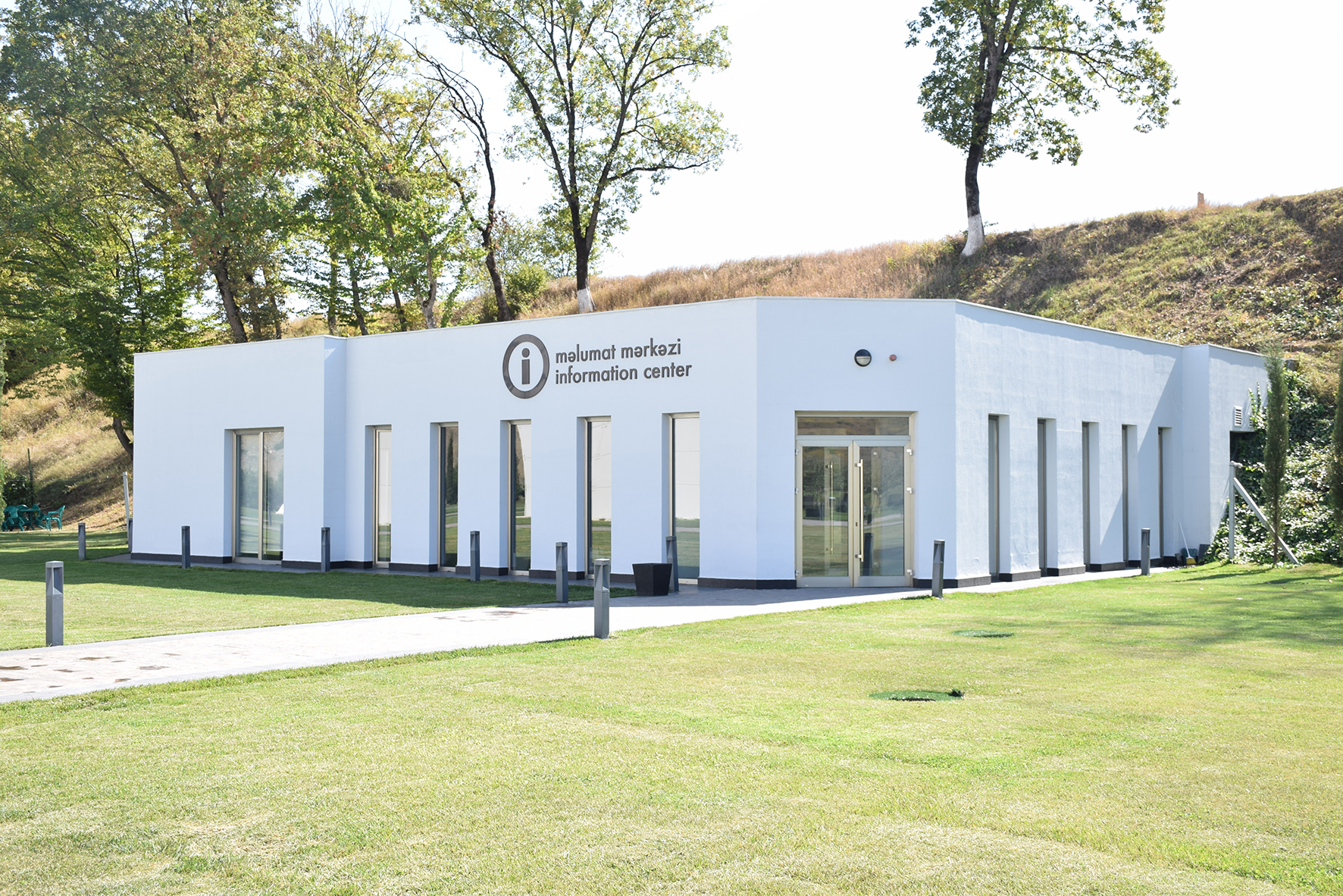
For visitors coming to the Information Center of the complex, the Heydar Aliyev Foundation has created conditions for using a rich library equipped with modern equipment, a reading hall, an audio guide, and 16 types of booklets and books in three languages reflecting the historical facts of the genocide that took place in Azerbaijani districts in 1918.

In addition, the complex provides free guide services in 4 languages (Azerbaijani, English, Russian, Arabic).

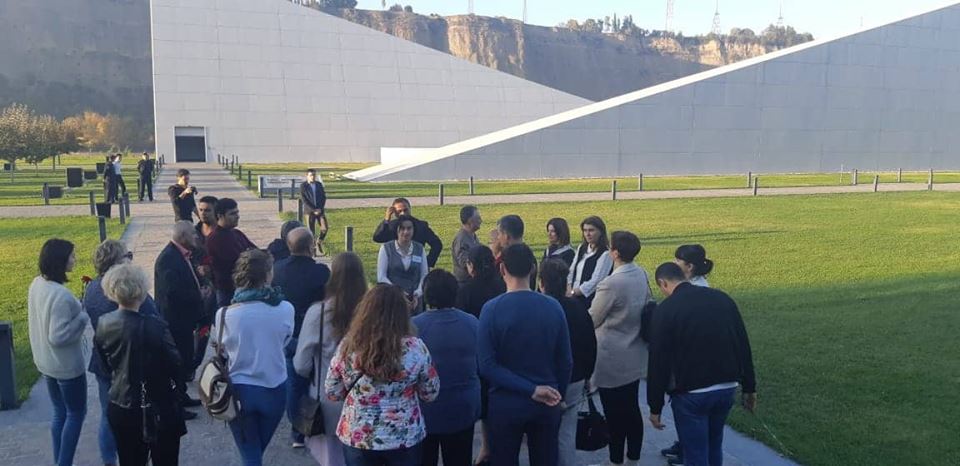
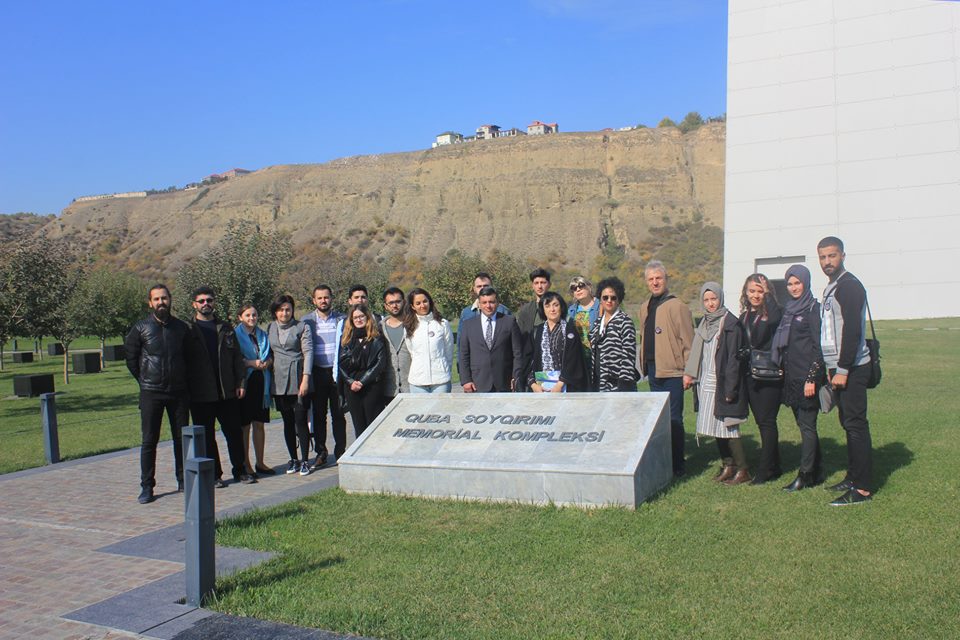
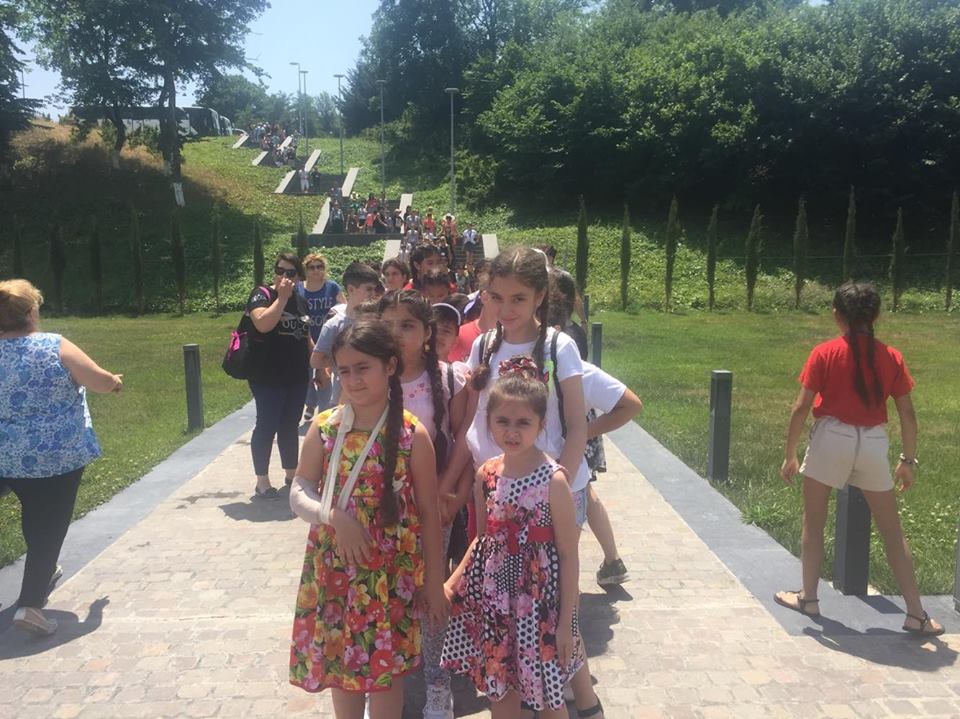
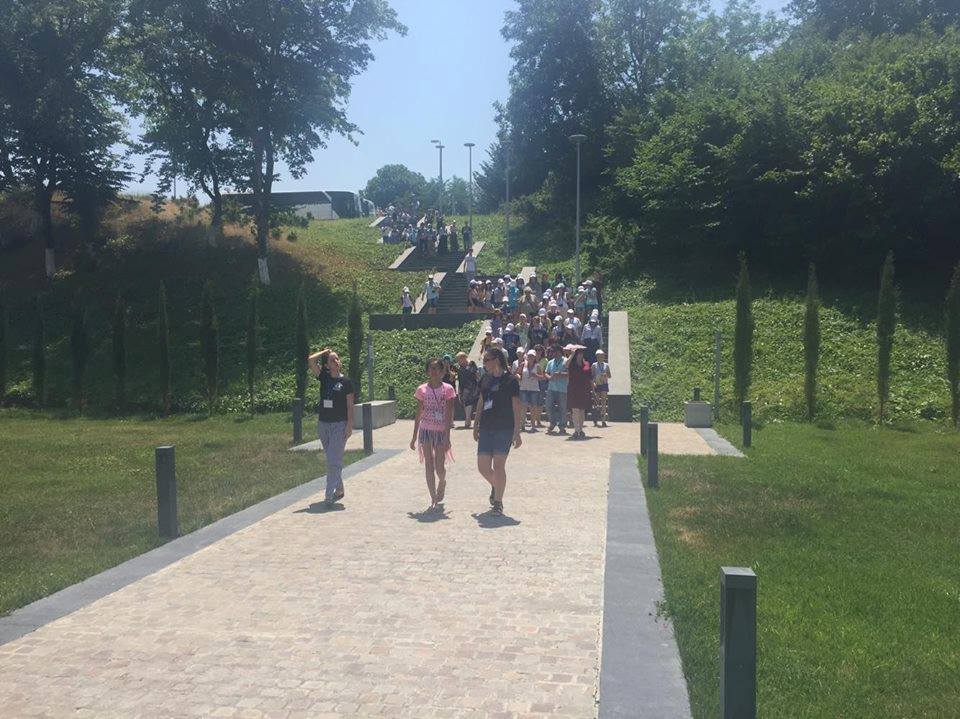
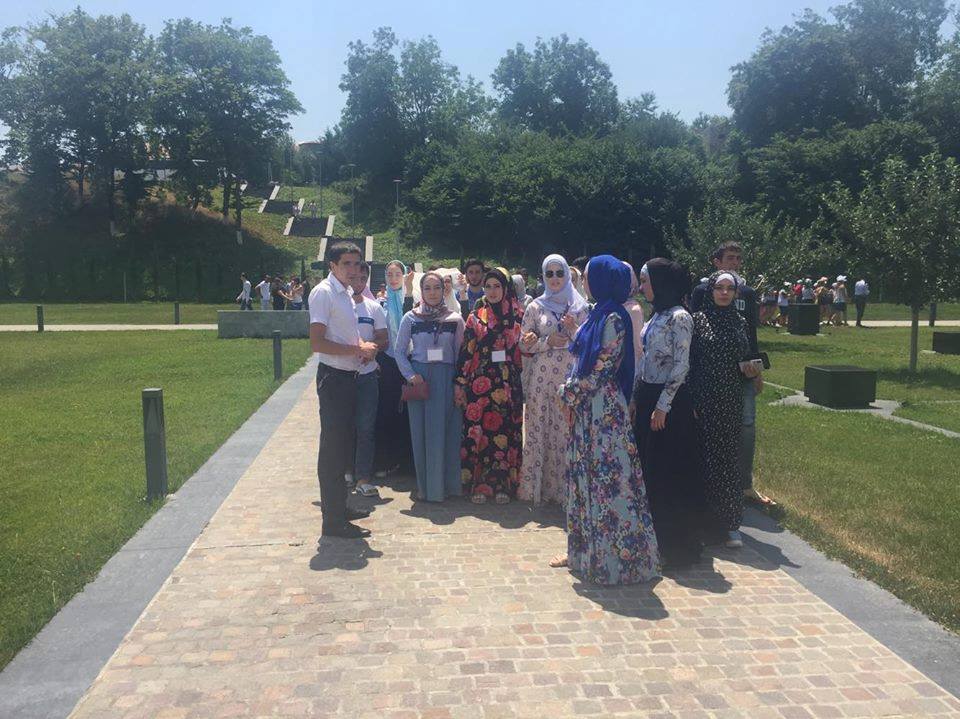
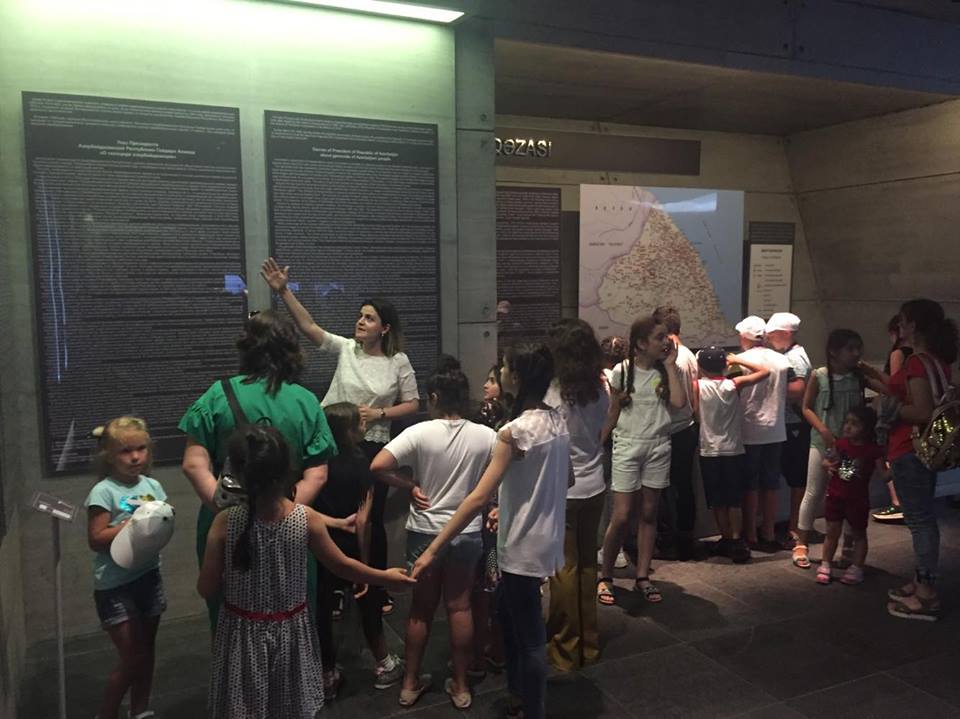
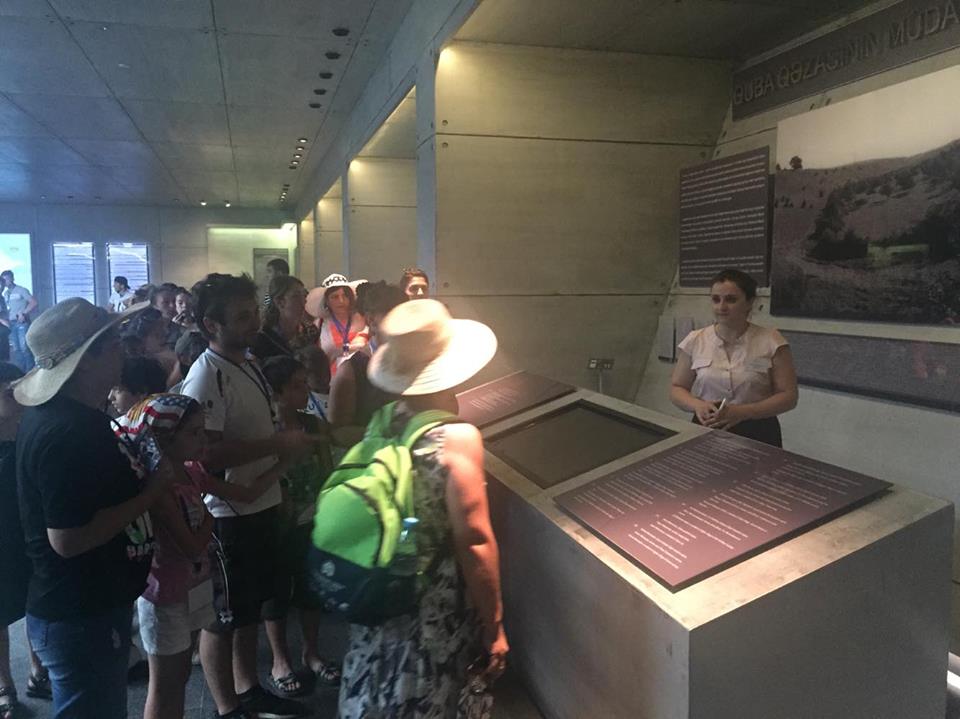
-“Dostluq körpüsü” Uşaqların və Gənclərin III Beynəlxalq Folklor-Rəqs Festivalının iştirakçıları Quba şəhərində “Soyqırımı Memorial Kompleksi”ndə.

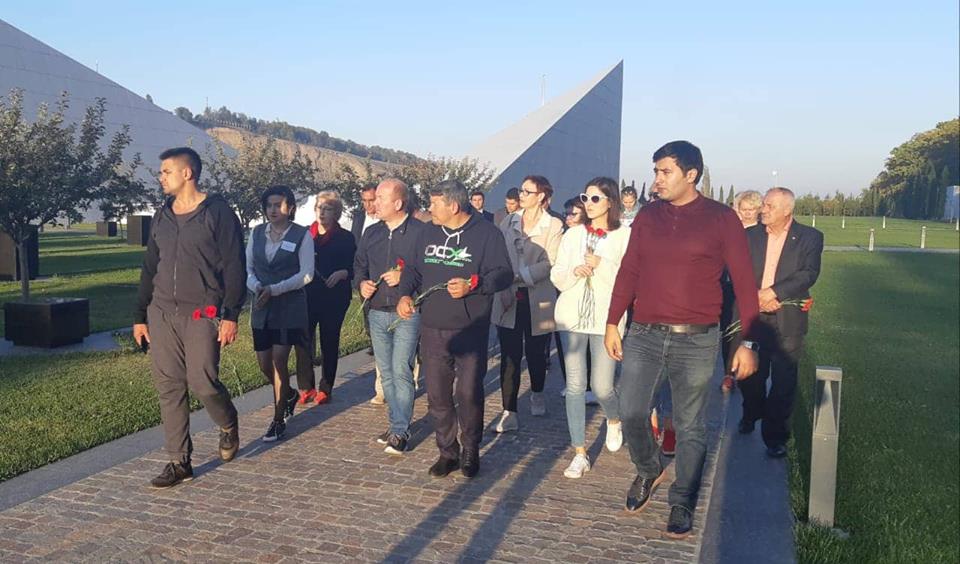
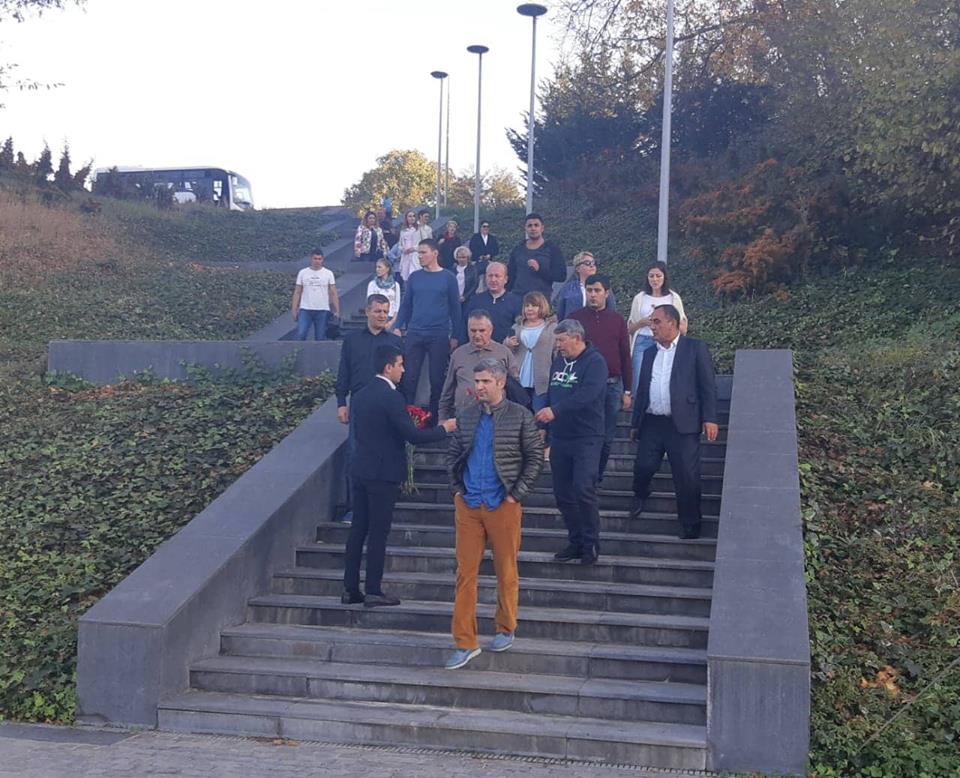
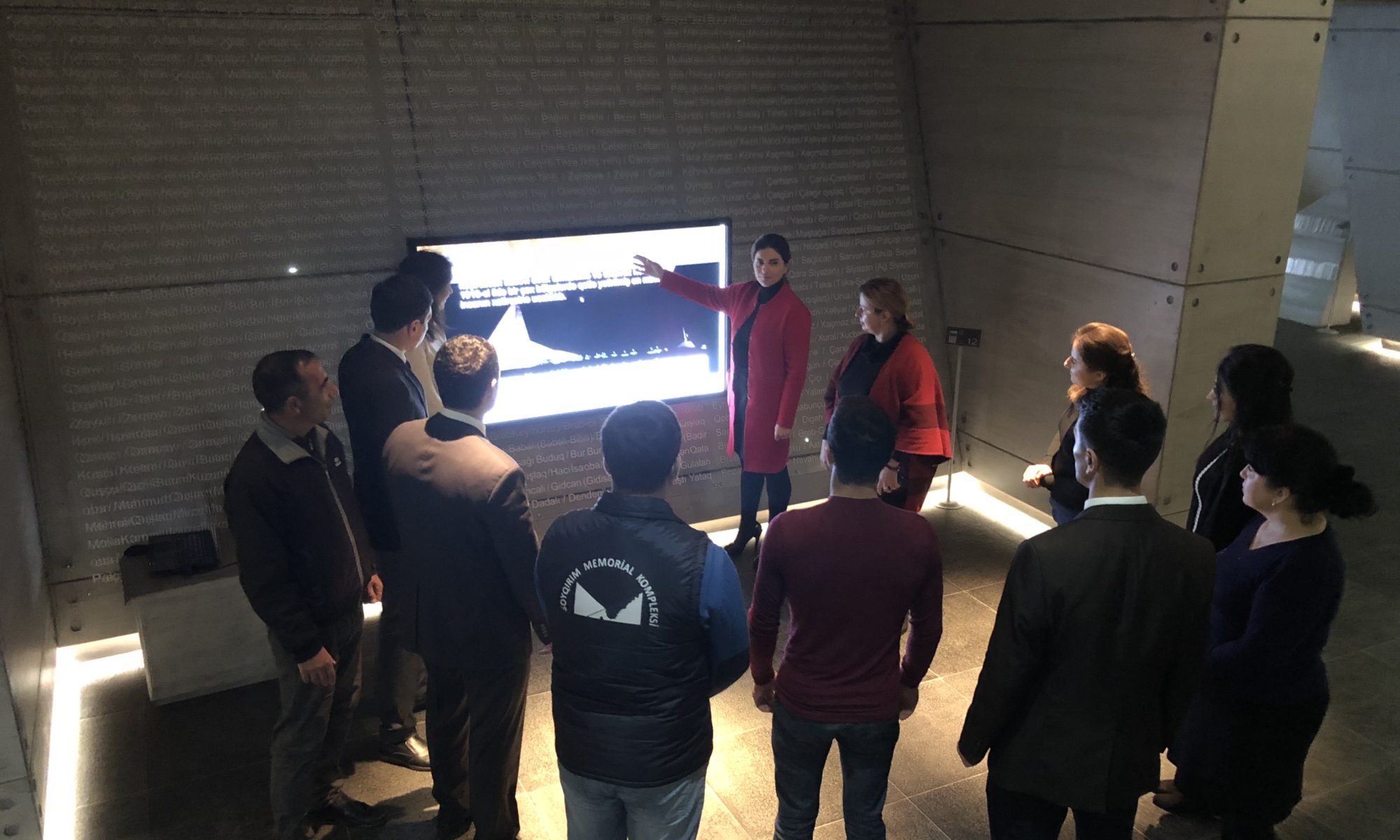
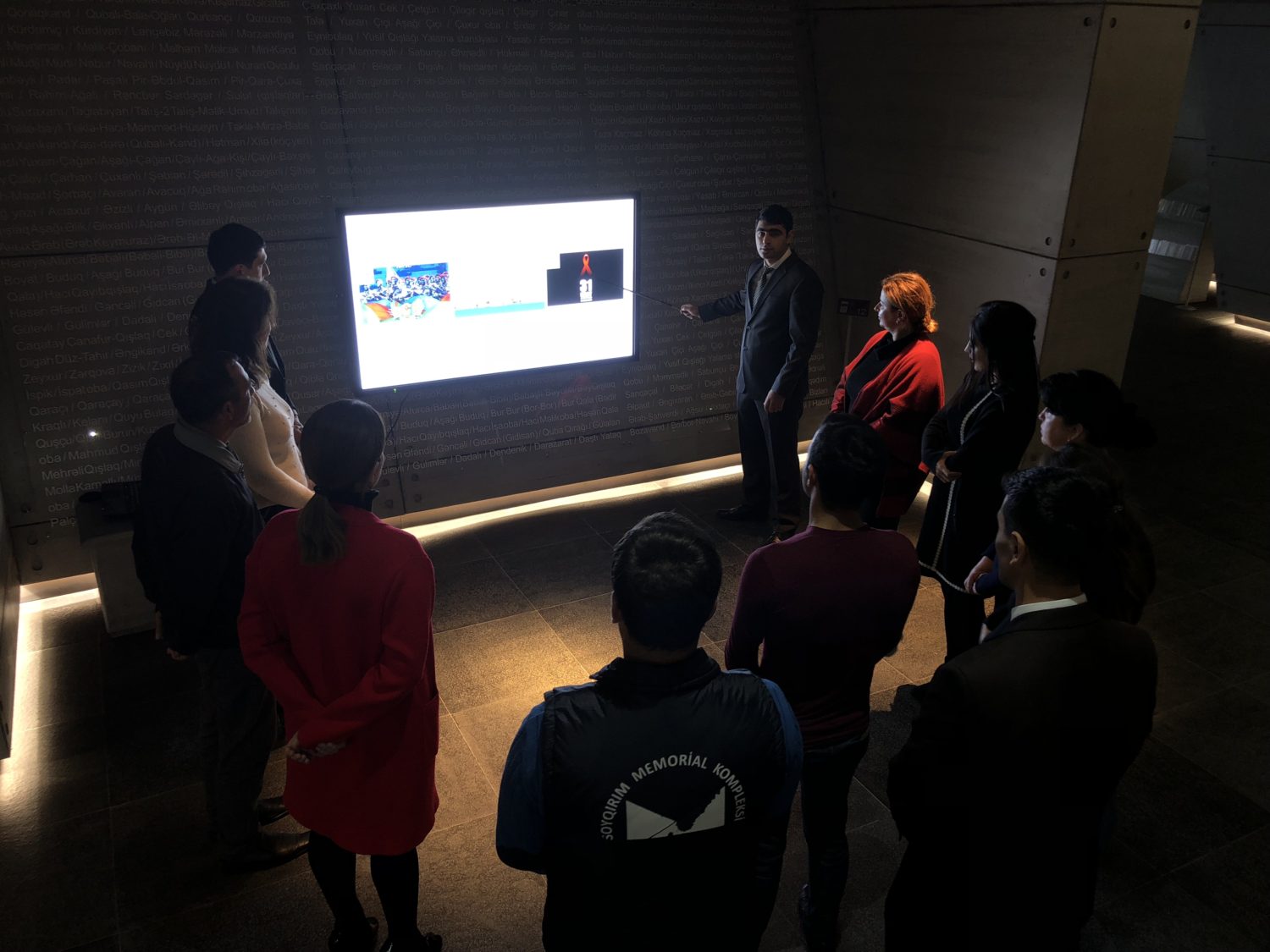
Təhsil Nazirliyinin dəstəyi ilə “Dostluq körpüsü” Uşaqların və Gənclərin III Beynəlxalq Folklor-Rəqs Festivalının -Azərbaycan, Rusiya (Çeçenistan və Şimali Osetiya-Alaniya Respublikaları), İran, Gürcüstan və Qırğızıstandan olan festival iştirakçıları Qubaya səfər ediblər. Səfər çərçivəsində 10.07.2018-ci il tarixində Quba şəhərində “Soyqırımı Memorial Kompleksi”ni ziyarət etmişlər. Qonaqlara 1918-ci ildə cinayətkar erməni dəstələri tərəfindən törədilmiş soyqırımı haqqında ətraflı məlumat verilmişdir.

“Alovlu Qafqaz” II Uşaq –Gənclərin Folklor Rəqs və Yaradıcılıq festivalının kollektivi Quba şəhərində “Soyqırımı Memorial Kompleksi”ndə.


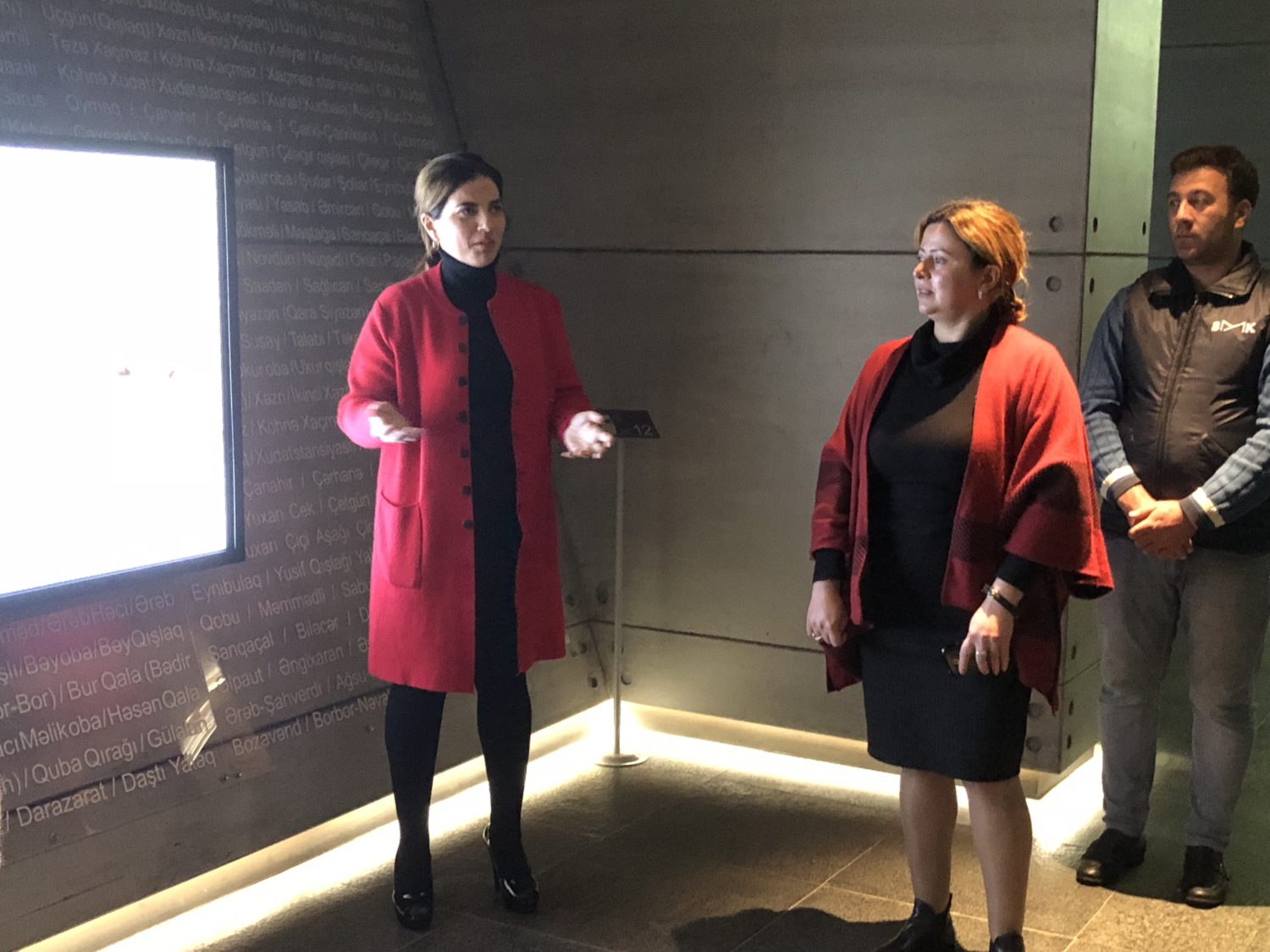
Təhsil nazirliyinin dəstəyi ilə keçiriən “Alovlu Qafqaz” II Uşaq –Gənclərin Folklor Rəqs və Yaradıcılıq festivalının Bakı, Sumqayıt, Quba, Qusar, Goranboy UGİM-ni eləcə də Gürcüstan və Şimali Osetiya–Alaniya Respublikasını təmsil edən rəqs və yaradıcılıq kollektivləri 22.06.2018-ci il tarixində Quba şəhərində “Soyqırımı Memorial Kompleksi”ni ziyarət etmişlər. Ziyarət zamanı qonaqlara 1918-ci ildə ermənilərin yerli dinc əhaliyə qarşı törətdikləri soyqırımları ilə bağlı məlumat verilmişdir.

Population of Guba


The Guba district included the present-day Guba, Gusar, Shabran, Khachmaz, and Siyazan districts. The center of the area was the city of Guba. This territorial division existed in Tsarist Russia, the Azerbaijan Democratic Republic, and the Azerbaijan SSR until 1929.

The 1916 statistical data “Tifliskiye Vedomosti” show the national composition of Guba district as follows:

Of the total 198,204 people of Quba area, 64.15% were Azerbaijanis and Tatars, 24.72% were Lezghins, Kyrgyz, Buduks, Czechs, Avars, etc., 7.58% were Jews and 2.71% were Russians. , 0.78% were others.

The section shows a map of Guba district compiled during the Azerbaijan Democratic Republic.On that map, the villages that were subjected to genocide in 1918 are marked with special red labels.167 villages were exposed to massacre. 38 villages were destroyed in Guba , 27 in Gusar, 65 in Khachmaz, 21 in Shabran and 16 in Siyazan

Guba comission

We present to you a section of the Museum of the Genocide Memorial Complex, which contains a brief description of the facts of the genocide committed in Guba in 1918 and photos of eyewitnesses of these events and interrogative protocols. The collection of 36 volumes and 3,500 pages of investigative materials by the Extraordinary Investigation Commission between July 15, 1918 and November 1, 1919 also reflected the genocide committed in Guba.Andrei Fomich Novatsky, a member of the Extraordinary İnvestigation Commission , conducted made a research on the crimes associated with the massacre of the Muslim population in the Guba area onApril and May 1918. Based on the collected documents, it was found out that 167 villages were burned and looted in Guba district, and the number of people killed in Guba district was more than 16,000. The material damage to the local population amounted to more than 121,824,819 rubles.

There are photos and interrogative protocols of Haji Ismayil Orujov (55 years old), Durna Mashadi Dadash gizi, Haji Hidayat Musa oglu (60 years old), Mashadi Ibad Bagirov (45 years old), Mammad Ali Kabalai Irza oglu (40 years old), who testified as witnesses.


Geychay area

On June 14, 1918, Goychay was subjected to a strong attack by the Armenian army, acting under the name “Bolshevik army”. The Armenian gangs that broke the resistance of the residents of the village of Kurdamir, Goychay area, committed a brutal massacre here. As a result, 56 houses and shops, 127 properties, 2 mosques were completely burned, all other houses and objects were destroyed and looted. The complete destruction of the station or village of Kurdemir, as well as the destruction of the rest of the population was prevented by the Russians, consisting of the Red Army and Iranian (southern Azerbaijanis) workers, partially cooperating with the Bolsheviks.            The EIC documents provide evidence of “relations between the Armenians and the Russian and Azerbaijani Bolsheviks,” local conflicts to put an end to the national killings in Kurdemir, even reports of the execution of several Armenian soldiers. In addition to Kurdamir, Armenian attacks were also carried out on the villages of Jayli, Garavalla, Karabuchak, Mustafali, Khalil-Gasymbay, Arab-Mehdibeyli, Dadali and other villages of Goychay area and were accompanied by the killing of the population. For example, in the village of Arab-Mehdibeyli 84 houses were destroyed and 83 people were killed, including 78 men, 4 women and one boy. The battle between the Baku Soviet Army and the Caucasus Islamic Army in the summer of 1918 in the area of Karamariam village of Geichai County changed for the benefit of the Azeris and laid the foundation for the liberation of Azerbaijani lands from the enemy.  

Defenders of Guba

Photographs of Alibay Zizikski, Hamdulla Efendi Efendizade, Aliabbas bey Alibeyov, Mursal bey and Ibrahim bey, Mohubali Efendi Kuzunlu, Hatam aga Jagarvi, Beybala bey Alpanli and other prominent figures of the Guba community who fought bravely against Dashnak Hamazasp, who had a special hatred for Turkish-Muslims and were instructed by the head of Baku Soviet Stepan Shaumyan and 3,000 Armenian gangs led by him, committed ruthless murders and robberies in April-May 1918, are presented to the visitors in the “Defenders of Guba district” section of the museum

            In addition, the exposition shows the so-called “Bloody Valley” between the villages of Digah and Khujbala, where the defense forces of the Guba region fought fiercely against the Dashnak-Armenians. There is also, a copy of the document signed by 90 Armenians of Kilvar village of Devechi (Shabran) on the protection of their lives, property and safety and not causing any damage to them.

Shemakhy area

The Shamakhi genocide occupies a special place among the criminal acts committed by the Armenian nationalists in 1918, who wanted to create a “Greater Armenia” state in Azerbaijan, in terms of its scale, number of victims and the amount of material and moral damage. In Shamakhi district, the Armenian Dashnaks led by S. Lalayan and T. Amirov brutally killed the Muslim population. Armenian and Molokan soldiers break into Muslim homes, take valuables and money from frightened people, and then kill their entire families.Also, by the order of S. Lalayan, Armenian soldiers burned alive the residents of the city who took refuge in 12 neighborhood mosques of the city, as well as the Juma Mosque, which dates back to the VIII century. The violence and looting continued for four days, until Azerbaijani troops came to the aid of Shamakhi Muslims from Ganja and entered the city. During the two-time genocide of Azerbaijanis in Shamakhi, between 8,000 and 10,000 people out of the city’s 21,127 Muslims were killed, and the rest were displaced to various cities and districts of Azerbaijan. In addition to residential areas and mosques, all public buildings, markets, hundreds of shops, warehouses, mills and other civilian objects in the city were burned and completely destroyed. The genocide in Shamakhi lasted until mid-July 1918, when it was liberated by Turkish-Azerbaijani troops.During that period, 106 villages of Shamakhi district were burned and destroyed, and residents of 110 villages suffered from attacks by Armenian-Molokan gangs.The total number of those killed during the attacks and in captivity was 10,341, including 4,359 women and children. Thousands of wandered refugees in the mountains, forests and plains for months, have died of cold, hunger and disease. The total amount of material damage inflicted on the residents of Muslim villages of Shamakhi district amounted to 607,167,420 rubles. The main difference between the genocide in Shemakhi and the genocides in other regions of Azerbaijan is the active participation of the Molokan-Russian population in these events along with the Armenians. The documents of the Extraordinary Investigation Commission on the Shamakhi genocide totaled 22 volumes of investigative material and 63 photographs. These documents allow us to know the scale of the full picture of the 1918 Shamakhi tragedy.  


Baku area

At the end of 1917 – early 1918,in Baku had opened struggle by the Dashnak-Bolshevik forces against the national forces. On December 1917,the arrival of the Military Revolutionary Committee headed by S. Shaumyan, appointed by the Chairman of the Russian People’s Commissars Soviet from Tbilisi to Baku exacerbated the political situation. Red Army which was at the disposal of the Baku Council, was comprised of 20,000 armed forces, mostly Armenians. In March 1918 the political situation in Baku was very tense. Musavat, the strongest political party in the South Caucasus, was striving for Azerbaijan’s territorial autonomy.The Bolshevik forces, headed by Shaumyan, in cooperation with the Armenian National Council and the Dashnaktsutyun party, began a real war against Musavat. Disarmament of 48 officers and soldiers of the 48th Muslim division on the Evelina ship from Lankaran to Baku on March 27, 1918 was an excuse for the bloody clashes in Baku.On March 30, 1918, non-organized protest rallies began in different parts of the city.The city’s central and all Muslim neighborhoods have been subjected to armed attacks by Bolshevik-Armenian units, bombardment from airplanes, and continuous firing from the ships from the Caspian Fleet.On March, all sections of Azerbaijani population in Baku became victims of Armenian violence and looting.All efforts made by the Azerbaijani national elites and political forces to prevent further escalation of tension in the city have ultimately been ineffective. 

           According to the documents of the Extraordinary Investigation Comission, during the March massacre in 1918, in Baku and surrounding villages (Mohammadi, Ahmadli, Balakhani, Binagadi, Bibi-Heybat, Hokimli, Zabrat, Sabunchu, Ramana, Khirdalan, etc.) 12000 Muslims were the victims of the atrocities of the Armenian armed groups. In the tragic March of 1918, the amount of material damage inflicted on the city’s Muslim population was estimated at 400,000,000 rubles. The burned and destroyed buildings included the “Ismailia” (the building of Muslim Charity Association), the “Kaspi” newspaper, the Dagestan, Alexandria and Islamiya hotels. These Muslim hotels and caravanserai were burned with the people inside.